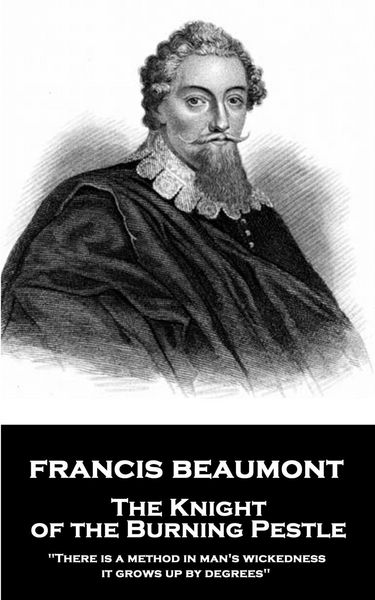
The Knight of the Burning Pestle "There is a method in man's wickedness; it grows up by degrees"
-
- Hardcover
- Taschenbuch
- eBook ausgewählt
-
Form:Einzelkauf Download
-
Sprache:Englisch
-
eBook Format:ePUB
- PDF 11,99 €
- ePUB 4,49 € ausgewählt
-
Verlag:Copyright Group
4,49 €
inkl. gesetzl. MwSt.Beschreibung
Produktdetails
Format
ePUB
Kopierschutz
Ja
Family Sharing
Nein
Text-to-Speech
Ja
Erscheinungsdatum
30.01.2018
Verlag
Copyright GroupSeitenzahl
91 (Printausgabe)
Dateigröße
57 KB
Sprache
Englisch
EAN
9781787377585
Francis Beaumont was born in 1584 near the small Leicestershire village of Thringstone. Unfortunately precise records of much of his short life do not exist.
The first date we can give for his education is at age 13 when he begins at Broadgates Hall (now Pembroke College, Oxford). Sadly, his father died the following year, 1598. Beaumont left university without a degree and entered the Inner Temple in London in 1600. A career choice of Law taken previously by his father.
The information to hand is confident that Beaumont's career in law was short-lived. He was quickly attracted to the theatre and soon became first an admirer and then a student of poet and playwright Ben Jonson. Jonson at this time was a cultural behemoth; very talented and a life full of volatility that included frequent brushes with the authorities.
Beaumont's first work was Salmacis and Hermaphroditus, it debuted in 1602.
By 1605, Beaumont had written commendatory verses to Volpone one of Ben Jonson's masterpieces.
His solo playwriting career was limited. Apart from his poetry there were only two; The Knight of the Burning Pestle was first performed by the Children of the Blackfriars company in 1607. The audience however was distinctly unimpressed.
The Masque of the Gentlemen of Grays-Inne and the Inner-Temple was written for part of the wedding festivities for the Princess Elizabeth, daughter of King James I and Frederick V, Elector Palatine. It was performed on 20 February 1613 in the Banqueting House at Whitehall Palace.
By that point his collaboration with John Fletcher, which was to cover approximately 15 plays together with further works later revised by Philip Massinger, was about to end after his stroke and death later that year.
That collaboration is seen as one of the most significant and fruitful of the English theatre.
Noch keine Bewertungen vorhanden
Verfassen Sie die erste Bewertung zu diesem Artikel
Helfen Sie anderen Kundinnen und Kunden durch Ihre Meinung.
Kurze Frage zu unserer Seite
Vielen Dank für Ihr Feedback
Wir nutzen Ihr Feedback, um unsere Produktseiten zu verbessern. Bitte haben Sie Verständnis, dass wir Ihnen keine Rückmeldung geben können. Falls Sie Kontakt mit uns aufnehmen möchten, können Sie sich aber gerne an unseren Kund*innenservice wenden.
zum Kundenservice