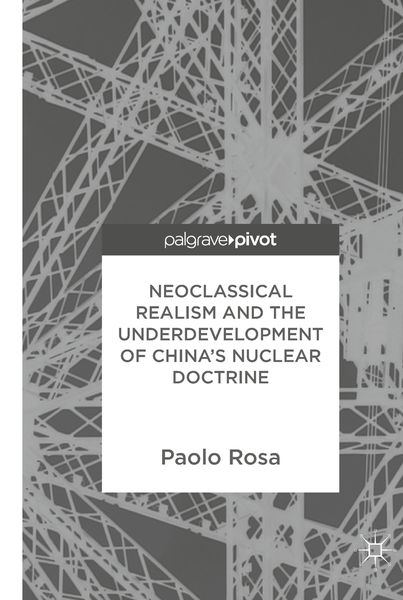
Produktbild: Neoclassical Realism and the Underdevelopment of China’s Nuclear Doctrine

Neoclassical Realism and the Underdevelopment of China’s Nuclear Doctrine

55,99 €

inkl. gesetzl. MwSt., Versandkostenfrei


Beschreibung

Produktdetails

Einband

Gebundene Ausgabe

Erscheinungsdatum

20.04.2018

Verlag

Springer

Seitenzahl

167

Maße (L/B/H)

21,6/15,3/1,5 cm

Gewicht

353 g

Auflage

1st ed. 2018

Sprache

Englisch

ISBN

978-3-319-78639-1

Beschreibung

Produktdetails

Einband

Gebundene Ausgabe

Erscheinungsdatum

20.04.2018

Verlag

Springer

Seitenzahl

167

Maße (L/B/H)

21,6/15,3/1,5 cm

Gewicht

353 g

Auflage

1st ed. 2018

Sprache

Englisch

ISBN

978-3-319-78639-1

Herstelleradresse

Springer-Verlag GmbH
Tiergartenstr. 17
69121 Heidelberg
DE

Email: ProductSafety@springernature.com

Ein neues Kapitel für Ihre Bücher

Ein neues Kapitel für Ihre Bücher

Schenken Sie Ihren alten Schätzen ein zweites Leben und erhalten dafür eine Thalia Geschenkkarte.

Jetzt verkaufen
Jetzt verkaufen

Noch keine Bewertungen vorhanden

Verfassen Sie die erste Bewertung zu diesem Artikel

Helfen Sie anderen Kundinnen und Kunden durch Ihre Meinung.

Kundinnen und Kunden meinen

Bewertungen (0)

  • Produktbild: Neoclassical Realism and the Underdevelopment of China’s Nuclear Doctrine
  • 1. Introduction: Competing explanations for the underdevelopment of China’s nuclear doctrine 1.1. The underdevelopment of China’s nuclear doctrine – 1.2. “Existential deterrence” and minimum means of reprisal – 1.3. Traditional strategic culture and the art of ambiguity – 1.4. Maoist military thought and the downplaying of military technology – 1.5. Organization of the book

    2. A neoclassical realist approach to military doctrines 2.1. Military doctrine and nuclear doctrine – 2.2. International source of military doctrine: The “balance of power” model – 2.3. Domestic sources of military doctrine (1): The organisational model – 2.4. Domestic sources of military doctrine (2): Strategic cultures – 2.5. A neoclassical realist framework of China’s nuclear doctrine formation

    3. China’s nuclear programme: Origins and progress3.1. Mao and the Bomb – 3.2. The development of the programme – 3.3. The doctrine of “no-first-use”

    4. Nuclear doctrine as a continuation of factional politics by other means, 1964-19714.1. The international situation: the Indochina war, the Soviet threat and the 1969 military clashes – 4.2. The domestic environment: “Politics in command” – 4.3. The strategic debate during the Cultural Revolution: Factions and foreign policy attitudes – 4.4. The impact on nuclear doctrine: Lack of operational concepts

    5. Elite stability and nuclear doctrine formulation, 1978-1989 5.1. The international situation: The Vietnam “lesson”, the Soviet invasion of Afghanistan, and the SDI – 5.2. The domestic environment: Deng, elite stability and military modernization – 5.3. The strategic debate: People’s war under modern conditions – 5.4. The impact on nuclear doctrine: Considering limited nuclear war-fighting options

    6. Conclusions