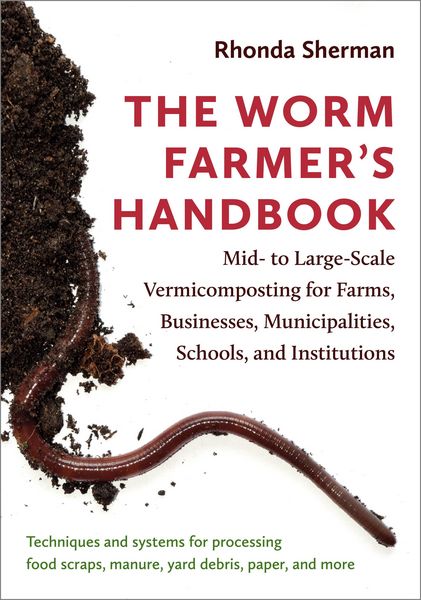
The Worm Farmer''s Handbook Techniques and Systems for Successful Large-Scale Vermicomposting
-
- Englisch ausgewählt
27,95 €
UVP
31,50 €
inkl. gesetzl. MwSt.,
Beschreibung
Produktdetails
Einband
Taschenbuch
Erscheinungsdatum
19.10.2018
Abbildungen
Farb. Abb.
Verlag
KNV BesorgungSeitenzahl
224
Maße (L/B/H)
25,1/17,7/2 cm
Gewicht
623 g
Sprache
Englisch
ISBN
978-1-60358-779-2
Choice Reviews, Outstanding Academic Title
Techniques and systems for processing food scraps, manure, yard debris, paper, and more
Turning waste into wealth sounds too good to be true, but many worm farmers are finding that vermicomposting is a reliable way to do just that. Vermicast—a biologically active, nutrient-rich mix of earthworm castings and decomposed organic matter—sells for $400 or more per cubic yard. Compare that to regular compost, sold at about $30 a cubic yard, and you’ll see why vermicomposting has taken root in most countries and on every continent but Antarctica.
Vermicomposting is also one of the best sustainable solutions for organic waste management. Vermicomposting manure and crop wastes on farms improves crop yields while reducing demand for off-farm inputs. Vermicast has higher nutrient levels and lower soluble salt content than regular compost, and it improves soil aeration, porosity, and water retention. Plus, vermicast suppresses plant diseases and insect attacks. Municipalities, businesses, community gardens, schools, and universities can set up vermicomposting operations to process food residuals and other waste materials.
The Worm Farmer’s Handbook details the ins and outs of vermicomposting for mid- to large-scale operations, including how to recycle organic materials ranging from food wastes and yard trimmings to manure and shredded office paper. Vermicomposting expert Rhonda Sherman shares what she has learned over twenty-five years working with commercial worm growers and researchers around the world. Her profiles of successful worm growers across the United States and from New Zealand to the Middle East and Europe describe their proven methods and systems.
This book digs into all the details, including:
- Choosing the right production system
- Regulatory issues and developing a business and marketing plan
- Finding and managing feedstocks
- Pre-composting: why and how to do it
- Monitoring an active worm bed
- Harvesting, screening, testing, packaging, and storing vermicast
- Markets for earthworms and vermicast
- Food security: how vermicast benefits soils and plants
- Keys to success: avoiding common pitfalls
From livestock farms and restaurants to colleges, military bases, and prisons, Sherman details why and how commercial-scale vermicomposting is a fast-growing, sustainable solution for organic waste management. The Worm Farmer’s Handbook is the first and only authoritative how-to guide that goes beyond small-scale operations and demystifies the science and logistics of the fascinating process that is vermicomposting.
Ein neues Kapitel für Ihre Bücher
Ein neues Kapitel für Ihre Bücher
Schenken Sie Ihren alten Schätzen ein zweites Leben und erhalten dafür eine Thalia Geschenkkarte.
Noch keine Bewertungen vorhanden
Verfassen Sie die erste Bewertung zu diesem Artikel
Helfen Sie anderen Kundinnen und Kunden durch Ihre Meinung.
Kurze Frage zu unserer Seite
Vielen Dank für Ihr Feedback
Wir nutzen Ihr Feedback, um unsere Produktseiten zu verbessern. Bitte haben Sie Verständnis, dass wir Ihnen keine Rückmeldung geben können. Falls Sie Kontakt mit uns aufnehmen möchten, können Sie sich aber gerne an unseren Kund*innenservice wenden.
zum Kundenservice