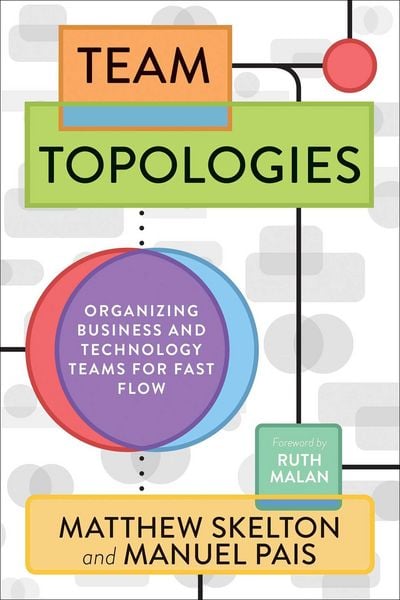
Team Topologies Organizing Business and Technology Teams for Fast Flow
-
- Taschenbuch ausgewählt
- eBook
-
Sprache:Englisch
- Deutsch 34,90 €
- Englisch 19,99 € ausgewählt
-
Verlag:IT Revolution Press
19,99 €
UVP
25,00 €
inkl. gesetzl. MwSt.,
Beschreibung
Produktdetails
Einband
Taschenbuch
Erscheinungsdatum
17.09.2019
Abbildungen
Illustrations, unspecified Color Illustrations Illustrations, unspecified Color Illustrations
Verlag
IT Revolution PressSeitenzahl
240
Maße (L/B/H)
22,6/14,9/1,7 cm
Gewicht
394 g
Auflage
1. Auflage
Sprache
Englisch
ISBN
978-1-942788-81-2
Design better teams to deliver value faster.
"This book will help executives and business leaders focus on the key strategies of high performance teams to effectively address the needs of today and the evolving landscape of tomorrow.” —Barry O'Reilly, author of Unlearn and Lean Enterprise
Effective software teams are essential for any organization to deliver value continuously and sustainably. But how do you build the best team organization for your specific goals, culture, and needs?
Team Topologies is a practical, step-by-step, adaptive model for organizational design and team interaction based on four fundamental team types and three team interaction patterns. It is a model that treats teams as the fundamental means of delivery, where team structures and communication pathways are able to evolve with technological and organizational maturity.
In Team Topologies, IT consultants Matthew Skelton and Manuel Pais share secrets of successful team patterns and interactions to help readers choose and evolve the right team patterns for their organization, making sure to keep the software healthy and optimize value streams.
Team Topologies is a major step forward in organizational design for software, presenting a well-defined way for teams to interact and interrelate that helps make the resulting software architecture clearer and more sustainable, turning inter-team problems into valuable signals for the self-steering organization.
Ein neues Kapitel für Ihre Bücher
Ein neues Kapitel für Ihre Bücher
Schenken Sie Ihren alten Schätzen ein zweites Leben: Einfach Barcode scannen, Versandetikett ausdrucken, Bücher verschicken und Thalia Geschenkkarte erhalten.
Jetzt verkaufenKundinnen und Kunden meinen
Verfassen Sie die erste Bewertung zu diesem Artikel
Helfen Sie anderen Kund*innen durch Ihre Meinung
Kurze Frage zu unserer Seite
Vielen Dank für Ihr Feedback
Wir nutzen Ihr Feedback, um unsere Produktseiten zu verbessern. Bitte haben Sie Verständnis, dass wir Ihnen keine Rückmeldung geben können. Falls Sie Kontakt mit uns aufnehmen möchten, können Sie sich aber gerne an unseren Kund*innenservice wenden.
zum Kundenservice