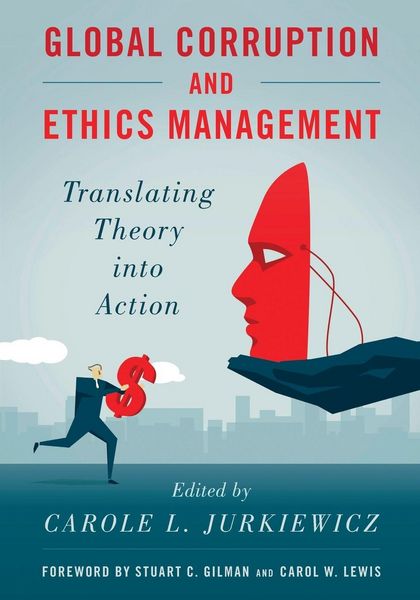
Preface: The Evolution of Corruption and Ethics Management Carole L. Jurkiewicz, Purdue University and University of Colorado Colorado Springs
Foreword by Stuart C. Gilman and Carol W. Lewis
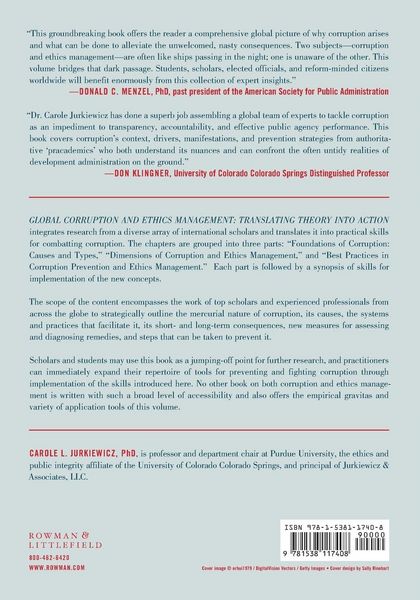
PART I: Foundations of Corruption: Causes and Types
1 The Contested Definition of Corruption, by Jonathan Rose, De Montfort University
Leicester, UK
2 Comparative Analysis of Unethical Practices across Cultures: Reversing the
Negative Social Aspects, by David Arellano-Gault, CIDE, División de Administración
Pública Ciudad de México
3 Disinformation Narratives as Evidence-Free Claims: A Socio-Rhetorical Perspective,
by Richard K. Ghere, University of Dayton, Ohio
4 Nonprofit/Nongovernmental Organization Sexual Corruption: A Critical Feminist
Perspective, by Angela M. Eikenberry, University of Nebraska at Omaha, and
Roseanne Mirabella, Seton Hall University
5 Outsourcing Corruption, by Adam B. Masters, The Australian National University
6 Corruption in Mexico: New Solutions to Old Problems? by Miguel A. Valverde Loya,
Tecnológico de Monterrey Ciudad de México
7 Corruption in Italy: Indigenous Impediments to Reform, by Daniel L. Feldman, John
Jay College of Criminal Justice, CUNY
8 When Two or More Rights Make a Wrong: How Conflicts between Ethical Standards
Affect Ethical Behavior, by Leonard L. Lira, San Jose State University
9 The Nonprofit Sector: Charity and Chicanery, by Barry D. Friedman, University of
North Georgia, and Amanda M. Main, Lynn University
10 The Impact of Social Media on Trust in Local Government
by Lisa Mahajan-Cusack, Rutgers University
Summary of Critical Knowledge Indicators for Part I by Carole L. Jurkiewicz
PART II: Dimensions of Corruption and Ethics Management
11 The Challenges of Individual Integrity in the Fight Against Corruption,
by J. Patrick Dobel, University of Washington
12 Ethics Management: A Pluralistic and Dynamic Perspective, by Alain Hoekstra,
Dutch Whistleblowing Authority and Muel Kaptein, Rotterdam University
13 The Ethical and Moral Bases of Social Equity, by Norma M. Riccucci, Rutgers
University
14 Moving from Trust to Trustworthiness in the Public Services, by Michael Macaulay,
Victoria University of Wellington
15 Corruption in Criminal Justice, by John Kleinig, John Jay College of Criminal Justice,
CUNY
16 Ethical Decision Making, by Angela Kline, Bowie State University,
and Maria P. Aristigueta, University of Delaware
17 The Ethinomics of Corruption, by Carole L. Jurkiewicz, Purdue University;
University of Colorado Colorado Springs
18 Facing the Dark Side: On the Unintended, Unanticipated and Unwelcome
Consequences of Ethics Management, by Jeroen Maesschalck, University of
Leuven
19 Organizational Evil, by Yahong Zhang, Rutgers, The State University of New Jersey,
and Cheon Lee, Rutgers University-Newark
20 Travails of Studying Corruption, by Krishna K. Tummala, Kansas State
University
Summary of Critical Knowledge Indicators for Part II by Carole L. Jurkiewicz
PART III: Best Practices in Corruption Prevention and Ethics
Management
21 Integrity of Governance: Toward a System Approach, by Leo Huberts, Vrije
Universiteit, and André van Montfort, Vrije Universiteit
22 Approaches to Combatting Corruption: Global Best Practices, by Adam Graycar,
Griffith University, and Catherine Cochrane, The University of Adelaide
23 Preventing Corruption in a Changing Military Culture: The Imperative of Ethical
Leadership, by Manfred F. Meine, Troy University, and Thomas P. Dunn, Troy
University
24 Whistleblowing: Encouraging Responsible Reporting and Developing Effective
Whistleblower Protections, by Kathryn G. Denhardt, Denhardt Consulting LLC
25 Transparency as a Tool to Combat Corruption in Italy, by Anna Simonati, University
of Trento
26 Auditability: Key to Accountability and Ethics, by Juanita M. Rendon, Naval
Postgraduate School
27 Accountability Institutions, Corruption Control, and Democratic Malaise: Institutional
Development and the Challenge of the Public Administration for Brazil's Political
System, by Fernando Filgueiras, National School of Public Administration,
Brazil
28 Keeping Up Ethical Standards When Fighting Organized Crime: A Case Study in
Law Enforcement, by Emile Kolthoff, Open University, and Hans Nelen, Maastricht
University
29 Post-Genocide Recovery and Governance, by Haris Alibasic, University of West
Florida
30 Strengthening the Fight Against Corruption: Complementing the Use of Ethics Codes
with a Culture-Based Model of Ethics Training, by Hugo D. Asencio, California State
University
Summary of Critical Knowledge Indicators for Part III by Carole L. Jurkiewicz