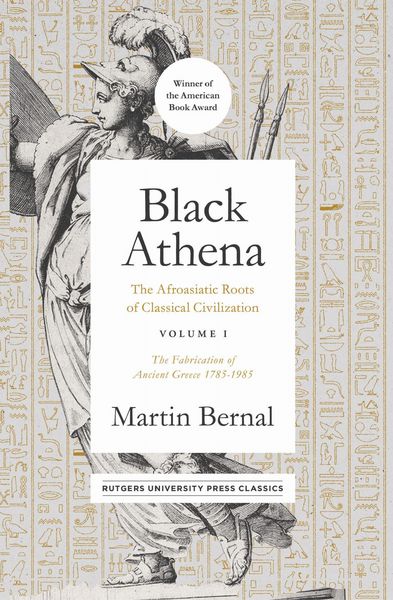
Produktbild: Black Athena

Black Athena The Afroasiatic Roots of Classical Civilization Volume I: The Fabrication of Ancient Greece 1785-1985 Volume 1

46,99 €

inkl. gesetzl. MwSt., Versandkostenfrei


Beschreibung

Produktdetails

Einband

Taschenbuch

Erscheinungsdatum

14.02.2020

Verlag

Rutgers University Press

Seitenzahl

669

Maße (L/B/H)

20/12,9/4,1 cm

Gewicht

694 g

Sprache

Englisch

ISBN

978-1-978804-26-5

Beschreibung

Rezension

"A monumental and path-breaking work." - Edward Said "Martin Bernal's Black Athena is nothing short of a monumental achievement in scholarship that re-oriented and transformed serious study of ancient civilizations. It remains a soaring accomplishment of classical erudition of the Afroasiatic foundation of Greek history." - Molefi Kete Asante (author of The History of Africa,Professor, Department of Africology, Temple University) "Black Athena is a powerfully written and brilliantly researched book that relentlessly unveils the historical and cultural African origins of Western civilization. Still a must read for all those in search of truth." - Ama Mazama (Professor of Africology and African American Studies, Temple University) "In a spectacular undertaking, Martin Bernal sets out to... restore the credibility of what he calls the Ancient Model of the beginnings of Greek civilizations... Bernal makes an exotic interloper in Classical studies. He comes to them with two outstanding gifts: a remarkable flair for the sociology - perhaps one should say politics - of knowledge, and a formidable linguistic proficiency... The story told by Bernal, with many fascinating twists and turns and quite a few entertaining digressions, is... a critical inquiry into a large part of the European imagination... a retrospect of ingenious and often sardonic erudition." - Perry Anderson (The Guardian) "A work which has much to offer the lay reader, and its multi-disciplinary sweep is refreshing: it is an important contribution to historiography and the sociology of knowledge, written with elegance, wit, and self-awareness... a thrilling journey... his account is as gripping a tale of scholarly detection and discovery as one could hope to find." - Margaret Drabble (The Observer) "Bernal's material is fascinating, his mind is sharp, and his analyses convince." - Richard Jenkyns (Times Higher Educational Supplement) "A formidable work of intellectual history, one that demonstrates that the politics of knowledge is never far from national politics." (Christian Science Monitor) "An astonishing work, breathtakingly bold in conception and passionately written... salutary, exciting, and, in its historiographical aspects, convincing." - G. W. Bowersock (Journal of Interdisciplinary History) "Bernal's work and the stir it has occasioned have caused ancient historians and archaeologists to undertake a major reexamination of methods and motives." - Robert L. Pounder (American Historical Review) "His book should be welcome to both classicists and ancient historians, most of whom will, now at least, be inclined to agree with him." - R. A. McNeal (Franklin and Marshall College) "Colossal.... Bernal aims to revise current understanding of Ancient Middle Eastern history by taking seriously the ancient Greeks' legends that portrayed much in their civilization as originating in the Middle East, especially Egypt." (New York Times Book Review) "[Bernal's] multifaceted assault on academic complacency is an important contribution to the development of a more open, historical, and culturally oriented post-processual archaeology." (Current Anthropology) "A breathtaking panoply of archaeological artifacts, texts, and myths." (Toronto Star) "Bernal's enterprise - his attack on the Aryan model and his promotion of a new paradigm - will profoundly mark the next century's perception of the origins of Greek civilization and the role of Ancient Egypt." (Transition) "Challenges the racism implicit in the recent 'cultural literacy' movement." (Socialist Review) "[Martin Bernal] has forced scholars to reexamine the roots of Western civilization." (Newsweek) "Martin Bernal has managed to make the subject of Ancient Greece both popular and controversial." (Baltimore Sun) "Demands to be taken seriously... Every page that Bernal writes is educating and enthralling. To agree with all his thesis may be a sign of naivety, but not to have spent time in his company is a sign of nothing at all." (Times Literary Supplement) "A serious work that deals in a serious way with many of the principal issues of Aegean history in the second millennium B.C., and one can ask little more of any historical work." - Stanley M. Burstein, California State University (Classic Philology) "Bernal has ample justification for calling into question many widely accepted hypotheses.... He shows that Egypt and its culture were misrepresented or simply ignored by European writers." - Mary Lefkowitz (The New Republic)

Produktdetails

Einband

Taschenbuch

Erscheinungsdatum

14.02.2020

Verlag

Rutgers University Press

Seitenzahl

669

Maße (L/B/H)

20/12,9/4,1 cm

Gewicht

694 g

Sprache

Englisch

ISBN

978-1-978804-26-5

Herstelleradresse

Libri GmbH
Europaallee 1
36244 Bad Hersfeld
DE

Email: GPSR Kontakt

Ein neues Kapitel für Ihre Bücher

Ein neues Kapitel für Ihre Bücher

Schenken Sie Ihren alten Schätzen ein zweites Leben und erhalten dafür eine Thalia Geschenkkarte.

Jetzt verkaufen
Jetzt verkaufen

Noch keine Bewertungen vorhanden

Verfassen Sie die erste Bewertung zu diesem Artikel

Helfen Sie anderen Kundinnen und Kunden durch Ihre Meinung.

Kundinnen und Kunden meinen

Bewertungen (0)

Die Leseprobe wird geladen.
  • Produktbild: Black Athena
  • Preface and Acknowledgements       
    Transcription and Phonetics  
    Maps and Charts        
    Chronological Table  
    Introduction   
    Background   
    Proposed historical outline    
    Black Athena, Volume I: a summary of the argument                      
    Greece European or Levantine? The Egyptian and West Semitic
    Components of Greek Civilization / a summary of Volume 2                      
    Solving the Riddle of the Sphinx and Other Studies in Egypto-Greek
    Mythology / a summary of Volume
    1          The Ancient Model in Antiquity       
    Pelasgians       
    Ionians
    Colonization
    The colonizations in Greek tragedy  
    Herodotos      
    Thucydides    
    Isokrates and Plato     
    Aristotle         
    Theories of colonization and later borrowing in the Hellenistic world
    Plutarch’s attack on Herodotos
    The triumph of Egyptian religion
    Alexander son of Ammon
    2          Egyptian wisdom and Greek transmission
    From the Dark Ages to the Renaissance        
    The murder of Hypatia
    The collapse of Egypto-Pagan religion
    Christianity, stars and fish     
    The relics of Egyptian religion: Hermeticism, Neo-Platonism and Gnosticism
    Hermeticism – Greek, Iranian, Chaldaean or Egyptian?       
    Hermeticism and Neo-Platonism under early Christianity, Judaism and Islam
    Hermeticism in Byzantium and Christian Western Europe  
    Egypt in the Renaissance       
    Copernicus and Hermeticism
    Hermeticism and Egypt in the 16th century
    3          The triumph of Egypt in the 17th and 18th centuries
    Hermeticism in the 17th century       
    Rosicrucianism: Ancient Egypt in Protestant countries        
    Ancient Egypt in the 18th century     
    The 18th century: China and the Physiocrats
    The 18th century: England, Egypt and the Freemasons        
    France, Egypt and ‘progress’: the quarrel between Ancients and Moderns  
    Mythology as allegory for Egyptian science 
    The Expedition to Egypt       
    4          Hostilities to Egypt in the 18th century         
    Christian reaction       
    The ‘triangle’: Christianity and Greece against Egypt          
    The alliance between Greece and Christianity          
    ‘Progress’ against Egypt
    Europe as the ‘progressive’ continent
    ‘Progress’       
    Racism           
    Romanticism  
    Ossian and Homer
    Romantic Hellenism
    Winckelmann and Neo-Hellenism in Germany
    Göttingen
    5          Romantic linguistics
    The rise of India and the fall of Egypt, 1740–1880
    The birth of Indo-European
    The love affair with Sanskrit
    Schlegelian Romantic linguistics
    The Oriental Renaissance
    The fall of China
    Racism in the early 19th century
    What colour were the Ancient Egyptians?
    The national renaissance of modern Egypt
    Dupuis, Jomard and Champollion
    Egyptian monotheism or Egyptian polytheism
    Popular perceptions of Ancient Egypt in the 19th and 20th centuries
    Elliot Smith and ‘diffusionism’
    Jomard and the Mystery of the Pyramids
    6           Hellenomania, 1
    The fall of the Ancient Model, 1790–1830   
    Friedrich August Wolf and Wilhelm von Humboldt
    Humboldt’s educational reforms       
    The Philhellenes         
    Dirty Greeks and the Dorians
    Transitional figures, 1: Hegel and Marx        
    Transitional figures, 2: Heeren
    Transitional figures, 3: Barthold Niebuhr
    Petit-Radel and the first attack on the Ancient Model
    Karl Otfried Müller and the overthrow of the Ancient Model
    7          Hellenomania, 2
    Transmission of the new scholarship to England and the rise of the Aryan Model, 1830–60           
    The German model and educational reform in England       
    George Grote 
    Aryans and Hellenes  
    8          The rise and fall of the Phoenicians, 1830–85
    Phoenicians and anti-Semitism          
    What race were the Semites? 
    The linguistic and geographical inferiorities of the Semites 
    The Arnolds   
    Phoenicians and English, 1: the English view           
    Phoenicians and English, 2: the French view
    Salammbô      
    Moloch
    The Phoenicians in Greece: 1820–80
    Gobineau’s image of Greece 
    Schliemann and the discovery of the ‘Mycenaeans’ 
    Babylon
    9          The final solution of the Phoenician problem, 1885–1945
    The Greek Renaissance
    Salomon Reinach
    Julius Beloch
    Victor Bérard
    Akhenaton and the Egyptian Renaissance
    Arthur Evans and the ‘Minoans’
    The peak of anti-Semitism, 1920–39
    20th-century Aryanism
    Taming the alphabet: the final assault on the Phoenicians
    10         The post-war situation
    The return to the Broad Aryan Model, 1945–85       
    The post-war situation
    Developments in Classics, 1945–65  
    The model of autochthonous origin   
    East Mediterranean contacts  
    Mythology     
    Language       
    Ugarit 
    Scholarship and the rise of Israel       
    Cyrus Gordon
    Astour and Hellenosemitica
    Astour’s successor? – J. C. Billigmeier
    An attempt at compromise: Ruth Edwards
    The return of the Iron Age Phoenicians
    Naveh and the transmission of the alphabet
    The return of the Egyptians?
    The Revised Ancient Model
    Conclusion
    Appendix        Were the Philistines Greek?
    Notes  
    Glossary         
    Bibliography
    Index