• Produktbild: Game Theory
  • Produktbild: Game Theory

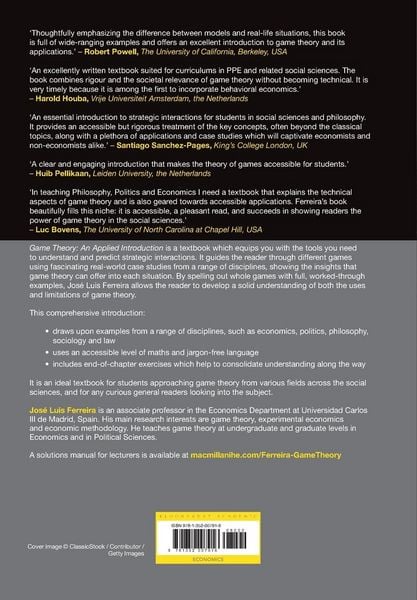
Game Theory An Applied Introduction

108,99 €

inkl. gesetzl. MwSt., Versandkostenfrei


Beschreibung

Produktdetails

Einband

Taschenbuch

Erscheinungsdatum

15.11.2019

Verlag

Macmillan Education Elt

Seitenzahl

293

Maße (L/B/H)

24,4/17/1,7 cm

Gewicht

538 g

Auflage

1st ed. 2020

Sprache

Englisch

ISBN

978-1-352-00791-6

Beschreibung

Produktdetails

Einband

Taschenbuch

Erscheinungsdatum

15.11.2019

Verlag

Macmillan Education Elt

Seitenzahl

293

Maße (L/B/H)

24,4/17/1,7 cm

Gewicht

538 g

Auflage

1st ed. 2020

Sprache

Englisch

ISBN

978-1-352-00791-6

Herstelleradresse

Libri GmbH
Europaallee 1
36244 Bad Hersfeld
DE

Email: gpsr@libri.de

Ein neues Kapitel für Ihre Bücher

Ein neues Kapitel für Ihre Bücher

Schenken Sie Ihren alten Schätzen ein zweites Leben und erhalten dafür eine Thalia Geschenkkarte.

Jetzt verkaufen
Jetzt verkaufen

Noch keine Bewertungen vorhanden

Verfassen Sie die erste Bewertung zu diesem Artikel

Helfen Sie anderen Kundinnen und Kunden durch Ihre Meinung.

Kundinnen und Kunden meinen

Bewertungen (0)

  • Produktbild: Game Theory
  • Produktbild: Game Theory
  • Chapter 1. The most famous games
    1.1 The coordination game
    1.2 Choice of standards
    1.3 The battle of the sexes
    1.4 The chicken game
    1.5 The prisoners' dilemma
    1.6 Matching pennies
    1.7 The ultimatum game
    Chapter 2. Building the theory for simultaneous games
    2.1 The normal form game
    2.2 Towards a solution
    2.3 Some propositions on maximin strategies, rationalizable strategies and Nash equilibria
    2.4 Finding the Nash equilibria
    2.5 Complications in finding the Nash equilibria
    2.6 The payoffs of the game and the mixed strategies
    Chapter 3. Static games
    3.1 Fiscal battles
    3.2 The median voter
    3.3 The advantage of being indifferent
    3.4 The broken windows theory
    3.5 The independence of Sylvania
    3.6 Cournot oligopoly
    3.7 Bertrand oligopoly
    3.8 Keeping up with the Joneses
    Chapter 4. Dynamic games
    4.1 The extensive form. Backwards induction
    4.2 The prisoners' dilemma with a previous contract
    4.3 Subgame perfect Nash equilibrium
    4.4 How to be credible (1): Elimination of strategies. Odysseus and the sirens
    4.5 How to be credible (2): Acquire costly compromises. Who enters?
    4.6 How to be credible (3): Give up control. Separation of powers
    4.7 The consequences of not being credible. The health care game
    4.8 The payment of the debt
    Chapter 5. Voting
    5.1 Sincere and strategic voting
    5.2 The manipulation of the agenda
    5.3 Condorcet's paradox
    5.4 Referendum with minimum participation
    5.5 The Borda count
    5.6 Arrow's theorem
    5.7 The theorems by Gibbard-Satterthwaite and May
    5.8 The median voter theorem
    5.9 I'll scratch your back and you'll scratch mine
    5.10 How to know the truth. The Groves-Clarke's mechanism
    5.11 Do we know what do the people want?
    5.12 The discursive dilemma
    5.13 A referendum in Catalonia
    Chapter 6. Negotiation games
    6.1 The model of offers and counteroffers
    6.2 Impatience
    6.3 Risk aversion
    6.4 Negotiating with fanatics
    6.5 Some discussion
    6.6 An actual case: the hijacking of the Alakrana
    6.7 The Coase theorem
    6.8 When not to apply the Coase theorem
    Chapter 7. Repeated games
    7.1 The Christmas truce
    7.2 A game repeated twice
    7.3 Cooperation in the infinite and indefinite repetitions
    7.4 Some technical details
    7.5 Other strategies in the repeated game
    7.6 The cooperation in the prisoners' dilemma repeated finitely many times
    7.7 What experiments say
    7.8 What the empirical data say
    7.9 Altruism, reciprocity and evolution
    7.10 Not a zero-sum game
    7.11 Axelrod's tournament
    Chapter 8. Agency problems: adverse selection
    8.1 The agency problem
    8.2 The information sets
    8.3 If you didn't have anything to hide you'd show me your e-mails
    8.4 Adverse selection in a first agency problem
    8.5 Adverse selection and public health systems
    8.6 Other examples of adverse selection
    8.7 Other types of adverse selection
    8.8 Competition reveals information: When the principal has information about the agent
    8.9 On Rawls' original position and the ex-ante criterion
    Chapter 9. Agency problems: signaling and moral hazard
    9.1 Signaling with a discrete variable
    9.2 The empirical evidence of education as a signal
    9.3 Signaling with a continuous variable and discrimination in the labor market
    9.4 Moral hazard: Fixed payment or payment by performance?
    9.5 Moral hazard: Copayment, yes or no?
    9.6 Moral hazard: Work with teams and cooperatives
    Chapter 10. Seven applications of Game Theory
    10.1 The battle of the Bismarck Sea
    10.2 The nuclear war
    10.3 You cannot use information without revealing it
    10.4 You should bluff from time to time
    10.5 There may not be weapons of mass destruction: should we still attack?
    10.6 Is free trade a prisoners' dilemma?
    10.7 Negotiations between Greece and the Troika
    Chapter 11. Seven more applications
    11.1 The minority language
    11.2 Pascal's Wager
    11.3 The surprise exam paradox
    11.4 The sentence as deterrence
    11.5 Solidarity versus charity
    11.6 Single round versus runoff elections
    11.7 How to end with infractions
    Chapter 12. Dynamics
    12.1 Evolutionary dynamics: The hawk-dove game
    12.2 Imitation dynamics: A segregation model
    12.3 Best-reply dynamics: The emergence of language
    12.4 No weakly dominated strategies dynamics: Self-inflicted injuries
    12.5 Adaptive dynamics: Voluntary contribution to the provision of public goods
    Chapter 13. Limited rationality and behavioral economics
    13.1 Preferences changing with time: which ones deserve priority?
    13.2 Time inconsistency and energy saving
    13.3 Irrationality due to the complexity of the election
    13.4 Irrationality due to overconfidence
    13.5 The age of majority
    13.6 Indoctrination
    13.7 Nudging: when to let others influence you
    13.8 On other irrationalities that are not so irrational
    13.9 Towards a behavioral theory
    Chapter 14. Power indices
    14.1 Cooperative and majority games
    14.2 Power indices in majority games
    14.3 Application of power indices to three parliaments
    14.4 Games with many quotas
    14.5 The distribution of power in the EU after Brexit
    14.6 Power indices with abstention.