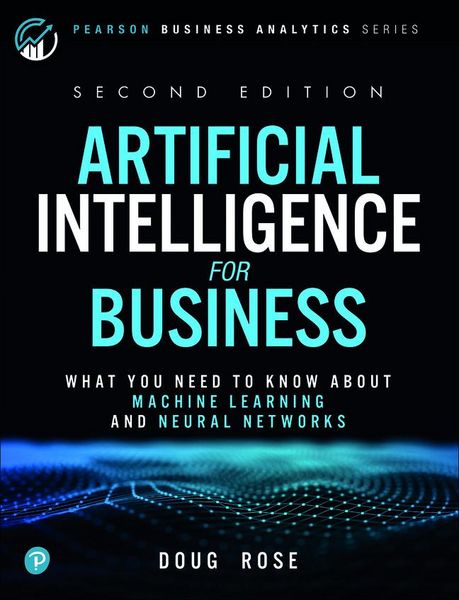
Produktbild: Artificial Intelligence for Business

Artificial Intelligence for Business

32,99 €

inkl. gesetzl. MwSt., Versandkostenfrei


Beschreibung

Produktdetails

Einband

Taschenbuch

Erscheinungsdatum

11.12.2020

Verlag

Pearson Academic

Seitenzahl

272

Maße (L/B/H)

23,1/17,8/1,8 cm

Gewicht

417 g

Auflage

2nd edition

Sprache

Englisch

ISBN

978-0-13-655661-9

Beschreibung

Produktdetails

Einband

Taschenbuch

Erscheinungsdatum

11.12.2020

Verlag

Pearson Academic

Seitenzahl

272

Maße (L/B/H)

23,1/17,8/1,8 cm

Gewicht

417 g

Auflage

2nd edition

Sprache

Englisch

ISBN

978-0-13-655661-9

Herstelleradresse

Libri GmbH
Europaallee 1
36244 Bad Hersfeld
DE

Email: gpsr@libri.de

Ein neues Kapitel für Ihre Bücher

Ein neues Kapitel für Ihre Bücher

Schenken Sie Ihren alten Schätzen ein zweites Leben und erhalten dafür eine Thalia Geschenkkarte.

Jetzt verkaufen
Jetzt verkaufen

Noch keine Bewertungen vorhanden

Verfassen Sie die erste Bewertung zu diesem Artikel

Helfen Sie anderen Kundinnen und Kunden durch Ihre Meinung.

Kundinnen und Kunden meinen

Bewertungen (0)

Die Leseprobe wird geladen.
  • Produktbild: Artificial Intelligence for Business
  • Foreword     xv

    Preface     xix

    PART I:  Thinking Machines: An Overview of Artificial Intelligence     1

    Chapter 1:  What Is Artificial Intelligence?     3

    What Is Intelligence?     4

    Testing Machine Intelligence     6

    The General Problem Solver     8

    Strong and Weak Artificial Intelligence     11

    Artificial Intelligence Planning     14

    Learning over Memorizing     15

    Chapter Takeaways     18

    Chapter 2:  The Rise of Machine Learning     19

    Practical Applications of Machine Learning     22

    Artificial Neural Networks     24

    The Fall and Rise of the Perceptron     27

    Big Data Arrives     30

    Chapter Takeaways     33

    Chapter 3:  Zeroing in on the Best Approach     35

    Expert System Versus Machine Learning     35

    Supervised Versus Unsupervised Learning     37

    Backpropagation of Errors     38

    Regression Analysis     41

    Chapter Takeaways     43

    Chapter 4:  Common AI Applications     45

    Intelligent Robots     45

    Natural Language Processing     48

    The Internet of Things     50

    Chapter Takeaways     51

    Chapter 5:  Putting AI to Work on Big Data     53

    Understanding the Concept of Big Data     54

    Teaming Up with a Data Scientist     54

    Machine Learning and Data Mining: What's the Difference?     55

    Making the Leap from Data Mining to Machine Learning     56

    Taking the Right Approach     57

    Chapter Takeaways     59

    Chapter 6:  Weighing Your Options     61

    Chapter Takeaways     64

    PART II:  Machine Learning     65

    Chapter 7:  What Is Machine Learning?     67

    How a Machine Learns     71

    Working with Data     74

    Applying Machine Learning     77

    Different Types of Learning     79

    Chapter Takeaways     81

    Chapter 8:  Different Ways a Machine Learns     83

    Supervised Machine Learning     83

    Unsupervised Machine Learning     86

    Semi-Supervised Machine Learning     89

    Reinforcement Learning     91

    Chapter Takeaways     93

    Chapter 9:  Popular Machine Learning Algorithms     95

    Decision Trees     99

    k-Nearest Neighbor     101

    k-Means Clustering     104

    Regression Analysis     108

    Naive Bayes     110

    Chapter Takeaways     113

    Chapter 10:  Applying Machine Learning Algorithms     115

    Fitting the Model to Your Data     119

    Choosing Algorithms     120

    Ensemble Modeling     121

    Deciding on a Machine Learning Approach     123

    Chapter Takeaways     124

    Chapter 11:  Words of Advice     125

    Start Asking Questions     125

    Don't Mix Training Data with Test Data     127

    Don't Overstate a Model's Accuracy     127

    Know Your Algorithms     128

    Chapter Takeaways     128

    PART III:  Artificial Neural Networks     129

    Chapter 12:  What Are Artificial Neural Networks?     131

    Why the Brain Analogy?     133

    Just Another Amazing Algorithm     133

    Getting to Know the Perceptron     135

    Squeezing Down a Sigmoid Neuron     138

    Adding Bias     141

    Chapter Takeaways     142

    Chapter 13:  Artificial Neural Networks in Action     143

    Feeding Data into the Network     143

    What Goes on in the Hidden Layers     145

    Understanding Activation Functions     149

    Adding Weights     151

    Adding Bias     152

    Chapter Takeaways     153

    Chapter 14:  Letting Your Network Learn     155

    Starting with Random Weights and Biases     156

    Making Your Network Pay for Its Mistakes: The Cost Function     157

    Combining the Cost Function with Gradient Descent     158

    Using Backpropagation to Correct for Errors     160

    Tuning Your Network     163

    Employing the Chain Rule     164

    Batching the Data Set with Stochastic Gradient Descent     166

    Chapter Takeaways     167

    Chapter 15:  Using Neural Networks to Classify or Cluster     169

    Solving Classification Problems     170

    Solving Clustering Problems     172

    Chapter Takeaways     174

    Chapter 16:  Key Challenges     175

    Obtaining Enough Quality Data     175

    Keeping Training and Test Data Separate     176

    Carefully Choosing Your Training Data     177

    Taking an Exploratory Approach     177

    Choosing the Right Tool for the Job     178

    Chapter Takeaways     178

    PART IV:  Putting Artificial Intelligence to Work     179

    Chapter 17:  Harnessing the Power of Natural Language Processing     181

    Extracting Meaning from Text and Speech with NLU     183

    Delivering Sensible Responses with NLG     184

    Automating Customer Service     186

    Reviewing the Top NLP Tools and Resources     187

    NLU Tools     189

    NLG Tools     190

    Chapter Takeaways     191

    Chapter 18:  Automating Customer Interactions     193

    Choosing Natural Language Technologies     195

    Review the Top Tools for Creating Chatbots and Virtual Agents     196

    Chapter Takeaways     198

    Chapter 19:  Improving Data-Based Decision-Making     199

    Choosing Between Automated and Intuitive Decision-Making     201

    Gathering Data in Real Time from IoT Devices     202

    Reviewing Automated Decision-Making Tools     204

    Chapter Takeaways     205

    Chapter 20:  Using Machine Learning to Predict Events and Outcomes     207

    Machine Learning Is Really about Labeling Data     208

    Looking at What Machine Learning Can Do     210

    Predict What Customers Will Buy     210

    Answer Questions Before They're Asked     210

    Make Better Decisions Faster     212

    Replicate Expertise in Your Business     213

    Use Your Power for Good, Not Evil: Machine Learning Ethics     214

    Review the Top Machine Learning Tools     216

    Chapter Takeaways     218

    Chapter 21:  Building Artificial Minds     219

    Separating Intelligence from Automation     221

    Adding Layers for Deep Learning     222

    Considering Applications for Artificial Neural Networks     223

    Classifying Your Best Customers     224

    Recommending Store Layouts     225

    Analyzing and Tracking Biometrics     226

    Reviewing the Top Deep Learning Tools     228

    Chapter Takeaways     229

    Index     231