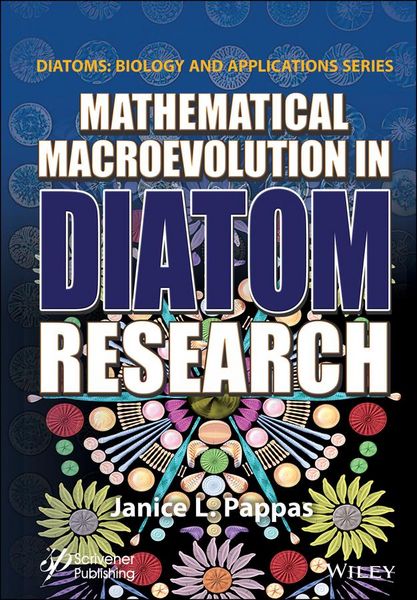
Mathematical Macroevolution in Diatom Research
276,99 €
inkl. gesetzl. MwSt.,
Beschreibung
Produktdetails
Einband
Gebundene Ausgabe
Erscheinungsdatum
13.09.2023
Verlag
John Wiley & Sons IncSeitenzahl
544
Maße (L/B/H)
25,6/18,5/3,1 cm
Gewicht
1262 g
Auflage
1. Auflage
Sprache
Englisch
ISBN
978-1-119-74985-1
Buy this book to learn how to use mathematics in macroevolution research and apply mathematics to study complex biological problems.
This book contains recent research in mathematical and analytical studies on diatoms. These studies reflect the complex and intricate nature of the problems being analyzed and the need to use mathematics as an aid in finding solutions. Diatoms are important components of marine food webs, the silica and carbon cycles, primary productivity, and carbon sequestration. Their uniqueness as glass-encased unicells and their presence throughout geologic history exemplifies the need to better understand such organisms. Explicating the role of diatoms in the biological world is no more urgent than their role as environmental and climate indicators, and as such, is aided by the mathematical studies in this book.
The volume contains twelve original research papers as chapters. Macroevolutionary science topics covered are morphological analysis, morphospace analysis, adaptation, food web dynamics, origination-extinction and diversity, biogeography, life cycle dynamics, complexity, symmetry, and evolvability. Mathematics used in the chapters include stochastic and delay differential and partial differential equations, differential geometry, probability theory, ergodic theory, group theory, knot theory, statistical distributions, chaos theory, and combinatorics. Applied sciences used in the chapters include networks, machine learning, robotics, computer vision, image processing, pattern recognition, and dynamical systems. The volume covers a diverse range of mathematical treatments of topics in diatom research.
Audience
Diatom researchers, mathematical biologists, evolutionary and macroevolutionary biologists, paleontologists, paleobiologists, theoretical biologists, as well as researchers in applied mathematics, algorithm sciences, complex systems science, computational sciences, informatics, computer vision and image processing sciences, nanoscience, the biofuels industry, and applied engineering.
Ein neues Kapitel für Ihre Bücher
Ein neues Kapitel für Ihre Bücher
Schenken Sie Ihren alten Schätzen ein zweites Leben und erhalten dafür eine Thalia Geschenkkarte.
Noch keine Bewertungen vorhanden
Verfassen Sie die erste Bewertung zu diesem Artikel
Helfen Sie anderen Kundinnen und Kunden durch Ihre Meinung.
Kurze Frage zu unserer Seite
Vielen Dank für Ihr Feedback
Wir nutzen Ihr Feedback, um unsere Produktseiten zu verbessern. Bitte haben Sie Verständnis, dass wir Ihnen keine Rückmeldung geben können. Falls Sie Kontakt mit uns aufnehmen möchten, können Sie sich aber gerne an unseren Kund*innenservice wenden.
zum Kundenservice