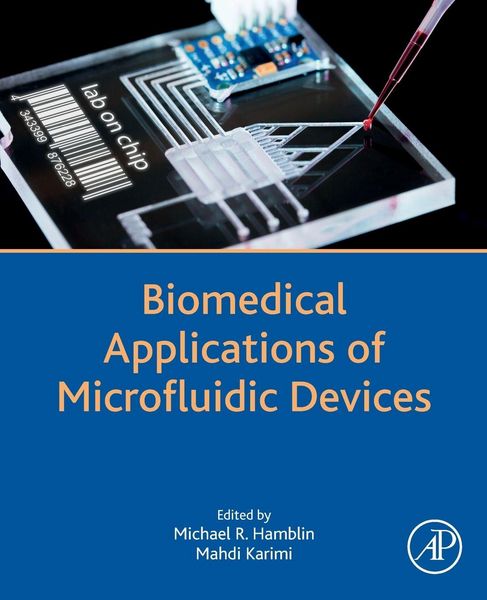
• Produktbild: Biomedical Applications of Microfluidic Devices
  • Produktbild: Biomedical Applications of Microfluidic Devices

Biomedical Applications of Microfluidic Devices

175,99 €

inkl. gesetzl. MwSt., Versandkostenfrei


Beschreibung

Produktdetails

Einband

Taschenbuch

Erscheinungsdatum

01.12.2020

Herausgeber

Michael R. Hamblin + weitere

Verlag

Elsevier Science & Technology

Seitenzahl

352

Maße (L/B/H)

23,5/19,1/1,9 cm

Gewicht

607 g

Sprache

Englisch

ISBN

978-0-12-818791-3

Beschreibung

Portrait

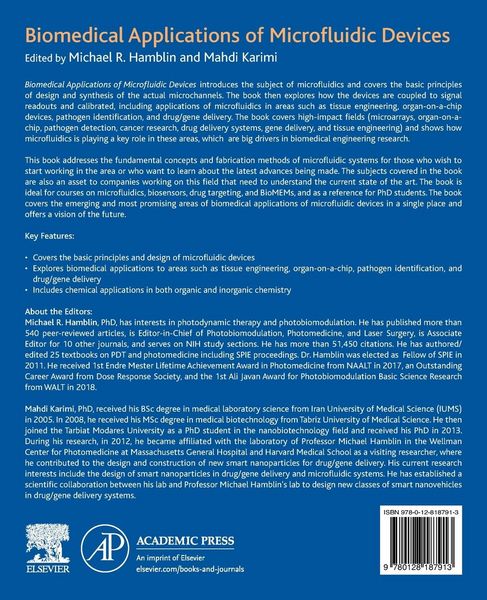
Michael R Hamblin Ph.D. is a Principal Investigator at the Wellman Center for Photomedicine at Massachusetts General Hospital, an Associate Professor of Dermatology at Harvard Medical School and is a member of the affiliated faculty of the Harvard-MIT Division of Health Science and Technology. He was trained as a synthetic organic chemist and received his PhD from Trent University in England. His research interests lie in the areas of photodynamic therapy (PDT) for infections, cancer, and heart disease and in low-level light therapy (LLLT) for wound healing, arthritis, traumatic brain injury and hair-regrowth. He directs a laboratory of around a sixteen post-doctoral fellows, visiting scientists and graduate students. His research program is supported by NIH, CDMRP, USAFOSR and CIMIT among other funding agencies. He has published 252 peer-reviewed articles, over 150 conference proceedings, book chapters and International abstracts and holds 8 patents. He is Associate Editor for 7 journals, on the editorial board of a further 12 journals and serves on NIH Study Sections. For the past 9 years Dr Hamblin has chaired an annual conference at SPIE Photonics West entitled "Mechanisms for low level light therapy" and he has edited the 9 proceedings volumes together with four other major textbooks on PDT and photomedicine. He has several other book projects in progress at various stages of completion. In 2011 Dr Hamblin was honored by election as a Fellow of SPIE.He received his BSc degree in Medical Laboratory Science from Iran University of Medical Science (IUMS), in 2005. In 2008, he received the MSc degree in Medical Biotechnology from Tabriz University of Medical Science and joined the Tarbiat Modares University as a PhD student in the nanobiotechnology field and received his PhD in 2013. During his research, in 2012, he became affiliated with the laboratory of Professor Michael Hamblin in the Wellman Center for Photomedicine at Massachusetts General Hospital and Harvard Medical School as a visiting researcher, where he contributed to the design and construction of new smart nanoparticles for drug/gene delivery. His current research interests include the design of smart nanoparticles in drug/gene delivery and microfluidic systems. He has established a scientific collaboration between his lab and Professor Michael Hamblin's lab to design new classes of smart nanovehicles in drug/gene delivery systems.

Produktdetails

Einband

Taschenbuch

Erscheinungsdatum

01.12.2020

Herausgeber

Verlag

Elsevier Science & Technology

Seitenzahl

352

Maße (L/B/H)

23,5/19,1/1,9 cm

Gewicht

607 g

Sprache

Englisch

ISBN

978-0-12-818791-3

EU-Ansprechpartner

Kolibri 360 GmbH
Ettore-Bugatti-Straße 6-14
51149 Köln
DE
produktsicherheit@kolibri360.de

Herstelleradresse

Elsevier Science & Technology
125 London Wall
EC2Y 5AS London
GB
tradeorders@elsevier.com

Ein neues Kapitel für Ihre Bücher

Ein neues Kapitel für Ihre Bücher

Schenken Sie Ihren alten Schätzen ein zweites Leben und erhalten dafür eine Thalia Geschenkkarte.

Jetzt verkaufen
Jetzt verkaufen

Noch keine Bewertungen vorhanden

Verfassen Sie die erste Bewertung zu diesem Artikel

Helfen Sie anderen Kundinnen und Kunden durch Ihre Meinung.

Kundinnen und Kunden meinen

Bewertungen (0)

Die Leseprobe wird geladen.
  • Produktbild: Biomedical Applications of Microfluidic Devices
  • Produktbild: Biomedical Applications of Microfluidic Devices
  • 1. Microfluidic devices: Concepts
    2. Microfludic devices: Synthesis approaches
    3. Design of microchannels in microfluidic devices
    4. Microarray technologies
    5. Organ-on-a-chip devices
    6. Microfluidic devices for pathogen detection
    7. Microfluidic devices for detection of cancer cells
    8. Microfluidic devices for drug delivery systems
    9. Microfluidic devices for gene delivery systems
    10. Microfluidic devices for tissue engineering
    11. Microfludics in organic chemistry
    12. Microfludics in inorganic chemistry
    13. Paper based microfluidic devices
    14. Smart phone based microfluidic devices
    15. Microfluidics: Future perspectives