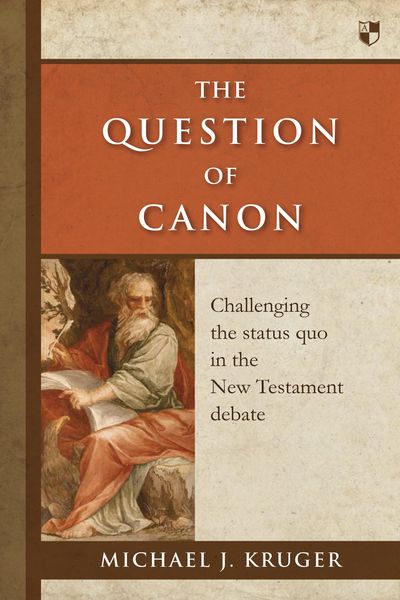
The Question of Canon Challenging The Status Quo In The New Testament Debate
1-
- Taschenbuch
- eBook ausgewählt
-
Form:Einzelkauf Download
-
Sprache:Englisch
14,99 €
inkl. gesetzl. MwSt.Beschreibung
Produktdetails
Format
ePUB
Kopierschutz
Nein
Family Sharing
Nein
Text-to-Speech
Ja
Erscheinungsdatum
21.05.2020
Verlag
IvpSeitenzahl
208 (Printausgabe)
Sprache
Englisch
EAN
9781789740172
For many years now, the topic of the New Testament canon has been the main focus of my research and writing. It is an exciting field of study that probes into questions that have long fascinated both scholars and laymen alike, namely when and how these 27 books came to be regarded as a new scriptural deposit.
But, the story of the New Testament canon is bigger than just the "when" and the "how". It is also, and perhaps most fundamentally, about the "why". Why did Christians have a canon at all? Does the canon exist because of some later decision or action of the second- or third-century church? Or did it arise more naturally from within the early Christian faith itself? Was the canon an extrinsic phenomenon, or an intrinsic one?
These are the questions this book is designed to address. And these are not micro questions, but macro ones. They address foundational and paradigmatic issues about the way we view the canon. They force us to consider the larger framework through which we conduct our research - whether we realized we had such a framework or not.
Of course, we are not the first to ask such questions about why we have a canon. Indeed, for many scholars this question has already been settled. The dominant view today, as we shall see below, is that the New Testament is an extrinsic phenomenon; a later ecclesiastical development imposed on books originally written for another purpose. This is the framework through which much of modern scholarship operates. And it is the goal of this volume to ask whether it is a compelling one. To be sure, it is no easy task challenging the status quo in any academic field. But, we should not be afraid to ask tough questions. Likewise, the consensus position should not be afraid for them to be asked.
Kundinnen und Kunden meinen
Kurze Frage zu unserer Seite
Vielen Dank für Ihr Feedback
Wir nutzen Ihr Feedback, um unsere Produktseiten zu verbessern. Bitte haben Sie Verständnis, dass wir Ihnen keine Rückmeldung geben können. Falls Sie Kontakt mit uns aufnehmen möchten, können Sie sich aber gerne an unseren Kund*innenservice wenden.
zum Kundenservice