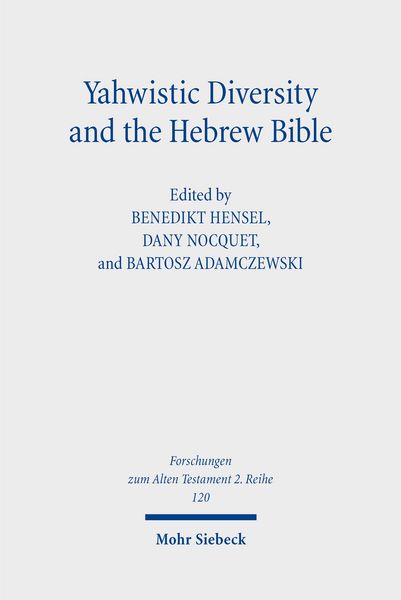
Produktbild: Yahwistic Diversity and the Hebrew Bible
Band 120 - 19%

Yahwistic Diversity and the Hebrew Bible Tracing Perspectives of Group Identity from Judah, Samaria, and the Diaspora in Biblical Traditions

19% sparen

87,99 € UVP 109,00 €

inkl. gesetzl. MwSt., Versandkostenfrei


Portrait

Born 1979; 2011 PhD; 2016 Habilitation; 2019-2021 positions as Interim Professor of Hebrew Bible and Biblical Archaeology at the universities of Mainz and Zurich; Full Professor of Hebrew Bible and Biblical Archaeology at Carl von Ossietzky Universität Oldenburg; Director, DA:O
Digital Ancient Studies Oldenburg; and Co-Director of the Hazor excavations/Israel.
Born 1967; 2001 Dr. theol.; 2011 Habilitation; Associate Professor at Cardinal Stefan Wyszynski University in Warsaw.
Born 1955; 1999 Dr. theol.; 2015 Habilitation; Emeritus Professor of Old Testament and Hebrew at the Institut Protestant de Théologie - Faculté de Montpellier.

Produktdetails

Einband

Taschenbuch

Erscheinungsdatum

15.07.2020

Herausgeber

Benedikt Hensel + weitere

Verlag

Mohr Siebeck

Seitenzahl

345

Maße (L/B/H)

2/15,6/23,3 cm

Gewicht

527 g

Auflage

1. Auflage

Sprache

Englisch

ISBN

978-3-16-158304-9

Portrait

Produktdetails

Einband

Taschenbuch

Erscheinungsdatum

15.07.2020

Herausgeber

Verlag

Mohr Siebeck

Seitenzahl

345

Maße (L/B/H)

2/15,6/23,3 cm

Gewicht

527 g

Auflage

1. Auflage

Sprache

Englisch

ISBN

978-3-16-158304-9

Herstelleradresse

Jana Trispel
Wilhelmstraße, 18
72074 Tübingen
DE
trispel@mohrsiebeck.com

Ein neues Kapitel für Ihre Bücher

Ein neues Kapitel für Ihre Bücher

Schenken Sie Ihren alten Schätzen ein zweites Leben: Einfach Barcode scannen, Versandetikett ausdrucken, Bücher verschicken und Thalia Geschenkkarte erhalten.

Jetzt verkaufen
Jetzt verkaufen

Kundinnen und Kunden meinen

0 Bewertungen

Informationen zu Bewertungen

Zur Abgabe einer Bewertung ist eine Anmeldung im Konto notwendig. Die Authentizität der Bewertungen wird von uns nicht überprüft. Wir behalten uns vor, Bewertungstexte, die unseren Richtlinien widersprechen, entsprechend zu kürzen oder zu löschen.

Die Bewertungen sind nach Format, Anzahl Sterne und Datum sortiert.

Verfassen Sie die erste Bewertung zu diesem Artikel

Helfen Sie anderen Kund*innen durch Ihre Meinung

Kundinnen und Kunden meinen

0 Bewertungen filtern

  • Produktbild: Yahwistic Diversity and the Hebrew Bible
  • Benedikt Hensel: Yahwistic Diversity and the Hebrew Bible: State of the Field, Desiderata, and Research Perspectives in a Necessary Debate on the Formative Period of Judaism(s)

    Part I: Perspectives for and from Judah, Samaria, and Diaspora? The Debate within the Pentateuch and Hexateuch
    Reinhard Achenbach: Die Integration der heiligen Orte der Provinz Samaria in das Narrativ des Hexateuch - Konrad Schmid: The Diaspora as a Blessing for the Nations: The Case of Gen 28:14 - Dany Nocquet: The Question of Israel's Kinship with the Arameans: Rachel and Laban in Gen 31:1 - 32:1: A Samaritan Contribution? - Julia Rhyder: Unity and Hierarchy: North and South in the Priestly Traditions - Raik Heckl: The Temple within the Book and Its Function: Considerations on the Cultic Conception of the Composition of the Torah

    Part II: Ongoing Debates - Historical Developments - Intensifying Polemics: Literary-Historical, Text-Historical, Theological, and Historical Aspects of the Formation Processes
    Jean Louis Ska: Why is the Chosen People Called Israel and Not Judah? - Hervé Gonzalez/Marc Mendoza: 'What Have the Macedonians Ever Done for Us?' A Reassessment of the Changes in Samaria by the Start of the Hellenistic Period - Stefan Schorch: Where is the Altar? Scribal Intervention in the Book of Joshua and Beyond - Detlef Jericke: Shiloh between Shechem and Jerusalem - Magnar Kartveit: The Tension between the Law and the Prophets as a Background to the Formation of the Samaritan Pentateuch - Veit Dinkelaker: Gen 2:2 Reconsidered: Marginal Notes on a Peculiar Variant in Samaritan, Greek, and other Manuscripts - Jonathan Miles Robker: Die Texttraditionen von 2. Könige 17 als Spiegel der Entwicklung des Verhältnisses von Juden und Samaritanern