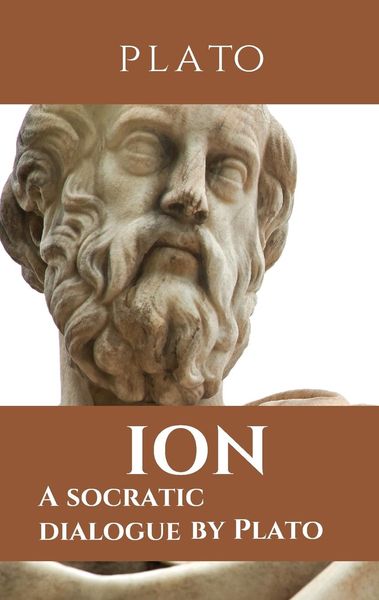
Ion A socratic dialogue by Plato
-
- Hardcover
- Taschenbuch ausgewählt
- eBook
- Hörbuch
-
Sprache:Englisch
- Englisch 15,99 € ausgewählt
- Griechisch 32,99 €
-
Verlag:Les prairies numériques
- USA Public Domain Books 16,99 €
- Susan Publishing Ltd 16,99 €
- Public Public Books 16,99 €
- The Library of Alexandria 16,99 €
- Yorkshire Public Books 18,99 €
- Notion Press 13,99 €
- Barclays Public Books 16,99 €
- Toronto Public Domain Publishing 16,99 €
- Public Publishing 16,99 €
- Mary Publishing Company 16,99 €
- Book Jungle 15,99 €
- Les prairies numériques 15,99 € ausgewählt
- Alpha Edition 17,99 €
- Texas Public Domain 16,99 €
- Bryn Mawr Commentaries 15,99 €
- Camel Publishing House 16,99 €
- Ingram Publishers Services 6,99 €
15,99 €
inkl. gesetzl. MwSt.,
Beschreibung
Produktdetails
Einband
Taschenbuch
Erscheinungsdatum
14.07.2020
Verlag
Les prairies numériquesSeitenzahl
24
Maße (L/B/H)
19/12/0,2 cm
Gewicht
34 g
Sprache
Englisch
ISBN
978-2-491-25127-7
In Plato's Ion Socrates discusses with the titular character, a professional rhapsode who also lectures on Homer, the question of whether the rhapsode, a performer of poetry, gives his performance on account of his skill and knowledge or by virtue of divine possession. It is one of the shortest of Plato's dialogues. Commentary Plato's argument is supposed to be an early example of a so-called genetic fallacy since his conclusion arises from his famous lodestone (magnet) analogy. Ion, the rhapsode "dangles like a lodestone at the end of a chain of lodestones. The muse inspires the poet (Homer in Ion's case) and the poet inspires the rhapsode." Plato's dialogues are themselves "examples of artistry that continue to be stageworthy;" it is a paradox that "Plato the supreme enemy of art is also the supreme artist." Plato develops a more elaborate critique of poetry in other dialogues such as in Phaedrus 245a, Symposium 209a, Republic 398a, Laws 817 b-d. summaryIon's skill: Is it genuine? (530a-533c) Ion has just come from a festival of Asclepius at the city of Epidaurus, after having won first prize in the competition. Socrates engages him in discussion and Ion explains how his knowledge and skill is limited to Homer, whom he claims to understand better than anyone alive. Socrates finds this puzzling as to him it seems that Homer treats many of the same subjects as other poets like Hesiod, subjects such as war or divination, and that if someone is knowledgeable in any one of those he should be able to understand what both of these poets say. Furthermore, this man is probably not the poet, like Ion, but a specialist like a doctor, who knows better about nutrition. The nature of poetic inspiration (533d-536d) Socrates deduces from this observation that Ion has no real skill, but is like a soothsayer or prophet in being divinely possessed: "For not by art do they utter these things, but by divine influence; since, if they had fully learned by art to speak on one kind of theme, they would know how to speak on all. And for this reason God takes away the mind of these men and uses them as his ministers, just as he does soothsayers and godly seers, in order that we who hear them may know that it is not they who utter these words of great price, when they are out of their wits, but that it is God himself who speaks and addresses us through them." (534b-d) Ion's choice: To be skilled or inspired (536e-542a) Ion tells Socrates that he cannot be convinced that he is possessed or mad when he performs (536d,e). Socrates then recites passages from Homer which concern various arts such as medicine, divining, fishing, and making war. He asks Ion if these skills are distinct from his art of recitation. Ion admits that while Homer discusses many different skills in his poetry, he never refers specifically to the rhapsode's craft, which is acting.
Ein neues Kapitel für Ihre Bücher
Ein neues Kapitel für Ihre Bücher
Schenken Sie Ihren alten Schätzen ein zweites Leben und erhalten dafür eine Thalia Geschenkkarte.
Noch keine Bewertungen vorhanden
Verfassen Sie die erste Bewertung zu diesem Artikel
Helfen Sie anderen Kundinnen und Kunden durch Ihre Meinung.
Kurze Frage zu unserer Seite
Vielen Dank für Ihr Feedback
Wir nutzen Ihr Feedback, um unsere Produktseiten zu verbessern. Bitte haben Sie Verständnis, dass wir Ihnen keine Rückmeldung geben können. Falls Sie Kontakt mit uns aufnehmen möchten, können Sie sich aber gerne an unseren Kund*innenservice wenden.
zum Kundenservice