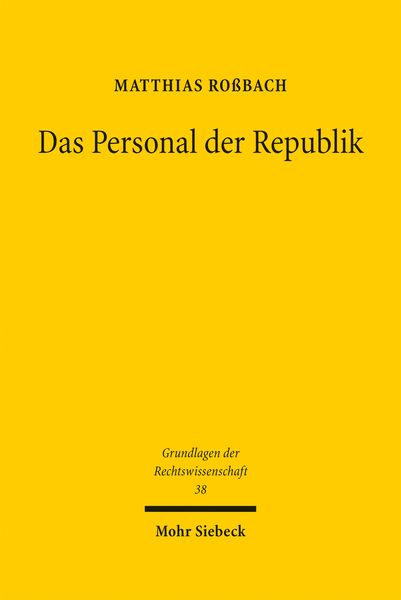
Roßbach, M: Personal der Republik Entstehung und Entwicklung eines demokratischen Personalverfassungsrechts der Exekutive am Beispiel der Vereinigten Staaten von Amerika
149,00 €
inkl. gesetzl. MwSt.,
Beschreibung
Produktdetails
Einband
Gebundene Ausgabe
Erscheinungsdatum
01.05.2021
Verlag
Mohr SiebeckSeitenzahl
705
Maße (L/B/H)
24,1/17,2/4,5 cm
Gewicht
1176 g
Auflage
1. Auflage
Sprache
Deutsch
ISBN
978-3-16-156721-6
When this question arose in Germany for the first time in 1919, traditional civil service principles had already influenced the administration for more than a century. In the United States, by contrast, the principle of popular sovereignty had shaped the executive branch long before the emergence of a modern administration in the late 19th century. This book therefore analyzes the multi-layered connection between a specifically democratic constitution and the personnel of the executive branch by using the United States of America as an example. It examines the transformation of constitutional theory into constitutional law, the relationship of constitutional law to the influence of political parties and to the modern administrative state, and the frictions that have become apparent in the United States in recent years. Thereby, this book establishes a Constitutional Law of Executive Personnel.
The theoretical starting point of this study is the separation of office and officeholder, which, unlike on the European continent, had a power-limiting function in the United States from the outset and led to the separation of organizational power from appointment power (Part 1, B.).
The historical starting point of the study is the Declaration of Independence, since important decisions on the course of the American constitutional law of executive personnel were already made before the constitution was adopted. In the period from 1776 to 1787, the separation of powers developed from a principle that was in practice directed only against the executive to a principle that was supposed to work for and against all three powers. The revolutionaries adapted the power to appoint and remove executive officers in the new institutions to this development (Part 2: The Executive Branch and its Personnel between the Declaration of Independence and the Federal Constitution).
These developments formed the basis for a distinctly republican ideal of executive personnel. This ideal of the American founding generation is elaborated in the third part of this book as a core element of the American understanding of the constitution and as a link between different constitutional principles (Part 3: Standards for the Personnel of the New Republic: Personnel Ideal and Constitutional Theory). This personnel ideal emerges less from the text of the Constitution but rather from other primary sources, particularly the Federalist Papers and the correspondence of the founding fathers: The executive was to be led by virtuous men distinguished by "fitness of character", who would not fall prey to "corruption" in the sense of abusing their office for their own ends. This interpretation of the American founding phase challenges those concepts that interpret the American founding in a completely pluralistic way. As shown in part 3, the republicanism thesis applies insofar as both pluralist and republican elements were influential during the founding era: Since the founders recognized that their personnel ideal was not easy to fulfill, they provided for safeguards. In addition to the checks and balances of the horizontal separation of powers, these safeguards also included the size and thus the diversity of a republic in which "factions" are controlling each other. In this way, Federalist No. 10 can be explained in terms of personnel constitutional law. The republican ideal of personnel is thus determined not by substantive constitutional law but by procedure. A complete constitutional determination of the appointment criteria would contradict the American understanding of personnel de
Ein neues Kapitel für Ihre Bücher
Ein neues Kapitel für Ihre Bücher
Schenken Sie Ihren alten Schätzen ein zweites Leben: Einfach Barcode scannen, Versandetikett ausdrucken, Bücher verschicken und Thalia Geschenkkarte erhalten.
Jetzt verkaufenKundinnen und Kunden meinen
Verfassen Sie die erste Bewertung zu diesem Artikel
Helfen Sie anderen Kund*innen durch Ihre Meinung
Kurze Frage zu unserer Seite
Vielen Dank für Ihr Feedback
Wir nutzen Ihr Feedback, um unsere Produktseiten zu verbessern. Bitte haben Sie Verständnis, dass wir Ihnen keine Rückmeldung geben können. Falls Sie Kontakt mit uns aufnehmen möchten, können Sie sich aber gerne an unseren Kund*innenservice wenden.
zum Kundenservice