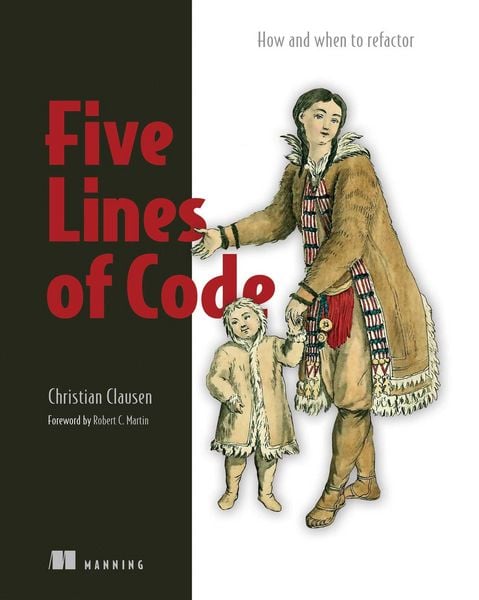
Five Lines of Code How and When to Refactor
-
- Taschenbuch ausgewählt
- eBook
-
Sprache:Englisch
56,99 €
inkl. gesetzl. MwSt.,
Beschreibung
Produktdetails
Einband
Taschenbuch
Erscheinungsdatum
26.10.2021
Verlag
Pearson AcademicSeitenzahl
336
Maße (L/B/H)
23,6/19/2,5 cm
Gewicht
619 g
Auflage
1. Auflage
Sprache
Englisch
ISBN
978-1-61729-831-8
Improving existing code—refactoring—is one of the most common tasks you’ll face as a programmer. Five Lines of Code teaches you clear and actionable refactoring rules that you can apply without relying on intuitive judgements such as “code smells.” It’s written for working developers, guiding you step by step through applying refactoring patterns to the codebase of a 2D puzzle game. Following the author’s expert perspective—that refactoring and code smells can be learned by following a concrete set of principles—you’ll learn when to refactor your code, what patterns to apply to what problem, and the code characteristics that indicate it’s time for a rework. Thanks to this hands-on guide, you’ll find yourself programming faster while still delivering high-quality code that your teammates will love to work with. about the technologyRefactoring is a fact of life. All code is imperfect, and refactoring is a systematic process you can use to improve the quality of your codebase. Whatever your architecture, choice of OO language, or skill as a programmer, the continuous design improvements of refactoring make your code simpler, more readable, and less prone to bugs. You’ll be amazed at the productivity boost of adding refactoring to your code hygiene routine—it’s quicker to hammer out bad code and then improve it than spending hours writing good code in the first place! about the book Five Lines of Code teaches working developers the shortcuts to quality code. You’ll follow author Christian Clausen’s unique approach to teaching refactoring that’s focused on concrete rules, and getting any method down to five lines or less to implement! There’s no jargon or tricky automated-testing skills required, just easy guidelines and patterns illustrated by detailed code samples. Chapter by chapter you’ll put techniques into action by refactoring a complete 2D puzzle game. Before you know it, you’ll be making serious and tangible improvements to your codebase. what's inside
- The symptoms of bad code
- The extracting method, introducing strategy pattern, and many other refactoring patterns
- Modifying code safely, even when you don’t understand it
- Writing stable code that enables change-by-addition
- Proper compiler practices
- Writing code that needs no comments
- Real-world practices for great refactoring
Ein neues Kapitel für Ihre Bücher
Ein neues Kapitel für Ihre Bücher
Schenken Sie Ihren alten Schätzen ein zweites Leben und erhalten dafür eine Thalia Geschenkkarte.
Noch keine Bewertungen vorhanden
Verfassen Sie die erste Bewertung zu diesem Artikel
Helfen Sie anderen Kundinnen und Kunden durch Ihre Meinung.
Kurze Frage zu unserer Seite
Vielen Dank für Ihr Feedback
Wir nutzen Ihr Feedback, um unsere Produktseiten zu verbessern. Bitte haben Sie Verständnis, dass wir Ihnen keine Rückmeldung geben können. Falls Sie Kontakt mit uns aufnehmen möchten, können Sie sich aber gerne an unseren Kund*innenservice wenden.
zum Kundenservice