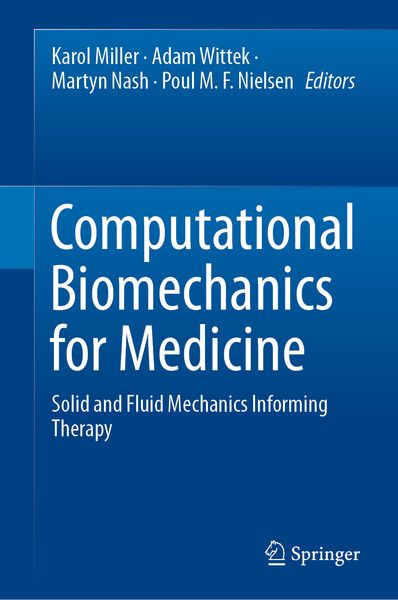
Computational Biomechanics for Medicine Solid and Fluid Mechanics Informing Therapy
-
- Hardcover ausgewählt
- Taschenbuch
- eBook
-
Sprache:Englisch
-
Verlag:Springer
- Springer Us 139,99 €
- Springer 97,99 € ausgewählt
-
Auflage:21001 Auflage 1st edition 2021
97,99 €
inkl. gesetzl. MwSt.,
Beschreibung
Produktdetails
Einband
Gebundene Ausgabe
Erscheinungsdatum
18.07.2021
Abbildungen
IX, 124 p. 71 illus., 67 illus. in color.
Herausgeber
Karol Miller + weitereVerlag
SpringerSeitenzahl
124
Maße (L/B/H)
24,1/16/1,4 cm
Gewicht
377 g
Auflage
21001 Auflage 1st edition 2021
Sprache
Englisch
ISBN
978-3-030-70122-2
Computational Biomechanics for Medicine: Solid and fluid mechanics for the benefit of patients contributions and papers from the MICCAI Computational Biomechanics for Medicine Workshop help in conjunction with Medical Image Computing and Computer Assisted Intervention conference (MICCAI 2020) in Lima, Peru. The content is dedicated to research in the field of methods and applications of computational biomechanics to medical image analysis, image-guided surgery, surgical simulation, surgical intervention planning, disease prognosis and diagnostics, analysis of injury mechanisms, implant and prostheses design, as well as artificial organ design and medical robotics. This book appeals to researchers, students and professionals in the field.
Ein neues Kapitel für Ihre Bücher
Ein neues Kapitel für Ihre Bücher
Schenken Sie Ihren alten Schätzen ein zweites Leben und erhalten dafür eine Thalia Geschenkkarte.
Noch keine Bewertungen vorhanden
Verfassen Sie die erste Bewertung zu diesem Artikel
Helfen Sie anderen Kundinnen und Kunden durch Ihre Meinung.
Kurze Frage zu unserer Seite
Vielen Dank für Ihr Feedback
Wir nutzen Ihr Feedback, um unsere Produktseiten zu verbessern. Bitte haben Sie Verständnis, dass wir Ihnen keine Rückmeldung geben können. Falls Sie Kontakt mit uns aufnehmen möchten, können Sie sich aber gerne an unseren Kund*innenservice wenden.
zum Kundenservice