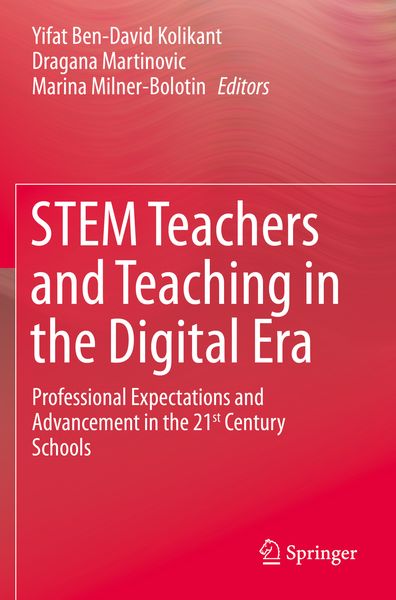
Produktbild: STEM Teachers and Teaching in the Digital Era

STEM Teachers and Teaching in the Digital Era Professional Expectations and Advancement in the 21st Century Schools

146,99 €

inkl. gesetzl. MwSt., Versandkostenfrei


Beschreibung

Produktdetails

Einband

Taschenbuch

Erscheinungsdatum

10.06.2021

Herausgeber

Yifat Ben-David Kolikant + weitere

Verlag

Springer

Seitenzahl

324

Maße (L/B/H)

23,5/15,5/1,9 cm

Gewicht

517 g

Auflage

1st ed. 2020

Sprache

Englisch

ISBN

978-3-030-29398-7

Beschreibung

Portrait

Marina Milner-Bolotin is an Associate Professor in science education in the Faculty of Education at the University of British Columbia, Vancouver, Canada. She holds a M.Sc. in theoretical physics from the Kharkov National University in Ukraine. She also holds M.A. and Ph.D. degrees in mathematics and science education from the University of Texas at Austin in 2001. At UT Austin, she investigated how project-based instruction in physics courses for future elementary teachers affected their interest in science and their ability to do and teach science. She specializes in science and mathematics education and science outreach. She studies how technology can be used in teacher education to prepare mathematics and science teachers who will be able to engage 21 st century students in meaningful learning. Her work has appeared in international peer-reviewed research journals, scientific books, conference proceedings, seminars, and workshops. Since 1993, she has been teaching science and mathematics in Israel, USA, China, and Canada to elementary students to university undergraduates in science programs, and to pre-service and in-service teachers. She has led many professional development activities for science in-service and pre-service teachers and university faculty. She is an author of an introductory physics textbook used by thousands of students. Before joining UBC, she was faculty member at Ryerson University in Toronto, Ontario. She has received numerous research and teaching awards and served on the Executive Board of Canadian and International science education associations. To learn more about her research and publications, visit her web site. 


Yifat Ben David Kolikant is an Associate Professor in the Seymor Fox School of Education, Hebrew University of Jerusalem. Her academic work is devoted to theorizing learning, teaching, and schooling in the age of globalization and digitalism, an age characterized by the ubiquity of digital technology, an information explosion, pluralism, and rapid changes. Over the past few years, she has dealt with two core questions: (a) How does digital technology influence schooling and (b) how can effective teaching environments be characterized? In recent years she has been involved in several studies aimed at understanding and enhancing  in-service teacher learning under conditions of dramatic curricular and policy changes, and the role that ICT plays and should play in it. Prof. Ben-David Kolikant holds a Ph.D. degree in science teaching from the Weizmann Institute of Science, received in 2002.

Dragana Martinovic is a Professor of Mathematics Education at University of Windsor, where she leads the Human Development Technologies Research Group. Dragana is a Fellow of the Fields Institute for Research in Mathematical Sciences and a Co-Director of the Fields Centre for Mathematics Education. She is a recipient of the Excellence in Mentoring Award at University of Windsor. In her research, Dr. Martinovic explores ways in which technology can improve teaching and learning outcomes, and the digital literacy skills needed for a successful learner and worker of the 21 st  century. She is dedicated to supporting teacher-led research and providing opportunities for all involved in education to collaboratively work towards increasing student engagement, success, and love for learning mathematics. Dragana is on the Executive for the Mathematics Knowledge Network, hosted by the Fields Centre for Mathematics Education. She co-chairs the Mathematics Leadership Community of Practice (since 2016) and the  Fields Cognitive Science Network for Empirical Study of Mathematics and How it is Learned , and is a founding and current co-editor of the Springer book series,  Mathematics Education in the Digital Era . 

Produktdetails

Einband

Taschenbuch

Erscheinungsdatum

10.06.2021

Herausgeber

Verlag

Springer

Seitenzahl

324

Maße (L/B/H)

23,5/15,5/1,9 cm

Gewicht

517 g

Auflage

1st ed. 2020

Sprache

Englisch

ISBN

978-3-030-29398-7

Herstelleradresse

Springer-Verlag KG
Sachsenplatz 4-6
1201 Wien
AT

Email: GPSR Kontakt

Ein neues Kapitel für Ihre Bücher

Ein neues Kapitel für Ihre Bücher

Schenken Sie Ihren alten Schätzen ein zweites Leben: Einfach Barcode scannen, Versandetikett ausdrucken, Bücher verschicken und Thalia Geschenkkarte erhalten.

Jetzt verkaufen
Jetzt verkaufen

Noch keine Bewertungen vorhanden

Verfassen Sie die erste Bewertung zu diesem Artikel

Helfen Sie anderen Kundinnen und Kunden durch Ihre Meinung.

Kundinnen und Kunden meinen

Bewertungen (0)

  • Produktbild: STEM Teachers and Teaching in the Digital Era
  • Preface; E. Faggiano.- Introduction: STEM Teachers and Traching in the Era of Change; Y. Ben-David Kolikant, D. Martinovic and M. Milner-Bolotin.- Part I: Expanding Teacher’s Roles: Empowerment.- Teacher Knowledge in the Era of Change; D. Martinovic and H. Horn-Olivito.- Mathematics Teachers Edit Textbooks: Opportunities and Challenges; R. Even.- Discussion: Teacher Learning in Community: Premises, Promises and Challenges; L. Orland-Barak.- Part II: Expanding Teacher’s Roles: Israeli and Canadian Perspectives; Professional Learning Communities of Science Teachers: Theoretical and Practical Perspectives; B-S Eylon, A. Scherz and E. Bagno; On Teaching and Learning Mathematics-Technologies; N. Sinclair; Part III: Developing Teacher Learning Communities in the Era of Change.- A Sense of Community in a Professional Learning Community of Chemistry Teachers: A Study of an Online Platform for Group Communication; R. Waldman and R. Blonder.- From Practice to Practical: Computer Science Teachers Teaching Teachers; O. Brandes, Y. Ben-David Kolikant and C. Beeri.- Motivators, Contributors, and Inhibitors to Physics Teacher-Leaders' Professional Development in a Program of Professional Learning Communities; S. Levy, E. Bagno, H. Berger and B-S. Eylon.- Discussion: Teacher Professional Development in the Era of Change; D. Martinovic and M. Milner-Bolotin.-Part IV: Emergent STEM Teaching Possibilities in the Era of Educational Technologies.- Deliberate Pedagogical Thinking with Technology in STEM Teacher Education; M. Miner-Bolotin.- Teaching Mathematics in the Digital Era: Standards and Beyond; M. Tabach and J. Trgalová.- Technology in mathematics teacher education: On trust and pitfalls; R. Zazkis.- Discussion: Emergent STEM teaching possibilities in an era of educational technologies; S. Kapon.- Part V: Teacher’s Knowledge for Successful 21 st Century Teaching.- Issues of Teaching in new Technology-rich Environment: Investigating the case of New Brunswick (Canada)School Makerspaces; V. Freiman.- The Influence of Teacher's Orchestration using a novel system for Advancing group Learning on Students’ Conceptual Learning - the case of a Geometry Lesson; N. Prusak, O. Swidan and B. Schwarz.- Discussion: Creating a new world: Teachers’ work in Innovative Educational Environments; Y. Ben-David Kolikant.