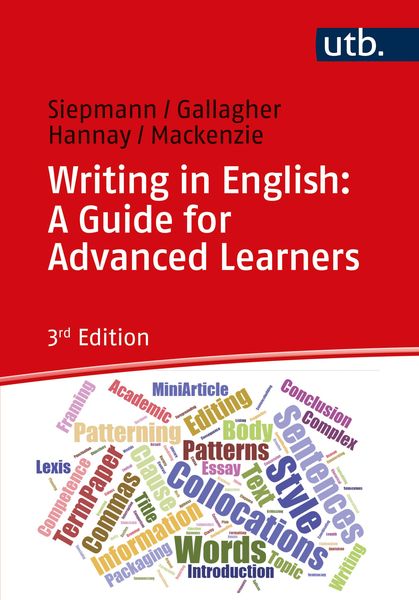
Produktbild: Writing in English: A Guide for Advanced Learners

Writing in English: A Guide for Advanced Learners

32,90 €

inkl. gesetzl. MwSt., Versandkostenfrei


Beschreibung

Produktdetails

Einband

Taschenbuch

Erscheinungsdatum

07.03.2022

Verlag

Utb GmbH

Seitenzahl

526

Maße (L/B/H)

21,4/14,9/3,6 cm

Gewicht

779 g

Farbe

Rot / Wollweiß

Auflage

3

Sprache

Englisch

ISBN

978-3-8252-5658-6

Beschreibung

Rezension

Aus: Exposé – Zeitschrift für wissenschaftliches Schreiben und Publizieren – Simone Christina Jerke – Exposé 1-2023

[…] Ganz im Gegenteil legen die Autoren Wert darauf, den Lesenden das notwendige grammatikalische Rüstzeug mitzugeben, um durch Fleiß und Training ein belastbares und profundes Verständnis von Textaufbau und -wirkung zu entwickeln. Wer sich die Zeit nimmt, den laden die Autoren dazu ein, sich im Fachbuch zu vergraben, zu schmökern und abzutauchen in die spannende Welt englischsprachlicher Schreibfertigkeit […]


[…] Writing in English: A Guide for Advanced Learners“ ist ein hochinteressanter und sehr aufschlussreicher Leitfaden zur Verbesserung der eigenen Fähigkeiten im Schreiben von englischen Texten. Zielpublikum ist an erster Stelle ganz klar der akademische Zweig. So eignet sich das Buch sehr gut zur Verwendung in Schreibseminaren, aber auch als umfangreicheres Referenzwerk im Bücherregal von Studenten. Auch für Englischlehrer in der Oberstufe des Gymnasiums sowie für Menschen in der freien Wirtschaft, die viel mit englischen Texten zu tun haben, bietet „Writing in English“ einige interessante Aspekte. Der Preis von 22,90 Euro ist im Vergleich mit anderen wissenschaftlichen Veröffentlichungen eher moderat und somit durchaus vertretbar. [..]

» Zum Volltext der Rezension

Produktdetails

Einband

Taschenbuch

Erscheinungsdatum

07.03.2022

Verlag

Utb GmbH

Seitenzahl

526

Maße (L/B/H)

21,4/14,9/3,6 cm

Gewicht

779 g

Farbe

Rot / Wollweiß

Auflage

3

Sprache

Englisch

ISBN

978-3-8252-5658-6

Herstelleradresse

Francke A. Verlag
Dischingerweg 5
72070 Tübingen
DE

Email: info@narr.de

Ein neues Kapitel für Ihre Bücher

Ein neues Kapitel für Ihre Bücher

Schenken Sie Ihren alten Schätzen ein zweites Leben: Einfach Barcode scannen, Versandetikett ausdrucken, Bücher verschicken und Thalia Geschenkkarte erhalten.

Jetzt verkaufen
Jetzt verkaufen

Noch keine Bewertungen vorhanden

Verfassen Sie die erste Bewertung zu diesem Artikel

Helfen Sie anderen Kundinnen und Kunden durch Ihre Meinung.

Kundinnen und Kunden meinen

Bewertungen (0)

  • Produktbild: Writing in English: A Guide for Advanced Learners
  • PrefacesIntroductionModule I Organizing ideas into textIntroductionChapter 1 The term paper: gearing up to start writing1.1 The term paper as an argued text1.2 The three processes of planning, writing proper and editing1.3 Making the plan1.4 Using a computer1.5 ConclusionChapter 2 Different types of term paper: Two models2.1 Term paper as essay or as mini-article2.2 Quotation and paraphrase2.3 The literary essay2.4 The linguistic mini-article2.5 ConclusionChapter 3 Title, Introduction, Body and Conclusion3.1 The Title3.2 The Introduction3.3 The Body sections3.4 Paragraphs within the Body sections3.5 The ConclusionChapter 4 Getting the paper ready for submission: Editing and formatting 4.1 Editing4.2 Formal requirementsBibliographyModule II Building effective sentencesIntroduction Chapter 1 Basic issues in sentence construction1.1 Sentence construction1.2 Information packaging1.3 Sentencing1.4 OverviewChapter 2 Information packaging2.1 Basic grammatical moulds2.2 The order of information in the clause2.3 Organizing the starting point2.4 Establishing a special kind of starting point: framing2.5 Organizing the end point2.6 What goes wrong in clause construction2.7 Overview Chapter 3 Complex sentences3.1 Different kinds of sentence3.2 Clause combining: the basic forms3.3 Foregrounding and backgrounding3.4 Complex framing3.5 Interruption techniques3.6 Elaborational techniques3.7 Coordinating and listing3.8 Problems with sentence length3.9 ReviewChapter 4 Punctuation4.1 Commas 1: the principle of semantic unity4.2 Commas 2: optional use4.3 Colons4.4 Semicolons4.5 Dashes and brackets4.6 Commas revisited: dealing with comma splices4.7 OverviewBibliographyReferencesModule III Lexis and GrammarIntroductionChapter 1 A constructional view of languageChapter 2 Academic lexis and patterning2.1 Nouns and noun patterns2.2 Adjective patterns2.3 Prepositions and prepositional phrases2.4 Verbs and verb patterns2.5 The interface between verb patterning and sentence-building Chapter 3 From word to collocation3.1 Words, words, words3.2 How words go together3.3 Collocation of semantic-pragmatic features3.4 Collocational gaps and incompatibilities3.5 Making creative use of collocation 3.6 The interplay of collocation and patterningChapter 4 Rhetorical moves and their lexical realizations4.1 Stating your topics and objectives4.2 Reporting, summarizing and paraphrasing4.3 Expressing opinions and criticizing4.4 Enumerating ideas and changing the topic4.5 Topicalizing specific items4.6 Exemplification4.7 Comparison and contrast4.8 Concession4.9 Cause, reason and explanation4.10 Consequence and result4.11 Static relationsBibliographyModule IV StyleIntroductionChapter I Style and stylistic competence1.1 What is style?1.2 How to achieve stylistic competence1.3 Academic style1.4 From non-specialist to specialist text1.5 Personal styleChapter 2 The principles of style2.1 Aptness2.2 Clarity2.3 Concision2.4 Variety2.5 EleganceBibliographyAfterwordGlossaryIndex