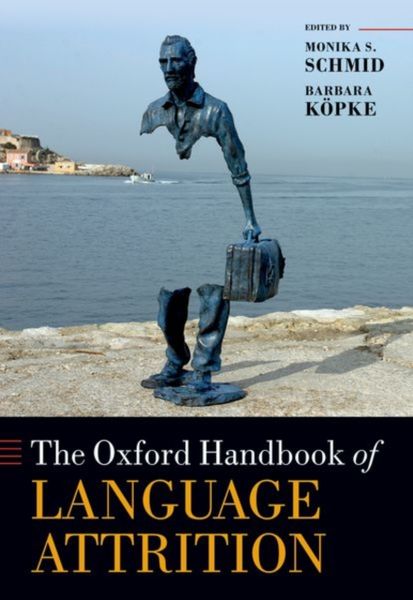
Produktbild: The Oxford Handbook of Language Attrition

The Oxford Handbook of Language Attrition

63,99 €

inkl. gesetzl. MwSt., Versandkostenfrei


Produktdetails

Einband

Taschenbuch

Erscheinungsdatum

02.06.2022

Herausgeber

Monika S Schmid + weitere

Verlag

Oxford University Press

Seitenzahl

656

Maße (L/B/H)

24,4/17,2/3,2 cm

Gewicht

1248 g

Sprache

Englisch

ISBN

978-0-19-286323-2

Produktdetails

Einband

Taschenbuch

Erscheinungsdatum

02.06.2022

Herausgeber

Verlag

Oxford University Press

Seitenzahl

656

Maße (L/B/H)

24,4/17,2/3,2 cm

Gewicht

1248 g

Sprache

Englisch

ISBN

978-0-19-286323-2

Herstelleradresse

Libri GmbH
Europaallee 1
36244 Bad Hersfeld
DE

Email: GPSR Kontakt

Ein neues Kapitel für Ihre Bücher

Ein neues Kapitel für Ihre Bücher

Schenken Sie Ihren alten Schätzen ein zweites Leben und erhalten dafür eine Thalia Geschenkkarte.

Jetzt verkaufen
Jetzt verkaufen

Noch keine Bewertungen vorhanden

Verfassen Sie die erste Bewertung zu diesem Artikel

Helfen Sie anderen Kundinnen und Kunden durch Ihre Meinung.

Kundinnen und Kunden meinen

Bewertungen (0)

Die Leseprobe wird geladen.
  • Produktbild: The Oxford Handbook of Language Attrition

    • 1: Introduction by Monika S. Schmid and Barbara Köpke


    • Part I: Theoretical Implications of Language Attrition


    • 2: Language attrition and the Competition Model by Brian MacWhinney


    • 3: Language Attrition and the Feature Reassembly Hypothesis by Michael T. Putnam, Silvia Perez-Cortes, and Liliana Sanchez


    • 4: The Interface Hypothesis as a Framework for Studying L1 Attrition by Gloria Chamorro and Antonella Sorace


    • 5: Implications of the Bottleneck Hypothesis for Language Attrition by Roumyana Slabakova


    • 6: A Complex Dynamic Systems Perspective on Personal Background Variables in L1 Attrition by Conny Opitz


    • Part II: Psycholinguistic and Neurolinguistic Approaches to Language Attrition


    • 7: Introduction to Psycholinguistic and Neurolinguistic approaches to language attrition by Barbara Köpke and Merel Keijzer


    • 8: Language attrition as a special case of processing change: A wider cognitive perspective by Michael Sharwood Smith


    • 9: Memory retrieval and language attrition: Language loss or manifestations of a dynamic system? by Jared A. Linck and Judith F. Kroll


    • 10: How bilingualism affects syntactic processing in the native language: Evidence from eye movements by Paola E. Dussias, Jorge ValdÃ(c)s Kroff, Michael Johns, and Álvaro Villegas


    • 11: First language attrition and Developmental Language Disorder by Elma Blom, Tessel Boersma, and Jan de Jong


    • 12: Aging as a confound in language attrition research: Lexical retrieval, language use, and cognitive and neural changes by Eve Higby, Aviva Lerman, Marta Korytkowska, Taryn Malcolm, and Loraine K. Obler


    • 13: Linguistic regression in bilingual patients with Alzheimer's disease by Melissa Barkat-Defradas, FrÃ(c)dÃ(c)rique Gayraud, Barbara Köpke, and Laurent Lefebvre


    • 14: Electrophysiological approaches to L1 attrition by Karsten Steinhauer and Kristina Kasparian


    • 15: Neuroimaging perspectives on L1 attrition and language change by Eleonora Rossi, Yanina Prystauka, and Michele T. Diaz


    • Part III: Linguistic Factors in Language Attrition


    • 16: Introduction to linguistic factors in language attrition by Monika S. Schmid and Esther de Leeuw


    • 17: Phonetic drift by Charles B. Chang


    • 18: Phonetic attrition by Esther de Leeuw


    • 19: Phonological attrition by Chiara Celata


    • 20: Morphological attrition by Elena Schmitt


    • 21: Lexical attrition by Scott Jarvis


    • 22: Null and overt pronouns in attrition by Ayse Gÿrel


    • Part IV: Extralinguistic Factors in Language Attrition


    • 23: Introduction to extralinguistic factors in language attrition by Monika S. Schmid and Mirela Cherciov


    • 24: Age effects in language attrition by Emanuel Bylund


    • 25: The impact of frequency of use and length of residence on L1 attrition by Monika S. Schmid


    • 26: L1 attrition, L2 development, and integration by Gÿlsen Yilmaz


    • 27: Language contact and language attrition by Claudia Maria Riehl


    • Part V: Second Language Attrition


    • 28: Introduction to L2 attrition by Teodora H. Mehotcheva and Barbara Köpke


    • 29: Exploring the impact of extra-linguistic factors on L2/FL attrition by Teodora H. Mehotcheva and Kleopatra Mytara


    • 30: Syntax and phonology in L2 attrition: Modularity and resilience by Kathleen Bardovi-Harlig and David Stringer


    • 31: L2 lexical attrition by Jenifer Larson-Hall


    • 32: Attrition studies on Japanese returnees by Hideyuki Taura


    • 33: Event-related potentials as metrics of foreign-language learning and loss by Lee Osterhout, Ilona Pitkÿnen, and Judith McLaughlin


    • Part VI: Heritage Languages


    • 34: Introduction to heritage language development by Silvina Montrul and Maria Polinsky


    • 35: Quantifying language experience in heritage language development by Sharon Unsworth


    • 36: Intra-generational attrition: Contributions to heritage speaker competence by Fatih Bayram, Diego Pascual y Cabo, and Jason Rothman


    • 37: 2L1 simultaneous bilinguals as heritage speakers by Tanja Kupisch


    • 38: Language loss and language learning in internationally-adopted children: Evidence from behaviour and the brain by Lara J. Pierce, Fred Genesee, and Denise Klein


    • 39: Childhood language memory in adult heritage language (re)learners by Janet S. Oh, Terry Kit-fong Au, Sun-Ah Jun, and Richard M. Lee


    • 40: Language development in bilingual returnees by Cristina Flores


    • Concluding remarks by Kees de Bot


    • Annotated bibliography by Monika S. Schmidt


    • References


    • Index