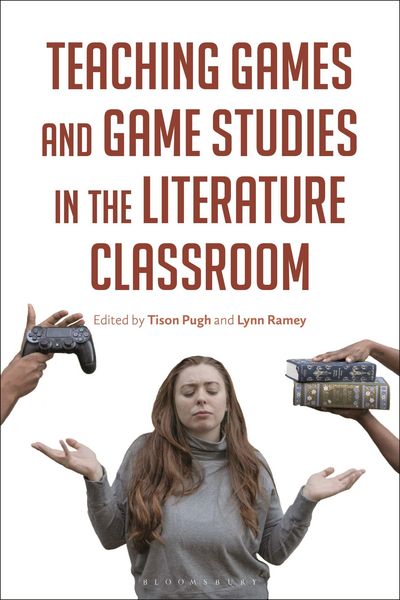
Produktbild: Teaching Games and Game Studies in the Literature Classroom

Teaching Games and Game Studies in the Literature Classroom

148,99 €

inkl. gesetzl. MwSt., Versandkostenfrei


Beschreibung

Produktdetails

Einband

Gebundene Ausgabe

Erscheinungsdatum

20.10.2022

Herausgeber

Tison Pugh + weitere

Verlag

Bloomsbury Academic

Seitenzahl

254

Maße (L/B/H)

24/16,1/1,8 cm

Gewicht

549 g

Sprache

Englisch

ISBN

978-1-350-26971-2

Beschreibung

Produktdetails

Einband

Gebundene Ausgabe

Erscheinungsdatum

20.10.2022

Herausgeber

Verlag

Bloomsbury Academic

Seitenzahl

254

Maße (L/B/H)

24/16,1/1,8 cm

Gewicht

549 g

Sprache

Englisch

ISBN

978-1-350-26971-2

Herstelleradresse

Libri GmbH
Europaallee 1
36244 Bad Hersfeld
DE

Email: gpsr@libri.de

Ein neues Kapitel für Ihre Bücher

Ein neues Kapitel für Ihre Bücher

Schenken Sie Ihren alten Schätzen ein zweites Leben: Einfach Barcode scannen, Versandetikett ausdrucken, Bücher verschicken und Thalia Geschenkkarte erhalten.

Jetzt verkaufen
Jetzt verkaufen

Noch keine Bewertungen vorhanden

Verfassen Sie die erste Bewertung zu diesem Artikel

Helfen Sie anderen Kundinnen und Kunden durch Ihre Meinung.

Kundinnen und Kunden meinen

Bewertungen (0)

Weitere Artikel finden Sie in

  • Produktbild: Teaching Games and Game Studies in the Literature Classroom
  • List of Figures
    Introduction: Ludology and Narratology in the Literature Classroom, Tison Pugh (University of Central Florida, USA) and Lynn Ramey (Vanderbilt University, USA)
    Part I: Theories of the Ludic and Literary Classroom
    1. Developing and Teaching Games-Focused English Courses: A Technological and Curricular Walkthrough, Eric Detweiler (Middle Tennessee State University, USA)
    2. Gaming Literature: Games as an Accessible Entry into the Study of Literature, Regina Mills (Texas A&M University, USA)
    3. Levelling Up: Transferring the Analytical Gaze from Print Literature to Digital Literature and Digital Games in the Literature Classroom, Nolan Bazinet (University of Sherbrooke, Canada)
    4. Reverse-Engineering Stories in the Literature Classroom: Linking Video Games and Traditional Narratives to Foster Critical Reading Skills, John Misak (New York Institute of Technology, USA)
    5. Pwning Tolkien's Trilogy: Game Studies in a Massively Open Online Course (MOOC), Jay Clayton (Vanderbilt University, USA) and Don Rodrigues (University of Memphis, USA)
    6. How/Why We Read/Play: Conceptualizing Reader Goals in the Game of Literature, Mitchell Gunn (University of Toronto, Canada)
    Part II: Videogames and Interactive Media in the Literature Classroom
    7. Ready Player Action: Teaching Close Reading and Critical Play in a Ludic Century, Craig Carey (University of Southern Mississippi, USA)
    8. Teaching Japanese Video Games: Practical Strategies for Analysis and Assessment, Ben Whaley (University of Calgary, Canada)
    9. Intervening in Game Cultures: Video Game Streams and/as Literature, Cody Mejeur (University at Buffalo, USA)
    10. Ethical Simulation Games in the Liberal Arts Classroom: Civilization V, SimEarth, and Sweatshop, Harry Brown and Nicole Lobdell (De Pauw University, USA)
    11. Thinking Outside the Book: Procedural Bibliography as Textual Pedagogy for Literary Video Games, Chloe Anna Milligan (Pennsylvania State University, USA)
    Part III: Gaming Identity and Ideology in the Literature Classroom
    12. Teaching the Iñupiaq Video Game Never Alone and/as Literature, Natalie Neill (York University, Canada)
    13. First Person in Translation: Gaming Perspectives on Indigenous Languages and Literature, Jillian Sayre (Rutgers University, USA)
    14. Playing in the Dark: Teaching Representation, Appropriation, and Identification with Assassin's Creed III, James K. Harris (Bronx Community College, USA)
    15. Constructing Subjectivities and Teaching Otherness through the Silent Hill Series, Katsuya Izumi (University at Albany, USA)
    Part IV: Gamifying the Literature Classroom
    16. Film and Literature Instruction through Live-Action Role-Play, Evan Torner (University of Cincinnati, USA)
    17. How to Develop Gamified Pedagogical Strategies: A Case Study of Classical Japanese Poetry in the Undergraduate Classroom, Catherine Ryu (Michigan State University, USA)
    18. Designing and Implementing a Roleplaying-Game-Based Course in Advanced Classical Literature: Challenges, Benefits, and Iterations, Roger Travis (University of Connecticut, USA)
    19. Games We Play on Paper: Understanding the Process of Discovery through Detective Fiction and Behavioral Neuroscience, Michelle Robinson (University of North Carolina at Chapel Hill, USA) and Marsha Penner (University of North Carolina at Chapel Hill, USA)
    20. Making Feminist Games in the Gender Studies and Literature Classroom, Gabi Kirilloff (Texas Christian University, USA)
    Afterword: Confessions of a Game Scholar in an English Department, Anastasia Salter (University of Central Florida, USA)
    Resources
    Notes on Contributors
    Selected Bibliography
    Index