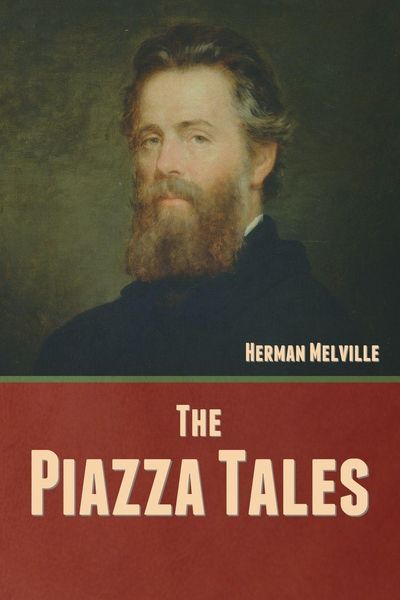
The Piazza Tales
-
- Hardcover
- Taschenbuch ausgewählt
- eBook
- Hörbuch
-
Sprache:Englisch
-
Verlag:Bibliotech Pr
- Alan Rodgers Books LLC 16,99 €
- Tredition 14,90 €
- Bibliotech Pr 15,99 € ausgewählt
- Book Jungle 29,99 €
- Serenity Publishers, LLC 9,99 €
- Alpha Edition 22,99 €
- Creative Media Partners, LLC 19,99 €
- Bottom of the Hill Publishing 15,99 €
- Bloomsbury Academic 10,99 €
- Ingram Publishers Services 11,99 €
- Northwestern University Press 16,99 €
- Double 9 Books 18,99 €
15,99 €
inkl. gesetzl. MwSt.,
Beschreibung
Produktdetails
Einband
Taschenbuch
Erscheinungsdatum
03.03.2022
Verlag
Bibliotech PrSeitenzahl
190
Maße (L/B/H)
22,9/15,2/1,1 cm
Gewicht
317 g
Sprache
Englisch
ISBN
978-1-63637-770-4
The Piazza Tales is a collection of six short stories by American writer Herman Melville, published by Dix & Edwards in the United States in May 1856 and in Britain in June. Except for the newly written title story, "The Piazza," all of the stories had appeared in Putnam's Monthly between 1853 and 1855. The collection includes what have long been regarded as three of Melville's most important achievements in the genre of short fiction, "Bartleby, the Scrivener", "Benito Cereno", and "The Encantadas", his sketches of the Galápagos Islands. (Billy Budd, arguably his greatest piece of short fiction, would remain unpublished in his lifetime.) Melville had originally intended to entitle the volume Benito Cereno and Other Sketches, but settled on the definitive title after he had written the introductory story. The book received largely favorable reviews, with reviewers especially praising "The Encantadas" but did not sell well enough to get Melville out of his financial straits, probably because short fiction for magazines had little appeal to bookbuyers. From after Melville's rediscovery to the end of the twentieth century, the short works that attracted the most critical attention were "Bartleby," "Benito Cereno" and "The Encantadas," with "The Piazza" a little behind those. For Warner Berthoff, Melville's short works of the mid-1850s show a grasp of his subject matter not previously in his possession, not even in Moby-Dick: "a clarity of exposition and a tonic firmness and finality of implication". John Bryant points to the experimental use of narrative voice in the stories: in addition to third-person narration, Melville makes his fictionalized narrators "less and less reliable." The lawyer-narrator in "Bartleby" is "not so reliable", Bryant finds, but the third-person narrator of "Benito Cereno" represents a "less conspicuous form of unreliability" and precisely because this third-person position seems objective, while in reality Delano's distorted point of view is adhered to. In line with other writers of short stories of the time like Poe, Melville's narrative structures stimulate readers to look beyond their initial readings to understand more. This view of "the stories to have a hidden text" has proven to be persuasieve.
Ein neues Kapitel für Ihre Bücher
Ein neues Kapitel für Ihre Bücher
Schenken Sie Ihren alten Schätzen ein zweites Leben und erhalten dafür eine Thalia Geschenkkarte.
Noch keine Bewertungen vorhanden
Verfassen Sie die erste Bewertung zu diesem Artikel
Helfen Sie anderen Kundinnen und Kunden durch Ihre Meinung.
Kurze Frage zu unserer Seite
Vielen Dank für Ihr Feedback
Wir nutzen Ihr Feedback, um unsere Produktseiten zu verbessern. Bitte haben Sie Verständnis, dass wir Ihnen keine Rückmeldung geben können. Falls Sie Kontakt mit uns aufnehmen möchten, können Sie sich aber gerne an unseren Kund*innenservice wenden.
zum Kundenservice