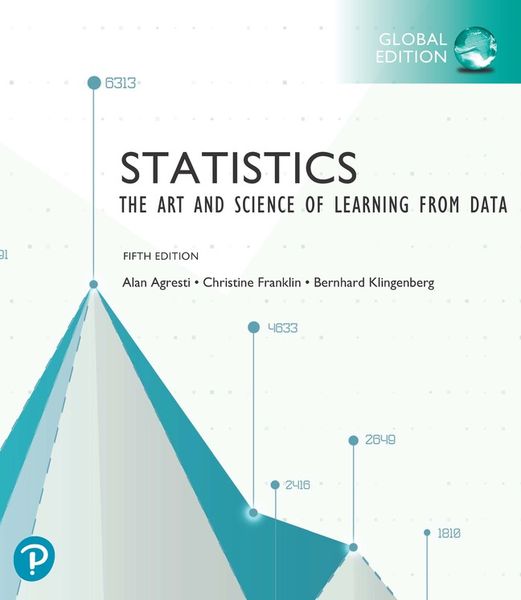
Produktbild: Statistics: The Art and Science of Learning from Data, Global Edition

Statistics: The Art and Science of Learning from Data, Global Edition The Art and Science of Learning from Data, Global Edition

101,99 €

inkl. gesetzl. MwSt., Versandkostenfrei


Beschreibung

Produktdetails

Einband

Taschenbuch

Erscheinungsdatum

15.09.2022

Verlag

Pearson Studium

Seitenzahl

880

Maße (L/B/H)

27,4/21,2/3,1 cm

Gewicht

1856 g

Auflage

5

Sprache

Englisch

ISBN

978-1-292-44476-5

Beschreibung

Produktdetails

Einband

Taschenbuch

Erscheinungsdatum

15.09.2022

Verlag

Pearson Studium

Seitenzahl

880

Maße (L/B/H)

27,4/21,2/3,1 cm

Gewicht

1856 g

Auflage

5

Sprache

Englisch

ISBN

978-1-292-44476-5

Herstelleradresse

Libri GmbH
Europaallee 1
36244 Bad Hersfeld
DE

Email: GPSR Kontakt

Ein neues Kapitel für Ihre Bücher

Ein neues Kapitel für Ihre Bücher

Schenken Sie Ihren alten Schätzen ein zweites Leben: Einfach Barcode scannen, Versandetikett ausdrucken, Bücher verschicken und Thalia Geschenkkarte erhalten.

Jetzt verkaufen
Jetzt verkaufen

Noch keine Bewertungen vorhanden

Verfassen Sie die erste Bewertung zu diesem Artikel

Helfen Sie anderen Kundinnen und Kunden durch Ihre Meinung.

Kundinnen und Kunden meinen

Bewertungen (0)

  • Produktbild: Statistics: The Art and Science of Learning from Data, Global Edition
  • PART I: GATHERING AND EXPLORING DATA
    1. Statistics: The Art and Science of Learning from Data
      • Using Data to Answer Statistical Questions
      • Sample Versus Population
      • Organizing Data, Statistical Software, and the New Field of Data Science
      • Chapter Summary
      • Chapter Exercises
    2. Exploring Data with Graphs and Numerical Summaries
      • Different Types of Data
      • Graphical Summaries of Data
      • Measuring the Center of Quantitative Data
      • Measuring the Variability of Quantitative Data
      • Using Measures of Position to Describe Variability
      • Linear Transformations and Standardizing
      • Recognizing and Avoiding Misuses of Graphical Summaries
      • Chapter Summary
      • Chapter Exercises
    3. Exploring Relationships Between Two Variables
      • The Association Between Two Categorical Variables
      • The Relationship Between Two Quantitative Variables
      • Linear Regression: Predicting the Outcome of a Variable
      • Cautions in Analyzing Associations
      • Chapter Summary
      • Chapter Exercises
    4. Gathering Data
      • Experimental and Observational Studies
      • Good and Poor Ways to Sample
      • Good and Poor Ways to Experiment
      • Other Ways to Conduct Experimental and Nonexperimental Studies
      • Chapter Summary
      • Chapter Exercises
    PART II: PROBABILITY, PROBABILITY DISTRIBUTIONS, AND SAMPLINGDISTRIBUTIONS
    1. Probability in Our Daily Lives
      • How Probability Quantifies Randomness
      • Finding Probabilities
      • Conditional Probability
      • Applying the Probability Rules
      • Chapter Summary
      • Chapter Exercises
    2. Random Variables and Probability Distributions
      • Summarizing Possible Outcomes and Their Probabilities
      • Probabilities for Bell-Shaped Distributions
      • Probabilities When Each Observation Has Two Possible Outcomes
      • Chapter Summary
      • Chapter Exercises
    3. Sampling Distributions
      • How Sample Proportions Vary Around the Population Proportion
      • How Sample Means Vary Around the Population Mean
      • Using the Bootstrap to Find Sampling Distributions
      • Chapter Summary
      • Chapter Exercises
    PART III: INFERENTIAL STATISTICS
    1. Statistical Inference: Confidence Intervals
      • Point and Interval Estimates of Population Parameters
      • Confidence Interval for a Population Proportion
      • Confidence Interval for a Population Mean
      • Bootstrap Confidence Intervals
      • Chapter Summary
      • Chapter Exercises
    2. Statistical Inference: Significance Tests About Hypotheses
      • Steps for Performing a Significance Test
      • Significance Tests About Proportions
      • Significance Tests About a Mean
      • Decisions and Types of Errors in Significance Tests
      • Limitations of Significance Tests
      • The Likelihood of a Type II Error
      • Chapter Summary
      • Chapter Exercises
    3. Comparing Two Groups
      • Categorical Response: Comparing Two Proportions
      • Quantitative Response: Comparing Two Means
      • Comparing Two Groups with Bootstrap or Permutation Resampling
      • Analyzing Dependent Samples
      • Adjusting for the Effects of Other Variables
      • Chapter Summary
      • Chapter Exercises
    PART IV: ANALYZING ASSOCIATION AND EXTENDED STATISTICALMETHODS
    1. Analyzing the Association Between Categorical Variables
      • Independence and Dependence (Association)
      • Testing Categorical Variables for Independence
      • Determining the Strength of the Association
      • Using Residuals to Reveal the Pattern of Association
      • Fisher's Exact and Permutation Tests
      • Chapter Summary
      • Chapter Exercises
    2. Analyzing the Association Between Quantitative Variables: Regression Analysis
      • Modeling How Two Variables Are Related
      • Inference About Model Parameters and the Association
      • Describing the Strength of Association
      • How the Data Vary Around the Regression Line
      • Exponential Regression: A Model for Nonlinearity
      • Chapter Summary
      • Chapter Exercises
    3. Multiple Regression
      • Using Several Variables to Predict a Response
      • Extending the Correlation and R2 for Multiple Regression
      • Using Multiple Regression to Make Inferences
      • Checking a Regression Model Using Residual Plots
      • Regression and Categorical Predictors
      • Modeling a Categorical Response
      • Chapter Summary
      • Chapter Exercises
    4. Comparing Groups: Analysis of Variance Methods
      • One-Way ANOVA: Comparing Several Means
      • Estimating Differences in Groups for a Single Factor
      • Two-Way ANOVA
      • Chapter Summary
      • Chapter Exercises
    5. Nonparametric Statistics
      • Compare Two Groups by Ranking
      • Nonparametric Methods for Several Groups and for Matched Pairs
      • Chapter Summary
      • Chapter Exercises
    • Appendix
    • Answers
    • Index
    • Index of Applications
    • Credits