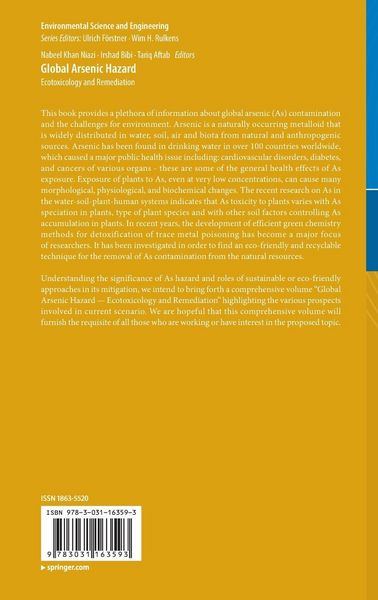
• Produktbild: Global Arsenic Hazard
  • Produktbild: Global Arsenic Hazard
- 12%

Global Arsenic Hazard Ecotoxicology and Remediation

12% sparen

187,99 € UVP 213,99 €

inkl. gesetzl. MwSt., Versandkostenfrei


Beschreibung

Produktdetails

Einband

Gebundene Ausgabe

Erscheinungsdatum

03.12.2022

Herausgeber

Nabeel Khan Niazi + weitere

Verlag

Springer

Seitenzahl

560

Maße (L/B/H)

24,1/16/3,7 cm

Gewicht

1016 g

Auflage

1st ed. 2023

Sprache

Englisch

ISBN

978-3-031-16359-3

Beschreibung

Produktdetails

Einband

Gebundene Ausgabe

Erscheinungsdatum

03.12.2022

Herausgeber

Verlag

Springer

Seitenzahl

560

Maße (L/B/H)

24,1/16/3,7 cm

Gewicht

1016 g

Auflage

1st ed. 2023

Sprache

Englisch

ISBN

978-3-031-16359-3

Herstelleradresse

Springer-Verlag KG
Sachsenplatz 4-6
1201 Wien
AT

Email: GPSR Kontakt

Ein neues Kapitel für Ihre Bücher

Ein neues Kapitel für Ihre Bücher

Schenken Sie Ihren alten Schätzen ein zweites Leben: Einfach Barcode scannen, Versandetikett ausdrucken, Bücher verschicken und Thalia Geschenkkarte erhalten.

Jetzt verkaufen
Jetzt verkaufen

Noch keine Bewertungen vorhanden

Verfassen Sie die erste Bewertung zu diesem Artikel

Helfen Sie anderen Kundinnen und Kunden durch Ihre Meinung.

Kundinnen und Kunden meinen

Bewertungen (0)

  • Produktbild: Global Arsenic Hazard
  • Produktbild: Global Arsenic Hazard
  • Chapter 1 Global arsenic hazard and sustainable development.- Chapter 02 Global arsenic contamination of groundwater, soil, and food crops and health impacts.- Chapter 03 Arsenic contamination in rice and the possible mitigation options.- Chapter 04 Arsenic in gold mining wastes: an environmental and human health threat in Ghana.- Chapter 05 Arsenic Contamination in Karst Regions.- Chapter 06 Arsenic dynamics in paddy rice ecosystems and human exposure.- Chapter 07 Interaction of arsenic with biochar in water and soil: principles, applications, and prospects.- Chapter 08 Accumulation and translocation of arsenic in rice with its distributional flow during cooking: A study in West Bengal, India.- Chapter 09 An overview of arsenic contamination in water resources of Pakistan, risk assessment and remediation strategies.- Chapter 10 Approaches for stochastic modelling of toxic ion adsorption at crystal-water interfaces: A case study of arsenic.- Chapter 11 A comparison of technologies for remediation of arsenic-bearing water: The significance of constructed wetlands.- Chapter 12 Application of nanotechnology in mitigating arsenic stress and accumulation in crops: Where we are and where we are moving towards?.- Chapter 13 Nano-enabled remediation of arsenic-bearing water and wastewater.- Chapter 14 Molecular Aspects of Arsenic Responsive Microbes in Soil-Plant-Aqueous Triphasic Systems.- Chapter 15 Phosphate-induced phytoextraction by Pteris vittata reduced arsenic uptake by rice.- Chapter 16 Modified biosorbents as potential biomaterials for arsenic removal from contaminated water.- Chapter 17 Phytoremedial potential of perennial woody vegetation under arsenic-contaminated conditions in diverse environments.- Chapter 18 Bacterial tolerance and biotransformation of arsenic in soil and aqueous media.- Chapter 19 Arsenic bioremediation of soil and water systems - an overview.- Chapter 20 Modern aspects of phytoremediation of arsenic-contaminated soils.- Chapter 21 Nanoparticulate iron oxide minerals for arsenic removal from contaminated water.- Chapter 22 Arsenic-toxicity and tolerance: phytochelatin-mediated detoxification and genetic engineering-based remediation.- Chapter 23 Distribution of arsenic in rice grain from West Bengal, India: Its relevance to geographical origin, variety, cultivars and cultivation season.