
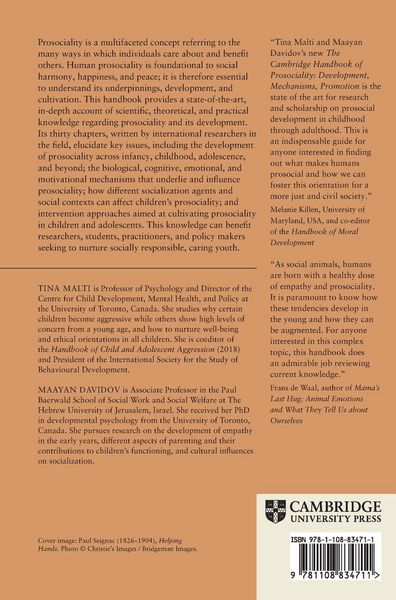
• Produktbild: The Cambridge Handbook of Prosociality
  • Produktbild: The Cambridge Handbook of Prosociality

The Cambridge Handbook of Prosociality Development, Mechanisms, Promotion

185,99 €

inkl. gesetzl. MwSt., Versandkostenfrei


Beschreibung

Produktdetails

Einband

Gebundene Ausgabe

Erscheinungsdatum

08.06.2023

Herausgeber

Tina Malti + weitere

Verlag

Cambridge Academic

Seitenzahl

678

Maße (L/B/H)

24,4/17/3,7 cm

Gewicht

1270 g

Sprache

Englisch

ISBN

978-1-108-83471-1

Beschreibung

Produktdetails

Einband

Gebundene Ausgabe

Erscheinungsdatum

08.06.2023

Herausgeber

Verlag

Cambridge Academic

Seitenzahl

678

Maße (L/B/H)

24,4/17/3,7 cm

Gewicht

1270 g

Sprache

Englisch

ISBN

978-1-108-83471-1

Herstelleradresse

Libri GmbH
Europaallee 1
36244 Bad Hersfeld
DE

Email: gpsr@libri.de

Ein neues Kapitel für Ihre Bücher

Ein neues Kapitel für Ihre Bücher

Schenken Sie Ihren alten Schätzen ein zweites Leben und erhalten dafür eine Thalia Geschenkkarte.

Jetzt verkaufen
Jetzt verkaufen

Noch keine Bewertungen vorhanden

Verfassen Sie die erste Bewertung zu diesem Artikel

Helfen Sie anderen Kundinnen und Kunden durch Ihre Meinung.

Kundinnen und Kunden meinen

Bewertungen (0)

  • Produktbild: The Cambridge Handbook of Prosociality
  • Produktbild: The Cambridge Handbook of Prosociality
  • Part I. Development of Prosociality: 1. Introduction: what is prosocial development? Definition, history, mechanisms Tina Malti and Maayan Davidov; 2. Developmental theories of prosociality Nancy Eisenberg and Tracy L. Spinrad; 3. The role of genetics in the development of prosocial behavior Ariel Knafo-Noam and Dana Katsoty; 4. Neurobiology of prosociality: investigating the link between empathy and prosocial behavior in the brain Claus Lamm and Paul A. G. Forbes; 5. The developmental psychophysiology of prosociality Paul D. Hastings, Ryan T. Hodge and Lindsey C. Partington; 6. Early prosociality from a developmental and comparative perspective Felix Warneken and Sarah Probst; 7. Prosocial behavior in infancy and early childhood Dale F. Hay; 8. Prosociality in middle childhood Richard A. Fabes and Stacy L. Morris; 9. Prosocial behaviors in adolescence Gustavo Carlo, Fiorella L. Carlos Chavez and Clara López-Mora; 10. Prosocial development across the lifespan Antonio Zuffiano, Emanuele Basili, Stefania Sette, Maria Gerbino, Concetta Pastorelli and Bernadette Paula Luengo Kanacri; Part II. Antecedents and Mechanisms of Prosociality: 11. The motives of prosocial behavior Joscha Kärtner; 12. Morality, values, and prosociality across development: intertwined yet distinct Audun Dahl and Marie Grace S. Martinez; 13. Emotions and prosociality Ross A. Thompson; 14. Social-cognitive development and early prosocial behavior Markus Paulus; 15. Temperament and prosocial behavior Deborah J. Laible, Afra E. Agalar, Clare Van Norden and Alysia Cruz; 16. Gender and prosocial development Jolien Van der Graaff; 17. Assessing prosociality: an early ontogeny perspective Robert Hepach; Part III. Development of Prosociality in Context: 18. Parenting and children's prosociality: multiple pathways to socialization Maayan Davidov and Joan E. Grusec; 19. Sibling influences upon prosociality: from infancy to adolescence Claire Hughes and Alison Pike; 20. Prosocial behavior, peer relationships, and friendships Kristina L. McDonald, Melanie A. Dirks, Kristen A. Dunfield and Estephen A. Hakim; 21. Explaining in-group bias and out-group bias in children's prosocial behavior: the role of group stereotypes Jellie Sierksma; 22. Prosocial behavior in school contexts Stuart I. Hammond, Robert P. Hill and Victoria L. L. Edwards; 23. Community and neighborhood influences on prosociality in children and youth Benjamin Edwards and Jacqueline Allen; 24. Culture and prosociality Tara Callaghan and John Corbit; 25. Prosocial media Laura M. Padilla-Walker, Hailey G. Holmgren, and Ryan D. McLean; Part IV. Applications: Nurturing Prosociality: 26. Fostering prosociality in the family context: a review of parent-and family-focused interventions promoting children's effortful control Qing Zhou, Aya Williams and Kaley Curtis; 27. Prosociality and civic engagement Laura Wray-Lake; 28. Prosocial behavior, positive youth development and character virtues: a dynamic, relational developmental systems-based model Richard M. Lerner, Jacqueline V. Lerner and Mary H. Buckingham; 29. Relational practices of care to nurture prosociality and advance policy Tina Malti and Ruth Speidel; 30. Toward a new era of prosociality research: priorities, challenges, and possibilities Maayan Davidov and Tina Malti.