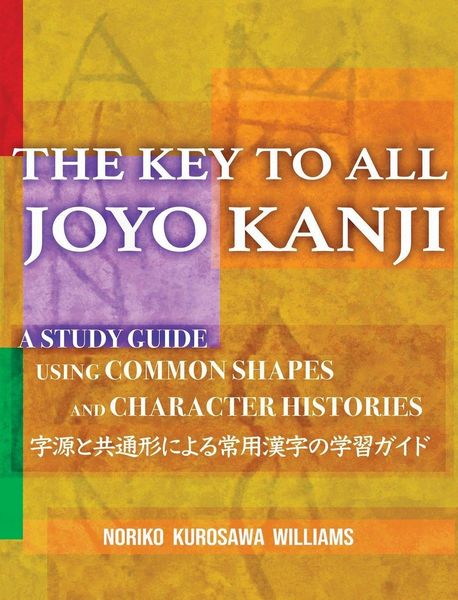
THE KEY TO ALL JOYO KANJI A Study Guide Using Common Shapes and Character Histories ¿¿¿¿¿¿¿¿¿¿¿¿¿¿¿¿¿¿¿
-
- Englisch ausgewählt
45,99 €
inkl. gesetzl. MwSt.,
Beschreibung
Produktdetails
ISBN
978-1-08-808047-4
Erscheinungsdatum
13.12.2022
Einband
Gebundene Ausgabe
Verlag
Noriko Kurosawa WilliamsSeitenzahl
472
Maße (L/B/H)
25,7/20,6/3,3 cm
Gewicht
1243 g
Sprache
Englisch
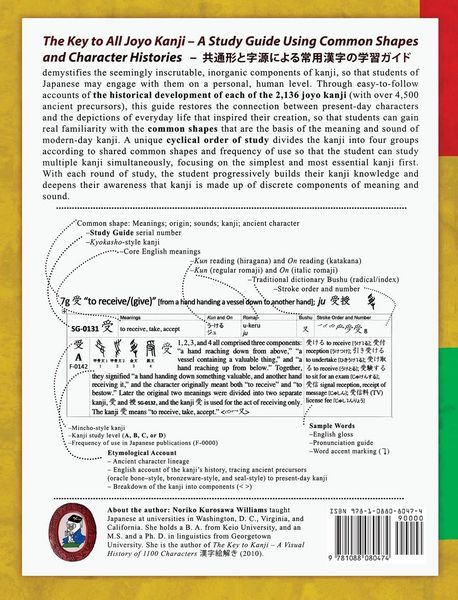
THE KEY TO ALL JOYO KANJI - A Study Guide Using Common Shapes and Character Histories (¿¿¿¿¿¿¿¿¿¿¿¿¿¿¿¿¿¿¿) This book is a study guide/reference intended to make learning and remembering kanji more efficient by grouping kanji that share the same components among the 2,136 Japanese Joyo kanji (commonly-used kanji ¿¿¿¿). Wherever the same component appears, its core meaning and/or sound is the same or closely related to every other kanji that has the same component because they were derived from the same origins. This book explains those origins, going back to ancient times, and shows how they developed into present-day Japanese kanji. Within each common shape group, kanji are labeled with a level of difficulty - A (easiest) to D (most challenging). The reader can start (or start to review) with the easiest level and move to more complex kanji, while also reinforcing knowledge of previously learned kanji within the same common shape group. A detailed table of Kanji Common Shapes provides an overview of the 432 common components, noting their origins, meaning, related kanji, and suggested study level. (Some typos corrected. May 2025) Each group of kanji component shapes includes the following: COMMON SHAPE (432 SHAPES)Meaning, historical development, sound, and kanji containing the same shape KANJI TABLE (2,136 KANJI)English core meaning, Kun and On reading, traditional bushu ("radical," ¿¿), full stroke order illustration, and total stroke number Four suggested levels of kanji study, roughly corresponding to the five levels of the JLPT (Japanese Language Proficiency Test) - Level A (566 kanji) - Beginning level [JLPT N5 and N4]; Level B (525 kanji) - Intermediate through Pre-advanced [JLPT N3 and N2]; Level C (520 kanji) - Advanced I level [JLPT N1]; and Level D (525 kanji) - Advanced II level [JLPT N1]. 4,500 ancient characters (in oracle bone-style ¿¿¿, bronzeware-style ¿¿, and seal-style ¿¿) allow the reader to visualize and grasp the development of the kanji. Succinct English accounts, linking its origin to present-day Japanese kanji. Several sample words and an accentual tonal fall marking in standard Japanese. For a reader to use the book as a reference, four indices are provided: Index 1 The Order of Kanji in the Book (by the Study Guide number) ¿¿¿¿¿¿¿¿; Index 2 Kanji by On and Kun Reading in Japanese Syllabary Order ¿¿¿¿¿¿¿¿¿¿¿¿¿¿; Index 3 Kanji by Total Stroke Number ¿¿¿¿¿¿¿¿¿; and Index 4 Kanji by Bushu ¿¿¿¿¿¿¿¿
Ein neues Kapitel für Ihre Bücher
Ein neues Kapitel für Ihre Bücher
Schenken Sie Ihren alten Schätzen ein zweites Leben: Einfach Barcode scannen, Versandetikett ausdrucken, Bücher verschicken und Thalia Geschenkkarte erhalten.
Jetzt verkaufenNoch keine Bewertungen vorhanden
Verfassen Sie die erste Bewertung zu diesem Artikel
Helfen Sie anderen Kundinnen und Kunden durch Ihre Meinung.
Kurze Frage zu unserer Seite
Vielen Dank für Ihr Feedback
Wir nutzen Ihr Feedback, um unsere Produktseiten zu verbessern. Bitte haben Sie Verständnis, dass wir Ihnen keine Rückmeldung geben können. Falls Sie Kontakt mit uns aufnehmen möchten, können Sie sich aber gerne an unseren Kund*innenservice wenden.
zum Kundenservice