
Mathematics of Public Health Proceedings of the Seminar on the Mathematical Modelling of COVID-19
-
- Hardcover
- Taschenbuch ausgewählt
- eBook
-
Sprache:Englisch
117,99 €
inkl. gesetzl. MwSt.,
Beschreibung
Produktdetails
Einband
Taschenbuch
Erscheinungsdatum
09.02.2023
Herausgeber
V. Kumar Murty + weitereVerlag
SpringerSeitenzahl
353
Maße (L/B/H)
23,5/15,5/2 cm
Gewicht
552 g
Auflage
1st ed. 2022
Sprache
Englisch
ISBN
978-3-030-85055-5
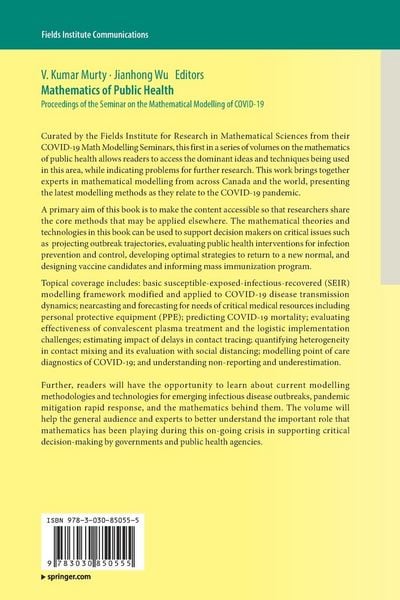
Curated by the Fields Institute for Research in Mathematical Sciences from their COVID-19 Math Modelling Seminars, this first in a series of volumes on the mathematics of public health allows readers to access the dominant ideas and techniques being used in this area, while indicating problems for further research. This work brings together experts in mathematical modelling from across Canada and the world, presenting the latest modelling methods as they relate to the COVID-19 pandemic.
A primary aim of this book is to make the content accessible so that researchers share the core methods that may be applied elsewhere. The mathematical theories and technologies in this book can be used to support decision makers on critical issues such as projecting outbreak trajectories, evaluating public health interventions for infection prevention and control, developing optimal strategies to return to a new normal, and designing vaccine candidates and informing mass immunization program.
Topical coverage includes: basic susceptible-exposed-infectious-recovered (SEIR) modelling framework modified and applied to COVID-19 disease transmission dynamics; nearcasting and forecasting for needs of critical medical resources including personal protective equipment (PPE); predicting COVID-19 mortality; evaluating effectiveness of convalescent plasma treatment and the logistic implementation challenges; estimating impact of delays in contact tracing; quantifying heterogeneity in contact mixing and its evaluation with social distancing; modelling point of care diagnostics of COVID-19; and understanding non-reporting and underestimation.
Ein neues Kapitel für Ihre Bücher
Ein neues Kapitel für Ihre Bücher
Schenken Sie Ihren alten Schätzen ein zweites Leben: Einfach Barcode scannen, Versandetikett ausdrucken, Bücher verschicken und Thalia Geschenkkarte erhalten.
Jetzt verkaufenNoch keine Bewertungen vorhanden
Verfassen Sie die erste Bewertung zu diesem Artikel
Helfen Sie anderen Kundinnen und Kunden durch Ihre Meinung.
Kurze Frage zu unserer Seite
Vielen Dank für Ihr Feedback
Wir nutzen Ihr Feedback, um unsere Produktseiten zu verbessern. Bitte haben Sie Verständnis, dass wir Ihnen keine Rückmeldung geben können. Falls Sie Kontakt mit uns aufnehmen möchten, können Sie sich aber gerne an unseren Kund*innenservice wenden.
zum Kundenservice