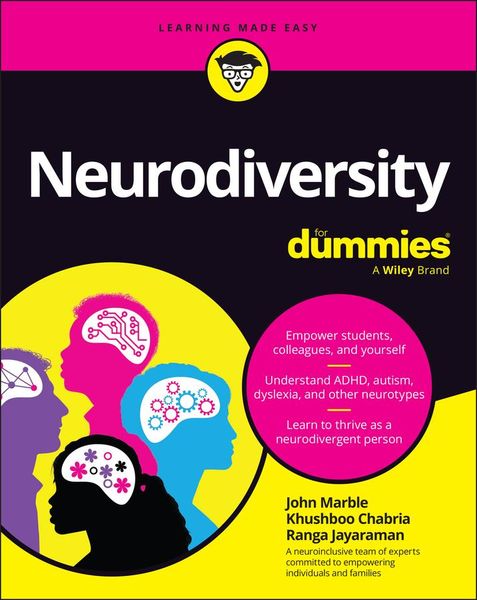
Neurodiversity For Dummies
-
- Taschenbuch ausgewählt
- eBook
-
Sprache:Englisch
25,99 €
inkl. gesetzl. MwSt.,
Beschreibung
Produktdetails
Einband
Taschenbuch
Erscheinungsdatum
19.03.2024
Verlag
John Wiley & Sons IncSeitenzahl
384
Maße (L/B/H)
23,4/18,5/2,4 cm
Gewicht
720 g
Auflage
1. Auflage
Sprache
Englisch
ISBN
978-1-394-21617-8
Neurodiversity For Dummies is your essential guide in understanding neurodivergent conditions like autism, ADHD, dyslexia, and more. This quick and easy guide is perfect for anyone needing to know more about neurodiversity. And that's all of us--because recent estimates say that 15-20% of the world's population have some form of neurodivergence. Your life is filled with neurodivergent people that you know and love, whether you realize it yet or not.
It's time to learn to support and include the neurodivergent among us, and to understand how neurodiversity impacts society and the workplace. This is for the neurodivergent person wanting to thrive in life, for parents and caregivers seeking success for their child, and for teachers who are working to make a difference in their students' lives. Filled with practical advice, Neurodiversity for Dummies also provides a helping hand to service providers, assistance for workplace managers and colleagues, and understanding for family members and friends.
Imagine a world where we all understood ourselves better and appreciated more deeply the differences in others. No matter how your own brain thinks, Neurodiversity for Dummies is for you. Check out this jargon-free introduction for an essential overview.
* Explore the Spectrum of Neurodiversity: Understand in plain language the world of autism, ADHD, dyslexia, and other neurodivergent conditions.
* Unlock Hidden Talents: Move yourself beyond common myths and misconceptions to discover how neurodiversity actually works. Learn how neurodiversity has always been with us, why society needs neurodivergent traits, and how neurodiversity can be a wellspring of innovation, creativity, and out-of-the-box thinking.
* Discover Yourself: Whether you are a neurodivergent person or not, learn how to understand your own normalcy, advocate for your needs, and build meaningful connections with those who think and experience the world differently than you.
* Change the World Around You: Be empowered through simple steps you can take to create inclusive environments for neurodivergent individuals in your school or workplace. Uncover proven strategies that cultivate a culture of acceptance and respect, where the unique perspectives of all individuals are valued and celebrated.
We believe in providing parents with better supports, empowering individuals with information, and shaping a world where we are all seen and understood. With an author team composed of neurodivergent individuals and parents writing together, Neurodiversity for Dummies is an example of the power of neurodiversity when put into action. It's why we wrote this for you.
Don't miss your chance to embark on this transformative journey. Order your copy of Neurodiversity for Dummies now to better understand yourself and others, and to join the movement that is revolutionizing how we understand and support the diversity of the human mind.
Ein neues Kapitel für Ihre Bücher
Ein neues Kapitel für Ihre Bücher
Schenken Sie Ihren alten Schätzen ein zweites Leben und erhalten dafür eine Thalia Geschenkkarte.
Noch keine Bewertungen vorhanden
Verfassen Sie die erste Bewertung zu diesem Artikel
Helfen Sie anderen Kundinnen und Kunden durch Ihre Meinung.
Kurze Frage zu unserer Seite
Vielen Dank für Ihr Feedback
Wir nutzen Ihr Feedback, um unsere Produktseiten zu verbessern. Bitte haben Sie Verständnis, dass wir Ihnen keine Rückmeldung geben können. Falls Sie Kontakt mit uns aufnehmen möchten, können Sie sich aber gerne an unseren Kund*innenservice wenden.
zum Kundenservice