• Produktbild: Photoelectrochemical Engineering for Solar Harvesting
  • Produktbild: Photoelectrochemical Engineering for Solar Harvesting
- 23%

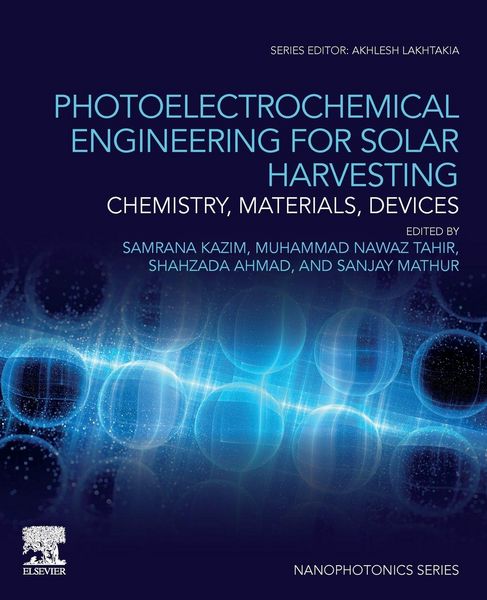
Photoelectrochemical Engineering for Solar Harvesting Chemistry, Materials, Devices

Aus der Reihe Nanophotonics
23% sparen

194,99 € UVP 256,50 €

inkl. gesetzl. MwSt., Versandkostenfrei


Beschreibung

Produktdetails

Einband

Taschenbuch

Erscheinungsdatum

17.06.2024

Herausgeber

Samrana Kazim + weitere

Verlag

Elsevier Science & Technology

Seitenzahl

504

Maße (L/B/H)

23,5/19,1/2,6 cm

Gewicht

859 g

Sprache

Englisch

ISBN

978-0-323-95494-5

Beschreibung

Portrait

Dr. Samrana Kazim is an Ikerbasque fellow and Group leader at Basque Centre for Materials, Applications, and Nanostructures (UPV). Before this, she worked as a tenured senior scientist, at Abengoa Research, a corporate research center of a multinational energy company in Spain. She obtained her doctoral degree (Ph.D.) in Materials chemistry. After finishing her Ph.D., she briefly worked as a post-doc at the Indian Institute of Technology (IIT Kanpur) and then moved to the Institute of Macromolecular Chemistry (IMC), Prague on an IUPAC/UNESCO fellowship and then later was a staff scientist there. She has authored over 80 research articles in reputed journals in the fields of material science, nanotechnology, and energy; also authored and edited book chapters and inventor of numerous patents in energy conversion and storage. Her research interests include synthesis and electro-optical characterization of organic semiconductors, hybrid nanostructured materials for optoelectronics applications, and perovskite solar cells.
Muhammad Nawaz Tahir earned his Ph.D. in 2006 from Johannes Gutenberg University (JGU) of Mainz, Germany with the distinction "Summa Cum Laude” under the supervision of Prof. W. Tremel. Later, as a post-doctoral fellow, he underwent many research projects funded by DFG, MWFZ, and Max Plank Society. In 2010, he joined the Institute of Inorganic and Analytical Chemistry JGU Mainz, as senior scientist and group leader for nanomaterials synthesis, characterization, and applications. Since September 2017, he joined the Chemistry Department, King Fahd University of Petroleum and Minerals, Dhahran, Kingdom of Saudi Arabia, as an Assistant Professor. His research publication list reflects interdisciplinary contributions. His research interests involve the synthesis of innovative nanomaterials, characterization, surface engineering for renewable energy conversion and energy storage applications.
Shahzada Ahmad is an Ikerbasque professor; his scientific interests include materials for energy. From 2012 to 2017, he was program director at Abengoa Research, a corporate research center. His scientific publications list reflects his diverse fields of interest in the domains of physical chemistry and materials science, with a research mission to develop advanced materials for energy application. His work has led to the invitation to speak at many scientific or policy-based conferences. He is an inventor of patents, Chief Editor of "Emergent Materials”, editorial board member of journals, European research council consolidator grant awardee, an elected fellow of the European Academies, distinguished scientist (<40) World Economic Forum. He is a strong advocate for renewable energy and regularly writes popular science articles for the public at large at the World Economic Forum.
Dr. Sanjay Mathur is the director of the Institute of Inorganic Chemistry at the University of Cologne in Germany. He is the Co-Director of the Institute of Renewable Energy Sources at the Xian Jiao Tong University, Xian, China and a World Class University Professor at the Chonbuk University in Korea. He also holds Visiting Professorships at the Central South University, China, Tokyo University of Agriculture and Technology, Japan and National Institute of Science Education and Research (NISER), India. He has been awarded the Honorary Doctorate of the Vilnius University in 2016.

Produktdetails

Einband

Taschenbuch

Erscheinungsdatum

17.06.2024

Herausgeber

Verlag

Elsevier Science & Technology

Seitenzahl

504

Maße (L/B/H)

23,5/19,1/2,6 cm

Gewicht

859 g

Sprache

Englisch

ISBN

978-0-323-95494-5

EU-Ansprechpartner

Zeitfracht Medien GmbH
Ferdinand-Jühlke-Straße 7
99095 Erfurt
DE
produktsicherheit@zeitfracht.de

Herstelleradresse

Elsevier Science & Technology
London Wall 125
EC2Y 5AS London
GB
tradeorders@elsevier.com

Ein neues Kapitel für Ihre Bücher

Ein neues Kapitel für Ihre Bücher

Schenken Sie Ihren alten Schätzen ein zweites Leben und erhalten dafür eine Thalia Geschenkkarte.

Jetzt verkaufen
Jetzt verkaufen

Noch keine Bewertungen vorhanden

Verfassen Sie die erste Bewertung zu diesem Artikel

Helfen Sie anderen Kundinnen und Kunden durch Ihre Meinung.

Kundinnen und Kunden meinen

Bewertungen (0)

Die Leseprobe wird geladen.
  • Produktbild: Photoelectrochemical Engineering for Solar Harvesting
  • Produktbild: Photoelectrochemical Engineering for Solar Harvesting
  • 1. Solar fuel generation based on first-row transition metal catalysts 1
    2. Au nanoparticles decorated textured Si with Fc/Fc+ and I-/I3- redox active gels for photoelectrochemical light harvesting
    3. Dual photoelectrodes in photoelectrochemical water splitting
    4. Metal-organic framework as light harvesting for photoelectrochemical water splitting: from fundamental to recent progress
    5. Applications of metal ferrites as photocatalyst for solar fuel production, water splitting and carbon dioxide reduction
    6. Redefining solar conversion: advancing technologies with metal-organic framework nanocomposites
    7. Photoelectrochemical water splitting based on 2D-transition metal dichalcogenide materials
    8. Perovskite materials: from synthesis to solar energy conversion applications
    9. Photo-valorization of biomass into H2 fuel and value-added chemicals
    10. Main group metal chalcogenides for photoelectrochemical water splitting
    11. Photoelectrochemical characterization of metal oxide semiconductors for solar water splitting using intensity-modulated photocurrent spectroscopy
    12. Graphitic carbon nitride-based materials for photoelectrochemical water splitting
    13. Hematite (¿-Fe2O3) as a solar energy harvesting photoanode for photo-electrochemical (PEC) water splitting
    14. New photoelectrochemical processes for small molecule activation: the case of methane
    15. Quantum dots in photoelectrochemical hydrogen production