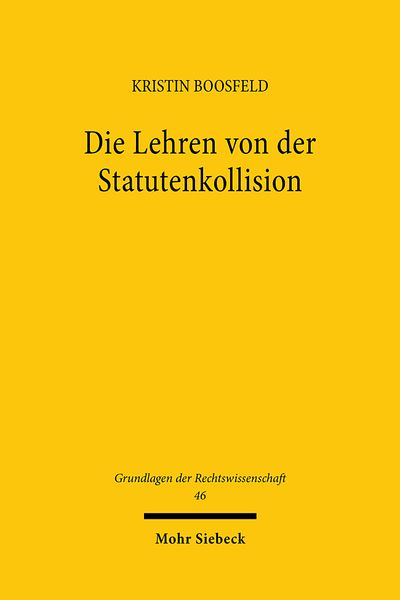
Boosfeld, K: Lehren von der Statutenkollision Eine Deutungsgeschichte aus Raum und Recht
-
- Deutsch ausgewählt
114,00 €
inkl. gesetzl. MwSt.,
Beschreibung
Produktdetails
Einband
Gebundene Ausgabe
Erscheinungsdatum
07.06.2023
Verlag
Mohr SiebeckSeitenzahl
426
Maße (L/B/H)
23,6/16,4/3,2 cm
Gewicht
769 g
Auflage
1. Auflage
Sprache
Deutsch
ISBN
978-3-16-162421-6
The book begins with an analysis of the late medieval theories of Bartolus and Baldus. Both developed universal theories determining the scope of application of statutes and customary laws alike. Depending on the legal question involved, local satutes and customs could extend to subjects outside the territory or to foreigners inside the territory. Bartolus and Baldus paint a picture of scholastic distinctions and overlapping arguments for and against the applicability of statutes and customs against the backdrop of the Roman-Canonist ius commune ( 1).
Bertrand d'Argentré (Argentraeus), who lived in Brittany between 1519 and 1590, left these complicated scholastic distinctions behind. His writings instead focused on the territory and aimed as far as possible at the application of local law within the territory. Therefore, he argued that only rules specifically concerning a person as such (statuta personalia) should be applied outside the territory. Reasons for this strong territoriality can be found in his biography, for d'Argentré was a local patriot whose aim it was to strengthen Breton law against French centralising tendencies. By contrast, the conflicts writings of his contemporary Charles Dumoulin (Molinaeus 1500-1566) are more closely connected with late medieval ideas, since Dumoulin - who came from Paris and was a supporter of the monarchy, was in favour of unifying French law on the basis of the Coutume de Paris ( 2).
During the 17th century, a new theory of statuta developed in the provinces of the United Netherlands. This so-called 'doctrine of comity' still referred to the older theories, but focused on a new argument. The reason lies in the historical situation of the Dutch provinces, which had been successful in their efforts to secure sovereignty in the Peace Treaty of Westphalia in 1648. In light of their recently acquired sovereignty, Dutch jurists were looking for an explanation why foreign law should be applicable within the territory at all. Jurists like Paulus Voet (1619-1667), Ulrik Huber (1636-1694) and Johannes Voet (1647-1713) found this explanation in the idea of comity, the friendly, mutual courtesy of peoples. According to the principle of sovereignty, no state could be under a duty to apply foreign law. However, since the application of foreign law was necessary to avoid impairments to trade (the economic boom in the Netherlands in the 17th century was primarily based on trade by ambitious Dutch businessmen), they argued that 'foreign' law should be applied out of courtesy ( 3).
German jurists of the 17th century rejected d'Argentré's writings and the entire Dutch doctrine of comity. The great number of citations shows that their writings are again closely connected with the writings of late medieval Italian lawyers. This must be understood against the background that German jurists were at the time confronted with a plurality of laws which had structural similarities with the late medi
Ein neues Kapitel für Ihre Bücher
Ein neues Kapitel für Ihre Bücher
Schenken Sie Ihren alten Schätzen ein zweites Leben: Einfach Barcode scannen, Versandetikett ausdrucken, Bücher verschicken und Thalia Geschenkkarte erhalten.
Jetzt verkaufenKundinnen und Kunden meinen
Verfassen Sie die erste Bewertung zu diesem Artikel
Helfen Sie anderen Kund*innen durch Ihre Meinung
Kurze Frage zu unserer Seite
Vielen Dank für Ihr Feedback
Wir nutzen Ihr Feedback, um unsere Produktseiten zu verbessern. Bitte haben Sie Verständnis, dass wir Ihnen keine Rückmeldung geben können. Falls Sie Kontakt mit uns aufnehmen möchten, können Sie sich aber gerne an unseren Kund*innenservice wenden.
zum Kundenservice