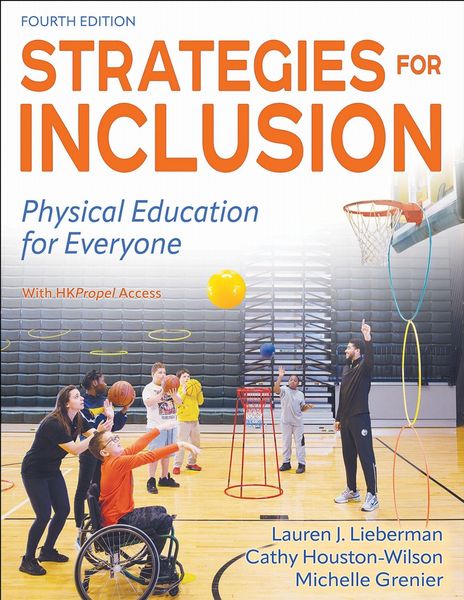
Strategies for Inclusion Physical Education for Everyone
-
- Englisch ausgewählt
94,99 €
inkl. gesetzl. MwSt.,
Beschreibung
Produktdetails
ISBN
978-1-71821-785-0
Erscheinungsdatum
13.03.2024
Einband
Taschenbuch
Verlag
Human Kinetics PublishersSeitenzahl
256
Maße (L/B/H)
27,3/21,3/1,7 cm
Gewicht
734 g
Sprache
Englisch
Since the passage of the Individuals with Disabilities Education Act in 1975, the process of including students with disabilities in general physical education classes has become a reality for school districts. Unfortunately for many students with disabilities, the transition from traditionally segregated classrooms to supportive, inclusive environments has been a continual struggle for all parties involved.
Strategies for Inclusion, Fourth Edition With HKPropel Access, facilitates a smooth transition and continues to raise the bar for successful integration of students with disabilities into general and adapted physical education settings. Its practical and easy-to-implement planning and assessment strategies make this a complete resource for current and future K-12 PE teachers.
The fourth edition provides background information and a clear road map for successful inclusion of students with disabilities in physical education settings. It offers 38 teachable units, complete with assessment tools and step-by-step guidelines for curriculum planning. Each unit contains an assessment rubric and provides ideas on how to incorporate objectives from the student’s individualized education plan (IEP). Adaptations and accommodations are also included in each unit and are divided into the categories of environment, equipment, instruction, and rules. The inclusive curriculum includes the following:
- 10 elementary units for basic skills such as balance and object control
- 11 sport units for team sports such as basketball and golf
- 5 health and fitness units, including swimming and weight training
- 12 recreation and life skills units such as paddleboarding and dancing
Each chapter of the text includes an opening scenario designed to help the reader explore their thoughts and feelings regarding various aspects of inclusion and adapted physical education. Teaching tips and ready-to-use forms, charts, and strategies are included, as well as a brand-new chapter on interdisciplinary and transdisciplinary collaborative practices to promote student engagement. In places where the SHAPE America National Standards for K-12 Physical Education are mentioned, they have been updated to the latest revision of the standards.
In addition, the fourth edition now offers five ready-to-use PowerPoint training modules, delivered in HK
Propel, that instructors or administrators can use for in-service workshops for their students or staff. Teachers will be empowered to advocate for themselves and their students with disabilities to receive the necessary supports that enable all students to lead a healthy and active lifestyle. The training module topics include
- assessments,
- universal design for learning,
- Lieberman-Brian Inclusion Rating Scale for Physical Education (LIRSPE) intervention,
- paraeducator training, and
- peer training.
Strategies for Inclusion offers the most up-to-date and useful strategies to include children with disabilities in physical education classes. With it, physical and adapted physical educators will help empower all students with the knowledge that anything is possible and that their goals can be achieved through understanding, cooperation, and creativity.
Note: A code for accessing HK
Propel is included with all new print books.
Ein neues Kapitel für Ihre Bücher
Ein neues Kapitel für Ihre Bücher
Schenken Sie Ihren alten Schätzen ein zweites Leben: Einfach Barcode scannen, Versandetikett ausdrucken, Bücher verschicken und Thalia Geschenkkarte erhalten.
Jetzt verkaufenKundinnen und Kunden meinen
Verfassen Sie die erste Bewertung zu diesem Artikel
Helfen Sie anderen Kund*innen durch Ihre Meinung
Kurze Frage zu unserer Seite
Vielen Dank für Ihr Feedback
Wir nutzen Ihr Feedback, um unsere Produktseiten zu verbessern. Bitte haben Sie Verständnis, dass wir Ihnen keine Rückmeldung geben können. Falls Sie Kontakt mit uns aufnehmen möchten, können Sie sich aber gerne an unseren Kund*innenservice wenden.
zum Kundenservice