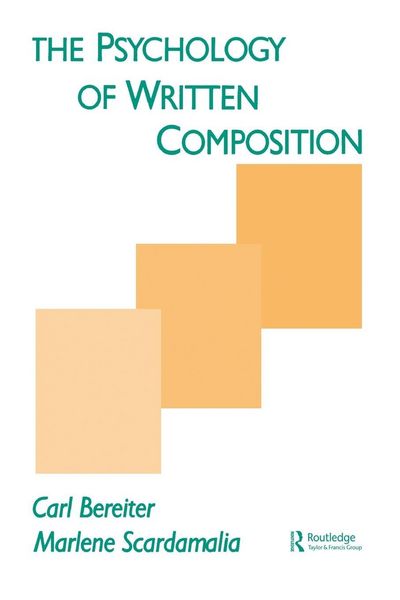
Produktbild: The Psychology of Written Composition

The Psychology of Written Composition

108,99 €

inkl. gesetzl. MwSt., Versandkostenfrei


Beschreibung

Produktdetails

Einband

Taschenbuch

Erscheinungsdatum

01.03.1987

Herausgeber

Bereiter Carl + weitere

Verlag

Taylor & Francis

Seitenzahl

412

Maße (L/B/H)

22,8/15,4/2,4 cm

Gewicht

562 g

Sprache

Englisch

ISBN

978-0-8058-0038-8

Beschreibung

Rezension

"Those who are concerned with promoting general cognitive attainment will find that knowledge-transforming writing is a powerful tool for achieving that end. Scholars with a primary interest either in writing or in cognitive science will find much of interest both in the specific experimental techniques that Bereiter and Scardamalia describe and in the overall conceptual framework of the volume."
Contemporary Psychology

Portrait

Carl Bereiter, Marlene Scardamalia, Ontario Institute for Studies in Education

Produktdetails

Einband

Taschenbuch

Erscheinungsdatum

01.03.1987

Herausgeber

Verlag

Taylor & Francis

Seitenzahl

412

Maße (L/B/H)

22,8/15,4/2,4 cm

Gewicht

562 g

Sprache

Englisch

ISBN

978-0-8058-0038-8

Herstelleradresse

Libri GmbH
Europaallee 1
36244 Bad Hersfeld
DE

Email: gpsr@libri.de

Ein neues Kapitel für Ihre Bücher

Ein neues Kapitel für Ihre Bücher

Schenken Sie Ihren alten Schätzen ein zweites Leben und erhalten dafür eine Thalia Geschenkkarte.

Jetzt verkaufen
Jetzt verkaufen

Noch keine Bewertungen vorhanden

Verfassen Sie die erste Bewertung zu diesem Artikel

Helfen Sie anderen Kundinnen und Kunden durch Ihre Meinung.

Kundinnen und Kunden meinen

Bewertungen (0)

Die Leseprobe wird geladen.
  • Produktbild: The Psychology of Written Composition
  • PART I CENTRAL CONCEPTS 1 Two Models of Composing Processes 2 An Integrative Schema for Studying the Composing Process 3 From Conversation to Composition PART II BASIC COGNITIVE FACTORS IN COMPOSITION 4 The Role of Production Factors in Writing Ability 5 Information Processing Load of Written Composition 6 How Children Cope with the Processing Demands of Coordinating Ideas in Writing PART III PERSPECTIVES ON THE COMPOSING STRATEGIES OF IMMATURE WRITERS 7 Knowledge Telling and the Problem of Inert Knowledge 8 The Development of Planning in Writing 9 Links Between Composing and Comprehending Strategies PART IV PROMOTING THE DEVELOPMENT OF MATURE COMPOSING STRATEGIES 10 Fostering Self-Regulation 11 Fostering Evaluative, Diagnostic, and Remedial Capabilities 12 Fostering Reflective Processes 13 Helping Children Gain Insight into Their Own Cognitive Processes PART V CONCLUSION 14 Knowledge-Telling and Knowledge Transforming Differences: Their Psychological and Educational Implications