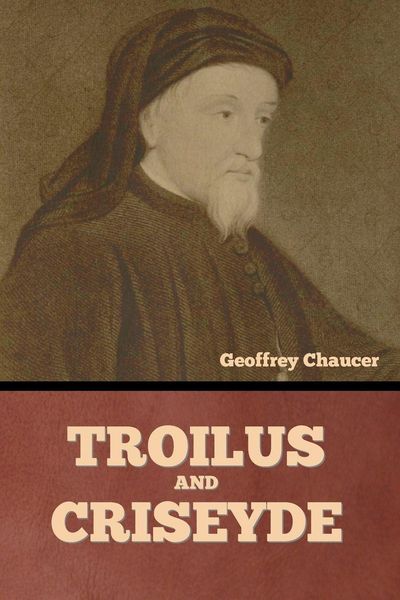
Troilus and Criseyde
-
- Hardcover
- Taschenbuch ausgewählt
- eBook
-
Sprache:Englisch
-
Verlag:Indoeuropeanpublishing.Com
- Tredition 12,90 €
- Oxford University Press 9,99 €
- Book Jungle 39,99 €
- Culturea 22,90 €
- Digireads.com 14,99 €
- Creative Media Partners, LLC 23,99 €
- Smk Books 23,99 €
- Penguin Books UK 23,99 €
- Norton 33,99 €
- Left of Brain Books 31,99 €
- Penguin Classics 27,99 €
- Ingram Publishers Services 14,99 €
- Routledge 186,99 €
- Indoeuropeanpublishing.Com 15,99 € ausgewählt
15,99 €
inkl. gesetzl. MwSt.,
Beschreibung
Produktdetails
Einband
Taschenbuch
Erscheinungsdatum
05.01.2024
Verlag
Indoeuropeanpublishing.ComSeitenzahl
224
Maße (L/B/H)
22,9/15,2/1,4 cm
Gewicht
371 g
Sprache
Englisch
EAN
9798888307410
Troilus and Criseyde is an epic poem by Geoffrey Chaucer which re-tells in Middle English the tragic story of the lovers Troilus and Criseyde set against a backdrop of war during the siege of Troy. It was written in rime royale and probably completed during the mid-1380s. Many Chaucer scholars regard it as the poet's finest work. As a finished long poem it is more self-contained than the better known but ultimately unfinished The Canterbury Tales. This poem is often considered the source of the phrase: "all good things must come to an end" (3.615). Although Troilus is a character from Ancient Greek literature, the expanded story of him as a lover was of Medieval origin. The first known version is from Benoît de Sainte-Maure's poem Roman de Troie, but Chaucer's principal source appears to have been Boccaccio, who re-wrote the tale in his Il Filostrato. Chaucer attributes the story to a "Lollius" (whom he also mentions in The House of Fame), although no writer with this name is known. Chaucer's version can be said to reflect a less cynical and less misogynistic world-view than Boccaccio's, casting Criseyde as fearful and sincere rather than simply fickle and having been led astray by the eloquent and perfidious Pandarus. It also inflects the sorrow of the story with humour. The poem had an important legacy for later writers. Robert Henryson's Scots poem The Testament of Cresseid imagined a rambunctious fate for Criseyde not given by Chaucer. In historical editions of the English Troilus and Criseyde, Henryson's distinct and separate work was sometimes included without accreditation as an "epilogue" to Chaucer's tale. Other texts, for example, John Metham's Amoryus and Cleopes (c. 1449), adapt language and authorship strategies from the famous predecessor poem. Shakespeare's tragedy Troilus and Cressida, although much darker in tone, was also based in part on the material. Troilus and Criseyde is usually considered to be a courtly romance, although the generic classification is an area of significant debate in most Middle English literature. He has been called the "father of English literature", or, alternatively, the "father of English poetry". He was the first writer to be buried in what has since come to be called Poets' Corner, in Westminster Abbey. Chaucer also gained fame as a philosopher and astronomer, composing the scientific A Treatise on the Astrolabe for his 10-year-old son Lewis. He maintained a career in the civil service as a bureaucrat, courtier, diplomat, and member of parliament. Among Chaucer's many other works are The Book of the Duchess, The House of Fame, The Legend of Good Women, and Troilus and Criseyde. He is seen as crucial in legitimising the literary use of Middle English when the dominant literary languages in England were still Anglo-Norman French and Latin. Chaucer's contemporary Thomas Hoccleve hailed him as "the firste fyndere of our fair langage" (i.e., the first one capable of finding poetic matter in English).
Ein neues Kapitel für Ihre Bücher
Ein neues Kapitel für Ihre Bücher
Schenken Sie Ihren alten Schätzen ein zweites Leben und erhalten dafür eine Thalia Geschenkkarte.
Noch keine Bewertungen vorhanden
Verfassen Sie die erste Bewertung zu diesem Artikel
Helfen Sie anderen Kundinnen und Kunden durch Ihre Meinung.
Kurze Frage zu unserer Seite
Vielen Dank für Ihr Feedback
Wir nutzen Ihr Feedback, um unsere Produktseiten zu verbessern. Bitte haben Sie Verständnis, dass wir Ihnen keine Rückmeldung geben können. Falls Sie Kontakt mit uns aufnehmen möchten, können Sie sich aber gerne an unseren Kund*innenservice wenden.
zum Kundenservice