
Getting Started in Mathematical Life Sciences From MATLAB Programming to Computer Simulations
-
- Hardcover
- Taschenbuch ausgewählt
- eBook
-
Sprache:Englisch
53,99 €
inkl. gesetzl. MwSt.,
Beschreibung
Produktdetails
Einband
Taschenbuch
Erscheinungsdatum
28.01.2024
Abbildungen
IX, 204 p. 1 illus.
Verlag
Springer SingaporeSeitenzahl
204
Maße (L/B/H)
23,5/15,5/1,2 cm
Gewicht
335 g
Auflage
24001 Auflage 1st ed. 2022
Sprache
Englisch
ISBN
978-981-19-8259-0
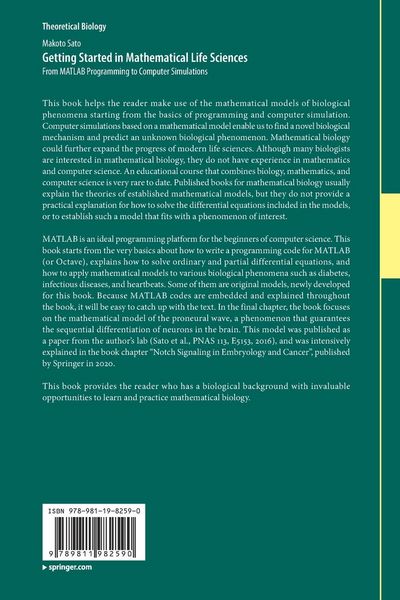
This book helps the reader make use of the mathematical models of biological phenomena starting from the basics of programming and computer simulation. Computer simulations based on a mathematical model enable us to find a novel biological mechanism and predict an unknown biological phenomenon. Mathematical biology could further expand the progress of modern life sciences. Although many biologists are interested in mathematical biology, they do not have experience in mathematics and computer science. An educational course that combines biology, mathematics, and computer science is very rare to date. Published books for mathematical biology usually explain the theories of established mathematical models, but they do not provide a practical explanation for how to solve the differential equations included in the models, or to establish such a model that fits with a phenomenon of interest.
MATLAB is an ideal programming platform for the beginners of computer science. This book starts from the very basics about how to write a programming code for MATLAB (or Octave), explains how to solve ordinary and partial differential equations, and how to apply mathematical models to various biological phenomena such as diabetes, infectious diseases, and heartbeats. Some of them are original models, newly developed for this book. Because MATLAB codes are embedded and explained throughout the book, it will be easy to catch up with the text. In the final chapter, the book focuses on the mathematical model of the proneural wave, a phenomenon that guarantees the sequential differentiation of neurons in the brain. This model was published as a paper from the author’s lab (Sato et al., PNAS 113, E5153, 2016), and was intensively explained in the book chapter “Notch Signaling in Embryology and Cancer”, published by Springer in 2020.
This book provides the reader who has a biological background with invaluable opportunities to learn and practice mathematical biology.
Ein neues Kapitel für Ihre Bücher
Ein neues Kapitel für Ihre Bücher
Schenken Sie Ihren alten Schätzen ein zweites Leben und erhalten dafür eine Thalia Geschenkkarte.
Noch keine Bewertungen vorhanden
Verfassen Sie die erste Bewertung zu diesem Artikel
Helfen Sie anderen Kundinnen und Kunden durch Ihre Meinung.
Kurze Frage zu unserer Seite
Vielen Dank für Ihr Feedback
Wir nutzen Ihr Feedback, um unsere Produktseiten zu verbessern. Bitte haben Sie Verständnis, dass wir Ihnen keine Rückmeldung geben können. Falls Sie Kontakt mit uns aufnehmen möchten, können Sie sich aber gerne an unseren Kund*innenservice wenden.
zum Kundenservice