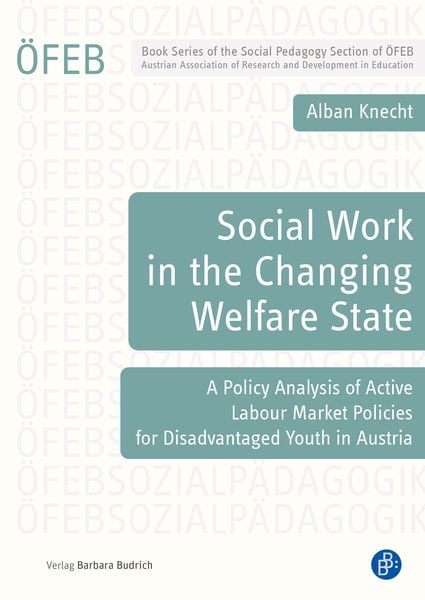
Produktbild: Social Work in the Changing Welfare State
Band 15 - 10%

Social Work in the Changing Welfare State A Policy Analysis of Active Labour Market Policies for Disadvantaged Youth in Austria

10% sparen

39,99 € UVP 44,90 €

inkl. gesetzl. MwSt., Versandkostenfrei


Beschreibung

Produktdetails

Einband

Taschenbuch

Erscheinungsdatum

12.02.2024

Verlag

Verlag Barbara Budrich

Seitenzahl

139

Maße (L/B/H)

21/14,8/1 cm

Gewicht

215 g

Auflage

1. Auflage

Sprache

Englisch

ISBN

978-3-8474-3053-7

Beschreibung

Rezension

“The book provides an insight into Austrian youth employment policy. Austria is often seen as a role model in this area at the European level. This is certainly a correct diagnosis, but it is also worth taking a closer look here, which puts some overly positive reports into perspective. Alban Knecht’s book offers such a closer look.“ 

Johann Bacher,
Social Work Education, May 2024

Produktdetails

Einband

Taschenbuch

Erscheinungsdatum

12.02.2024

Verlag

Verlag Barbara Budrich

Seitenzahl

139

Maße (L/B/H)

21/14,8/1 cm

Gewicht

215 g

Auflage

1. Auflage

Sprache

Englisch

ISBN

978-3-8474-3053-7

Herstelleradresse

Verlag Barbara Budrich GmbH
Stauffenbergstr. 7
51379 Leverkusen
Deutschland
Email: info@budrich.de
Url: https://shop.budrich-academic.de
Telephone: +49 2171 7949150
Fax: +49 2171 344693

Ein neues Kapitel für Ihre Bücher

Ein neues Kapitel für Ihre Bücher

Schenken Sie Ihren alten Schätzen ein zweites Leben und erhalten dafür eine Thalia Geschenkkarte.

Jetzt verkaufen
Jetzt verkaufen

Noch keine Bewertungen vorhanden

Verfassen Sie die erste Bewertung zu diesem Artikel

Helfen Sie anderen Kundinnen und Kunden durch Ihre Meinung.

Kundinnen und Kunden meinen

Bewertungen (0)

  • Produktbild: Social Work in the Changing Welfare State
  • List of tables and figures
    1 Youth employment promotion in the changing welfare state
    1.1 Challenges at the transition from school to vocational training
    1.2 Changes in the welfare state and the increasing socio-political importance of education
    1.3 Changes in the framework conditions of social work
    1.4 Structure of the work
    2 The Resource Theory perspective as a theoretical framework
    2.1 Resource Theory (IMTM) at a glance
    2.2 Resource Theory (IMTM) as a multidimensional theory of inequality
    2.3 Resource Theory (IMTM) as a socio-political theory
    2.4 Resource Theory (IMTM) in social work
    2.5 Understanding the mechanisms of resource distribution by analysing discourses and institutions – the role of political guiding principles and mission statements
    3 Changing discourses on labour market policies for youth and youth employment promotion
    3.1 Notes on design and method
    3.2 Public discourses on youth unemployment and labour market policies for youth
    3.3 The discourses of experts and professionals and their political significance
    3.4 Discourses of professionals working in the field and subjectification by young people
    3.5 Results of the discourse analysis
    4 Institutional changes of youth employment support in the government coalitions in Austria (2000–2020)
    4.1 ÖVP-FPÖ-Coalition I (2000–2007): The expansion of the company-oriented apprenticeship promotion
    4.2 SPÖ-ÖVP-Coalition (2007–2017): From the training guarantee to compulsory training
    4.3 ÖVP-FPÖ-Coalition II (2017–2019): The activation of Austrian youths and the blocking of young asylum-seekers
    5 Results and conclusions: On the governance of the welfare state
    5.1 Results of discourse analysis and institutional analysis
    5.2 Social inequalities and new divisions – issues of social justice
    5.3 Right-wing populist/extreme right social policy as a hierarchising and exclusionary policy of prevention
    5.4 Thinking the welfare state “from below”
    6 Impact of socio-political change on social work and on young people
    6.1 Changing social pedagogy of transition through social investment labour market policy
    6.2 The quasi-pedagogy of the market and right-wing populist/extreme-right exclusionary politics
    6.3 Discrimination and lack of recognition as problems of young people and as an issue of social work
    6.4 Lack of opportunities for participation and the possibility of vocational political training
    7 Conclusion and outlook
    8 Tables
    9 References
    10 Index