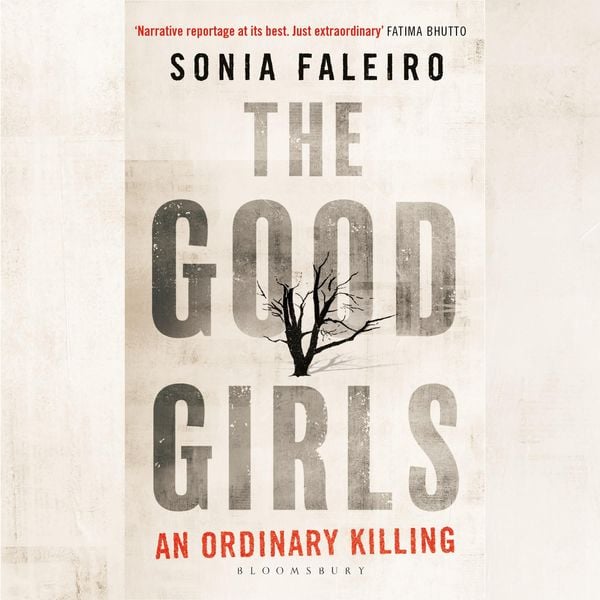
Produktbild: The Good Girls
Artikelbild von The Good Girls
Sonia Faleiro

1. The Good Girls

The Good Girls An Ordinary Killing

Aus der Reihe Bloomsbury Circus
Gesprochen von
2

16,99 €

inkl. gesetzl. MwSt., Versandkostenfrei


Beschreibung

Produktdetails

Family Sharing

Ja

Gesprochen von

Sonia Faleiro

Spieldauer

7 Stunden und 38 Minuten

Abo-Fähigkeit

Nein

Erscheinungsdatum

21.01.2021

Hörtyp

Lesung

Fassung

ungekürzt

Medium

MP3

Anzahl Dateien

70

Verlag

Bloomsbury Academic

Sprache

Englisch

EAN

9781526636379

Beschreibung

Rezension

Sonia Faleiro 's meticulously researched investigation results in a powerful, unflinching account of misogyny, female shame and the notion of honour

Produktdetails

Family Sharing

Ja

Mit Family Sharing können Sie Hörbücher innerhalb Ihrer Familie (max. sechs Mitglieder im gleichen Haushalt) teilen. Sie entscheiden selbst, welches Hörbuch Sie mit welchem Familienmitglied teilen möchten. Auch das parallele Hören durch verschiedene Familienmitglieder ist durch Family Sharing möglich. Um Hörbücher zu teilen oder geteilt zu bekommen, muss jedes Familienmitglied ein Konto bei einem tolino-Buchhändler haben.

Gesprochen von

Sonia Faleiro

Spieldauer

7 Stunden und 38 Minuten

Abo-Fähigkeit

Nein

Erscheinungsdatum

21.01.2021

Hörtyp

Lesung

Fassung

ungekürzt

Medium

MP3

Anzahl Dateien

70

Verlag

Bloomsbury Academic

Sprache

Englisch

EAN

9781526636379

Kundinnen und Kunden meinen

2 Bewertungen

Informationen zu Bewertungen

Zur Abgabe einer Bewertung ist eine Anmeldung im Konto notwendig. Die Authentizität der Bewertungen wird von uns nicht überprüft. Wir behalten uns vor, Bewertungstexte, die unseren Richtlinien widersprechen, entsprechend zu kürzen oder zu löschen.

Die Bewertungen sind nach Format, Anzahl Sterne und Datum sortiert.

5 Sterne

(2)

4 Sterne

(0)

3 Sterne

(0)

2 Sterne

(0)

1 Sterne

(0)

Sonia Faleiro - The Good Girls

Miss.mesmerized am 19.03.2021

Bewertungsnummer: 1458600

Bewertet: Buch (Gebundene Ausgabe)

Padma and Lalli, inseparable cousins and friends, were only 16 and 14 when they were killed. As their small village in Uttar Pradesh was rather underdeveloped in hygienic and housing terms, the girls needed to go to the nearby fields to relieve themselves. One night in 2014, they went missing and were found hanging in the orchard a couple of hours later. Rumours spread fast about what might have happened and who could be responsible for their deaths, however, even though national media became interested in the case, investigations took their time and the police only reluctantly tried to solve the case. Girls from lower classes have never been high priority and their death seemed to cause more nuisance than alarm. “This negligence contributed to an epidemic of missing and exploited children, many of them trafficked within and outside the country.” Sonia Faleiro’s book is a true crime account of how the girls’ lives might have looked like in their last hours, the immediate reaction of the families and villagers and also a lot of facts which help to understand the circumstances in which this crime could take place. The subheading “An Ordinary Killing” already gives away a lot: the murder of girls and women had become to ordinary in India that people didn’t bat an eyelid anymore. However, the events of 2012, when a student was violated in a bus, made worldwide headlines and stirred protests which finally made people aware of the hostile and misogynist climate they were living in. “Although Delhi was notoriously unsafe, stories about sexual assault didn’t often make the news.” There are a lot of factors which enabled the murder of Padma and Lalli, their status as girls, their belonging to an inferior class, the remoteness and backwardness of their village – many standards and rights we in the western world take for granted simply do not apply there. But it is not only the crime itself which is abhorrent, also the situation of the police – understaffed, ill-equipped, prone to bribery – and even more of the medical examiner – without any training, just doing the job because nobody else would do it with the logical result of a post-mortem which is simply absurd – are just incredible. What I found most interesting was actually not the girls’ story and the dynamics in the village afterwards but the background information. Sonia Faleiro convincingly integrates them into the narrative which thus becomes informative while being appealing to read. I’d rather call it a journalistic piece of work than

Sonia Faleiro - The Good Girls

Miss.mesmerized am 19.03.2021
Bewertungsnummer: 1458600
Bewertet: Buch (Gebundene Ausgabe)

Padma and Lalli, inseparable cousins and friends, were only 16 and 14 when they were killed. As their small village in Uttar Pradesh was rather underdeveloped in hygienic and housing terms, the girls needed to go to the nearby fields to relieve themselves. One night in 2014, they went missing and were found hanging in the orchard a couple of hours later. Rumours spread fast about what might have happened and who could be responsible for their deaths, however, even though national media became interested in the case, investigations took their time and the police only reluctantly tried to solve the case. Girls from lower classes have never been high priority and their death seemed to cause more nuisance than alarm. “This negligence contributed to an epidemic of missing and exploited children, many of them trafficked within and outside the country.” Sonia Faleiro’s book is a true crime account of how the girls’ lives might have looked like in their last hours, the immediate reaction of the families and villagers and also a lot of facts which help to understand the circumstances in which this crime could take place. The subheading “An Ordinary Killing” already gives away a lot: the murder of girls and women had become to ordinary in India that people didn’t bat an eyelid anymore. However, the events of 2012, when a student was violated in a bus, made worldwide headlines and stirred protests which finally made people aware of the hostile and misogynist climate they were living in. “Although Delhi was notoriously unsafe, stories about sexual assault didn’t often make the news.” There are a lot of factors which enabled the murder of Padma and Lalli, their status as girls, their belonging to an inferior class, the remoteness and backwardness of their village – many standards and rights we in the western world take for granted simply do not apply there. But it is not only the crime itself which is abhorrent, also the situation of the police – understaffed, ill-equipped, prone to bribery – and even more of the medical examiner – without any training, just doing the job because nobody else would do it with the logical result of a post-mortem which is simply absurd – are just incredible. What I found most interesting was actually not the girls’ story and the dynamics in the village afterwards but the background information. Sonia Faleiro convincingly integrates them into the narrative which thus becomes informative while being appealing to read. I’d rather call it a journalistic piece of work than

Padma and Lalli, inseparable…

Bewertung aus Mainz am 25.02.2021

Bewertungsnummer: 2995384

Bewertet: Buch (Gebundene Ausgabe)

Padma and Lalli, inseparable cousins and friends, were only 16 and 14 when they were killed. As their small village in Uttar Pradesh was rather underdeveloped in hygienic and housing terms, the girls needed to go to the nearby fields to relieve themselves. One night in 2014, they went missing and were found hanging in the orchard a couple of hours later. Rumours spread fast about what might have happened and who could be responsible for their deaths, however, even though national media became interested in the case, investigations took their time and the police only reluctantly tried to solve the case. Girls from lower classes have never been high priority and their death seemed to cause more nuisance than alarm. “This negligence contributed to an epidemic of missing and exploited children, many of them trafficked within and outside the country.” Sonia Faleiro’s book is a true crime account of how the girls’ lives might have looked like in their last hours, the immediate reaction of the families and villagers and also a lot of facts which help to understand the circumstances in which this crime could take place. The subheading “An Ordinary Killing” already gives away a lot: the murder of girls and women had become to ordinary in India that people didn’t bat an eyelid anymore. However, the events of 2012, when a student was violated in a bus, made worldwide headlines and stirred protests which finally made people aware of the hostile and misogynist climate they were living in. “Although Delhi was notoriously unsafe, stories about sexual assault didn’t often make the news.” There are a lot of factors which enabled the murder of Padma and Lalli, their status as girls, their belonging to an inferior class, the remoteness and backwardness of their village – many standards and rights we in the western world take for granted simply do not apply there. But it is not only the crime itself which is abhorrent, also the situation of the police – understaffed, ill-equipped, prone to bribery – and even more of the medical examiner – without any training, just doing the job because nobody else would do it with the logical result of a post-mortem which is simply absurd – are just incredible. What I found most interesting was actually not the girls’ story and the dynamics in the village afterwards but the background information. Sonia Faleiro convincingly integrates them into the narrative which thus becomes informative while being appealing to read. I’d rather call it a journalistic piece of work than

Padma and Lalli, inseparable…

Bewertung aus Mainz am 25.02.2021
Bewertungsnummer: 2995384
Bewertet: Buch (Gebundene Ausgabe)

Padma and Lalli, inseparable cousins and friends, were only 16 and 14 when they were killed. As their small village in Uttar Pradesh was rather underdeveloped in hygienic and housing terms, the girls needed to go to the nearby fields to relieve themselves. One night in 2014, they went missing and were found hanging in the orchard a couple of hours later. Rumours spread fast about what might have happened and who could be responsible for their deaths, however, even though national media became interested in the case, investigations took their time and the police only reluctantly tried to solve the case. Girls from lower classes have never been high priority and their death seemed to cause more nuisance than alarm. “This negligence contributed to an epidemic of missing and exploited children, many of them trafficked within and outside the country.” Sonia Faleiro’s book is a true crime account of how the girls’ lives might have looked like in their last hours, the immediate reaction of the families and villagers and also a lot of facts which help to understand the circumstances in which this crime could take place. The subheading “An Ordinary Killing” already gives away a lot: the murder of girls and women had become to ordinary in India that people didn’t bat an eyelid anymore. However, the events of 2012, when a student was violated in a bus, made worldwide headlines and stirred protests which finally made people aware of the hostile and misogynist climate they were living in. “Although Delhi was notoriously unsafe, stories about sexual assault didn’t often make the news.” There are a lot of factors which enabled the murder of Padma and Lalli, their status as girls, their belonging to an inferior class, the remoteness and backwardness of their village – many standards and rights we in the western world take for granted simply do not apply there. But it is not only the crime itself which is abhorrent, also the situation of the police – understaffed, ill-equipped, prone to bribery – and even more of the medical examiner – without any training, just doing the job because nobody else would do it with the logical result of a post-mortem which is simply absurd – are just incredible. What I found most interesting was actually not the girls’ story and the dynamics in the village afterwards but the background information. Sonia Faleiro convincingly integrates them into the narrative which thus becomes informative while being appealing to read. I’d rather call it a journalistic piece of work than

Kundinnen und Kunden meinen

The Good Girls

von Sonia Faleiro

0 Bewertungen filtern

  • Produktbild: The Good Girls