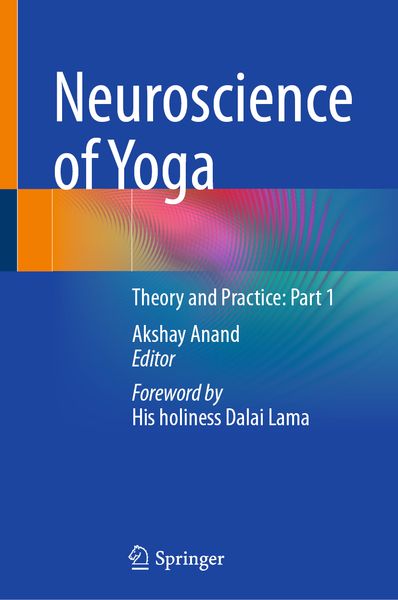
Produktbild: Neuroscience of Yoga
- 10%

Neuroscience of Yoga Theory and Practice: Part 1

10% sparen

133,99 € UVP 149,79 €

inkl. gesetzl. MwSt., Versandkostenfrei


Beschreibung

Produktdetails

Einband

Gebundene Ausgabe

Erscheinungsdatum

31.07.2024

Herausgeber

Akshay Anand

Verlag

Springer Singapore

Seitenzahl

275

Maße (L/B/H)

24,1/16/2,2 cm

Gewicht

610 g

Auflage

1. Auflage

Sprache

Englisch

ISBN

978-981-9728-50-3

Beschreibung

Portrait

Dr. Akshay Anand is a professor at the Neuroscience  Research Lab in the Department of Neurology, PGIMER, Chandigarh. He is Professor in charge CCRYN Yoga Centre of PGIMER. He earlier served as Visiting Professor at the Kyoto University of Medicine and is currently distinguished Visiting Professor at S-VYASA, Bengaluru. He has also worked as visiting scientist at Lesya Ukrainian Eastern European National University, Lutsk, and Sri Sri Institute of Advanced Research in Bengaluru. He has mentored more than two dozen PhD students, faculty members and editorial colleagues and completed equal number of research grants besides three MPLADS grants and currently remains engaged in advising different editorial, policy, and scientific enterprises across many countries which include Journal start ups, Quality Assurance programs, academic social activities and bringing rigour to Neuroscience of Yoga. He has published more than 200 research papers as corresponding/first author in international peer-reviewed Journals besides filing 3 patient applications. This includes publications in Nature Medicine, 50 policy research commentaries, popular articles and wide electronic media coverages.

Dr. Anand has an h index of 39 with about 5200 citations and is the editor in chief of  Annals of Neurosciences and Integrative Medicine Case Reports  (JIMCR) and former EIC of  Integrative Medicine International . He has received more than 20 national and international awards/honors for his exemplary work in advancing Neuroscience and Yoga research. He is also advisory board member at Centre for Consciousness, BIMDMC, Harvard University, Boston, USA. His academic and social activities, such as PM’s Clean India program and “Yoga Scholars PGIMER”,have cultivated an increased sense of preventive healthcare among his students, colleagues, and science practitioners.

Produktdetails

Einband

Gebundene Ausgabe

Erscheinungsdatum

31.07.2024

Herausgeber

Akshay Anand

Verlag

Springer Singapore

Seitenzahl

275

Maße (L/B/H)

24,1/16/2,2 cm

Gewicht

610 g

Auflage

1. Auflage

Sprache

Englisch

ISBN

978-981-9728-50-3

Herstelleradresse

Springer-Verlag KG
Sachsenplatz 4-6
1201 Wien
AT

Email: GPSR Kontakt

Ein neues Kapitel für Ihre Bücher

Ein neues Kapitel für Ihre Bücher

Schenken Sie Ihren alten Schätzen ein zweites Leben: Einfach Barcode scannen, Versandetikett ausdrucken, Bücher verschicken und Thalia Geschenkkarte erhalten.

Jetzt verkaufen
Jetzt verkaufen

Noch keine Bewertungen vorhanden

Verfassen Sie die erste Bewertung zu diesem Artikel

Helfen Sie anderen Kundinnen und Kunden durch Ihre Meinung.

Kundinnen und Kunden meinen

Bewertungen (0)

  • Produktbild: Neuroscience of Yoga
  • Chapter 1 Psycho neuroimmune modulation by Yoga, .- Chapter 2 The regulation of neuro-immune system by Pi   (Parasympathetic) and SiGMA   (Sympathetic Induction Governed by Meditation and Asana ) rhythmicity.- Chapter 3 Neurobiology of Yoga and Mindfulness and its impact on Neuronal Function, Wellbeing Addiction, and Palliative care.- Chapter 4 Computer vision and alternative therapies.- Chapter 5 Endocrinology of Yoga .- Chapter 6 Neurophysiological effects of Yoga intervention on Pregnancy.- Chapter 7 Psychosocial Implications of Yoga for Healthcare Workers During COVID-19.- Chapter 8 Psychometric analysis in mind-body interventions   (MBIs) and role of Ayurgenomics.- Chapter 9 Neuro-Molecular Effects of Yoga and Endurance Exercises: Similarities and Dissimilarities.- Chapter 10 The impact of Yoga , Pranayama , and Mindfulness training on Neurocognitive, Neurophysiological and Neuropsychological changes in high altitude.- Chapter 11 Yoga as a primer for Cardiac health.- Chapter 12 Effect of Meditation on Neuropsychological Profile of Prisoners.- Chapter 13 Tele- Yoga and its implications for digital health-emerging trends in health and wellness.- Chapter 14 Patanjali ’s Raj Yoga Meditation: An Indian Classical Intervention Technique.- Chapter 15 Yoga as a tool to achieve cardiovascular resonance and improve heart rate variability.