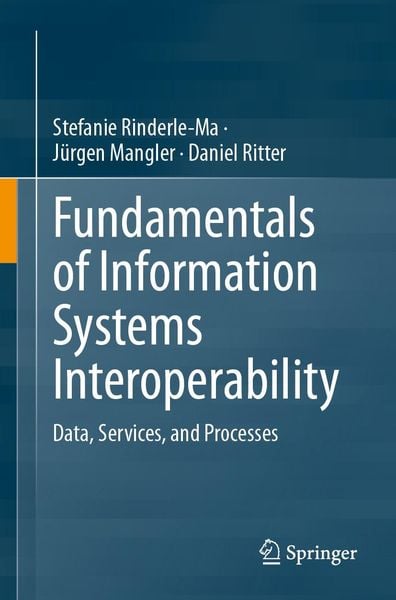
Fundamentals of Information Systems Interoperability Data, Services, and Processes
-
- Taschenbuch
- eBook ausgewählt
-
Form:Einzelkauf Download
-
Sprache:Englisch
37,44 €
inkl. gesetzl. MwSt.Beschreibung
Produktdetails
Format
Kopierschutz
Nein
Family Sharing
Nein
Text-to-Speech
Nein
Erscheinungsdatum
18.04.2024
Verlag
SpringerSeitenzahl
281 (Printausgabe)
Dateigröße
26060 KB
Sprache
Englisch
EAN
9783031483226
This book presents fundamental concepts and technologies to tackle interoperability between information systems. It details interoperability at the data, service, and process level, and combines theoretical foundations with hands-on presentation of technologies to enable the development of sound and practical integration.
Chapter 1 details general interoperability challenges and describes the structure of the book. To start with, Chapter 2 presents technologies for the exchange of data between two selected and highly relevant data formats, i.e., relational databases and XML. Next, Chapter 3 explains concepts for schema matching and mapping and data integration as well as the technological basis for implementing them based on query and transformation languages like XPath and XSLT. Chapter 4 then turns to service interoperability and explains two related technologies - REST and GraphQL - in detail. In Chapter 5, fundamentals for designing process orchestrations at the conceptual level are presented, focusing on how to model process orchestrations and how to verify their correctness and soundness, and showing BPMN as the de facto modeling standard. Chapter 6 then details the concepts and languages for the implementation of process orchestrations, including the presentation of execution languages for process orchestrations that are equipped with a formal semantics, e.g., Workflow Nets, the Refined Process Structure Tree, and CPEE Trees. Subsequently, Chapter 7 focuses on the growing number of distributed, loosely coupled, and often non-interoperable applications through the concepts of enterprise application integration and explains these by an implementation in CPN Tools and by two case studies. Eventually, Chapter 8 is lifting the orchestration and integration concepts and technologies to the choreography level by dealing with the interoperability between different process orchestrations. Chapter 9 concludes the book by featuring success factors for interoperability projects. It also provides a range of open research directions for interoperability such as compliance, sensor fusion, and blockchain technologies.
The book is mainly intended as a textbook to be used for developing and teaching courses on interoperability and integration. To this end, it is accompanied by a Web site with additional teaching materials. It also spans a bridge from researchers to graduate students and practitioners by providing a deep understanding on practical interoperability challenges and solutions. The focus here is put on de facto standards and open-source systems and tools to enable interoperability solutions at low cost.
Noch keine Bewertungen vorhanden
Verfassen Sie die erste Bewertung zu diesem Artikel
Helfen Sie anderen Kundinnen und Kunden durch Ihre Meinung.
Kurze Frage zu unserer Seite
Vielen Dank für Ihr Feedback
Wir nutzen Ihr Feedback, um unsere Produktseiten zu verbessern. Bitte haben Sie Verständnis, dass wir Ihnen keine Rückmeldung geben können. Falls Sie Kontakt mit uns aufnehmen möchten, können Sie sich aber gerne an unseren Kund*innenservice wenden.
zum Kundenservice