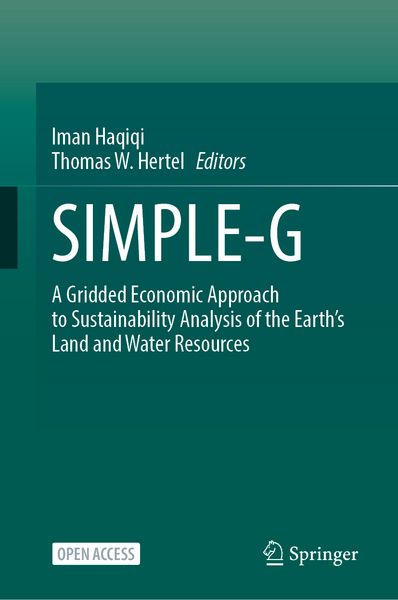
Simple-G A Gridded Economic Approach to Sustainability Analysis of the Earth’s Land and Water Resources
-
- Englisch ausgewählt
48,99 €
inkl. gesetzl. MwSt.,
Beschreibung
Produktdetails
Einband
Gebundene Ausgabe
Erscheinungsdatum
29.10.2024
Abbildungen
XXVIII, 75 illus., 70 illus. in color., farbige Illustrationen, schwarz-weiss Illustrationen
Herausgeber
Iman Haqiqi + weitereVerlag
SpringerSeitenzahl
327
Maße (L/B/H)
24,1/16/2,4 cm
Gewicht
762 g
Sprache
Englisch
ISBN
978-3-031-68053-3
This is an open access book.
Crafted for both the economist and the curious mind, this book introduces a novel approach to blending economic and biophysical sciences to enable multi-scale analysis of a range of sustainability challenges confronting the world’s land and water resources at both local and global scales. It focuses specifically on the interface between the environment and food systems, utilizing economic theory to structure the overall framework. However, within the SIMPLE-G framework, there is ample room to incorporate fine-scale biophysical knowledge from agronomy, climate science, ecology, geography, hydrology, as well as a range of socioeconomic considerations. This enables multi-scale analyses incorporating grid cells that can vary in size from 250 meters to sub-regional scales. This, in turn, allows for investigation of global change drivers’ impacts on local sustainability, as well as feedbacks from local sustainability policies to regional and global outcomes.
The book opens with a foreword by a prominent sustainability scientist, Prof. Navin Ramankutty, and proceeds in five parts covering, respectively: (1) introduction and overview, (2) basic economic theory underpinning SIMPLE-G, (3) the SIMPLE-G framework, including structure, data, parameters, computer implementation, and validation, (4) eight diverse applications of the SIMPLE-G framework, covering a range of geographies and sustainability challenges, and (5) a forward-looking chapter on future directions. The book provides step-by-step guidance on building and utilizing gridded models with real-world case studies demonstrating practical applications which will facilitate its use by academics, practitioners, and students conducting research on climate impacts, land-use, water resource management, food security, poverty, equity, nutritional outcomes, and overall sustainability.
Ein neues Kapitel für Ihre Bücher
Ein neues Kapitel für Ihre Bücher
Schenken Sie Ihren alten Schätzen ein zweites Leben: Einfach Barcode scannen, Versandetikett ausdrucken, Bücher verschicken und Thalia Geschenkkarte erhalten.
Jetzt verkaufenNoch keine Bewertungen vorhanden
Verfassen Sie die erste Bewertung zu diesem Artikel
Helfen Sie anderen Kundinnen und Kunden durch Ihre Meinung.
Kurze Frage zu unserer Seite
Vielen Dank für Ihr Feedback
Wir nutzen Ihr Feedback, um unsere Produktseiten zu verbessern. Bitte haben Sie Verständnis, dass wir Ihnen keine Rückmeldung geben können. Falls Sie Kontakt mit uns aufnehmen möchten, können Sie sich aber gerne an unseren Kund*innenservice wenden.
zum Kundenservice