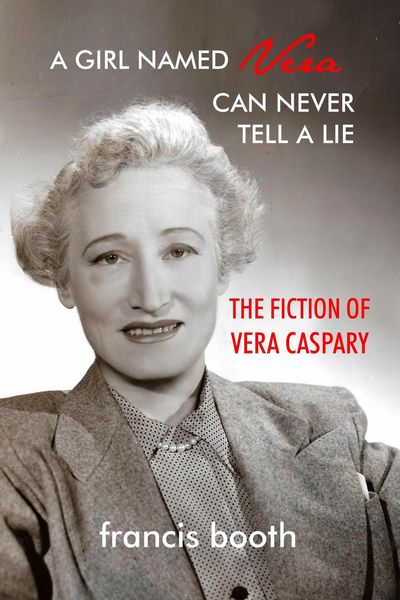
A Girl Named Vera Can Never Tell A Lie: The Fiction of Vera Caspary
-
- Einzelkauf Download ausgewählt
-
Sprache:Englisch
6,99 €
inkl. gesetzl. MwSt.Beschreibung
Produktdetails
Format
ePUB
Kopierschutz
Ja
Family Sharing
Ja
Text-to-Speech
Ja
Erscheinungsdatum
29.06.2024
Verlag
Wu Wei PressSeitenzahl
(Printausgabe)
Dateigröße
745 KB
Sprache
Englisch
EAN
9798227626530
Vera Caspary (1899 - 1987) was ahead of her time but is perfectly aligned with ours. Caspary put strong, independent women at the center of over twenty novels, while tackling sexism, racism, fascism and antisemitism head on in both her life and her work; in the 1940s J. Edgar Hoover personally initiated an FBI investigation of her.
In the 21st century Caspary's novels have been republished by The Murder Room and The Feminist Press, showing the range of her writing and the breadth of her appeal.
Caspary's first published novel, The White Girl, 1929, concerns a young Black woman passes as white, very much akin to Nella Larsen's Passing, which came out later the same year. A 1930s family saga explored the Jewish experience in America. Then in 1942 Caspary turned the hard-boiled murder mystery inside out with Laura, putting a woman at its heart rather than the usual male detective and inventing the genre of the psycho-thriller. Laura was made into a highly successful film, as was its successor Bedelia, 1945, about "the wickedest woman who ever loved." Fritz Lang's great film noir The Blue Gardenia, 1953, was adapted from a Caspary novella. In the 1960s Caspary followed a gentle satire on sex in the suburbs with a searing Holocaust novel and then a "confession disguised as a novel" about communism in Connecticut; the final novels of the 1970s all explore the mystery of individual identity.
She made her living writing frothy, romantic stories and scripts for Hollywood movies and several of her novels were republished as lurid pulp paperbacks but at heart Vera Caspary was a connoisseur of classic British literature. One Caspary woman calls herself Haworth after the Brontë Parsonage and another is named Elaine after Tennyson's Idylls, while Stranger Than Truth pays homage to Wilkie Collins' The Woman in White and Bedelia echoes Mary Elizabeth Braddon's Lady Audley's Secret. In False Face, Nina was "weaned on Browning and Keats, taught to use my eyes in Florence," and in The Dreamers Ernestine is plans a Ph.D. on George Eliot.
A Girl Named Vera Can Never Tell a Lie is a monumental and ground-breaking study, examining all of Caspary's published fiction, setting her in the context of her contemporaries and celebrating the Caspary woman, a heroine for our time.
Noch keine Bewertungen vorhanden
Verfassen Sie die erste Bewertung zu diesem Artikel
Helfen Sie anderen Kundinnen und Kunden durch Ihre Meinung.
Kurze Frage zu unserer Seite
Vielen Dank für Ihr Feedback
Wir nutzen Ihr Feedback, um unsere Produktseiten zu verbessern. Bitte haben Sie Verständnis, dass wir Ihnen keine Rückmeldung geben können. Falls Sie Kontakt mit uns aufnehmen möchten, können Sie sich aber gerne an unseren Kund*innenservice wenden.
zum Kundenservice