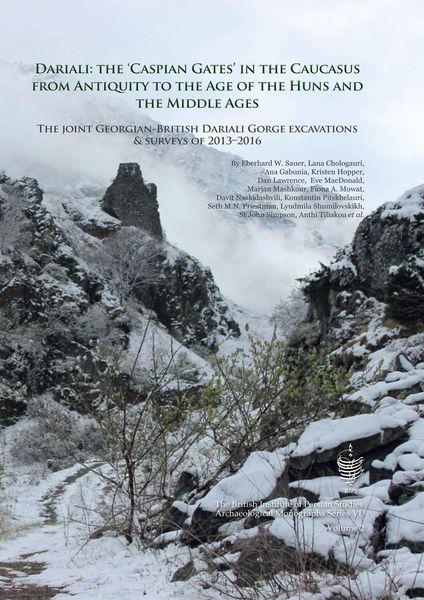
Dariali: The 'Caspian Gates' in the Caucasus from Antiquity to the Age of the Huns and the Middle Ages The Joint Georgian-British Dariali Gorge Excavations and Surveys of 2013-2016
-
Form:Einzelkauf Download
-
Sprache:Englisch
-
eBook Format:PDF
- PDF 56,49 € ausgewählt
- ePUB 56,49 €
56,49 €
inkl. gesetzl. MwSt.Beschreibung
Produktdetails
Format
Kopierschutz
Ja
Family Sharing
Ja
Text-to-Speech
Nein
Erscheinungsdatum
30.04.2020
Verlag
Oxbow BooksSeitenzahl
1088 (Printausgabe)
Dateigröße
137597 KB
Sprache
Englisch
EAN
9781789251951
The Huns, invading through Dariali Gorge on the modern-day border between Russia and Georgia in AD 395 and 515, spread terror across the late antique world. Was this the prelude to the apocalypse? Prophecies foresaw a future Hunnic onslaught, via the same mountain pass, bringing about the end of the world. Humanity's fate depended on a gated barrier deep in Europe's highest and most forbidding mountain chain.
Centuries before the emergence of such apocalyptic beliefs, the gorge had reached world fame. It was the target of a planned military expedition by the Emperor Nero. Chained to the dramatic sheer cliffs, framing the narrow passage, the mythical fire-thief Prometheus suffered severe punishment, his liver devoured by an eagle. It was known under multiple names, most commonly the Caspian or Alan Gates.
Featuring in the works of literary giants, no other mountain pass in the ancient and medieval world matches Dariali's fame. Yet little was known about the materiality of this mythical place. A team of archaeologists has now shed much new light on the major gorge-blocking fort and a barrier wall on a steep rocky ridge further north. The walls still standing today were built around the time of the first major Hunnic invasion in the late fourth century - when the Caucasus defenses feature increasingly prominently in negotiations between the Great Powers of Persia and Rome. In its endeavor to strongly fortify the strategic mountain pass through the Central Caucasus, the workforce erased most traces of earlier occupation. The Persian-built bastion saw heavy occupation for 600 years. Its multi-faith medieval garrison controlled Trans-Caucasian traffic. Everyday objects and human remains reveal harsh living conditions and close connections to the Muslim South, as well as the steppe world of the north. The Caspian Gates explains how a highly strategic rock has played a pivotal role in world history from Classical Antiquity into the twentieth century.
Centuries before the emergence of such apocalyptic beliefs, the gorge had reached world fame. It was the target of a planned military expedition by the Emperor Nero. Chained to the dramatic sheer cliffs, framing the narrow passage, the mythical fire-thief Prometheus suffered severe punishment, his liver devoured by an eagle. It was known under multiple names, most commonly the Caspian or Alan Gates.
Featuring in the works of literary giants, no other mountain pass in the ancient and medieval world matches Dariali's fame. Yet little was known about the materiality of this mythical place. A team of archaeologists has now shed much new light on the major gorge-blocking fort and a barrier wall on a steep rocky ridge further north. The walls still standing today were built around the time of the first major Hunnic invasion in the late fourth century - when the Caucasus defenses feature increasingly prominently in negotiations between the Great Powers of Persia and Rome. In its endeavor to strongly fortify the strategic mountain pass through the Central Caucasus, the workforce erased most traces of earlier occupation. The Persian-built bastion saw heavy occupation for 600 years. Its multi-faith medieval garrison controlled Trans-Caucasian traffic. Everyday objects and human remains reveal harsh living conditions and close connections to the Muslim South, as well as the steppe world of the north. The Caspian Gates explains how a highly strategic rock has played a pivotal role in world history from Classical Antiquity into the twentieth century.
Noch keine Bewertungen vorhanden
Verfassen Sie die erste Bewertung zu diesem Artikel
Helfen Sie anderen Kundinnen und Kunden durch Ihre Meinung.
Kurze Frage zu unserer Seite
Vielen Dank für Ihr Feedback
Wir nutzen Ihr Feedback, um unsere Produktseiten zu verbessern. Bitte haben Sie Verständnis, dass wir Ihnen keine Rückmeldung geben können. Falls Sie Kontakt mit uns aufnehmen möchten, können Sie sich aber gerne an unseren Kund*innenservice wenden.
zum Kundenservice