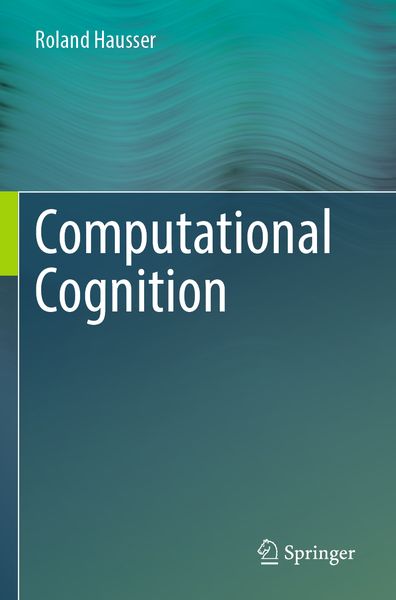
Computational Cognition
-
- Hardcover
- Taschenbuch ausgewählt
- eBook
-
Sprache:Englisch
175,99 €
inkl. gesetzl. MwSt.,
Beschreibung
Produktdetails
Einband
Taschenbuch
Erscheinungsdatum
01.09.2024
Verlag
SpringerSeitenzahl
235
Maße (L/B/H)
23,5/15,5/1,5 cm
Gewicht
394 g
Sprache
Englisch
ISBN
978-3-031-37501-9
Modern science is divided into three parts: natural sciences, engineering sciences and humanities. Over the last millennia, natural and engineering sciences evolved a symbiotic relationship, but humanities still stand apart. Today, however, designing and building a talking robot is a comparatively new challenge for which all three branches are needed. Starting from the idea that designing a theory of computational cognition should be as complete as possible, and trying to answer questions such as “Which ontology is required for building a computational cognition?”, the current book integrates interfaces, components, functional flows, data structure, database schema, and algorithms into a coherent system with an extensive range of cognitive functions, and constitutes the background to the book “Ontology of Communication” recently published by the author (Springer, 2023).
Part I discusses ontological distinctions between a sign-based and an agent-based approach, and continues with explanations of the data structure, the content-addressable database schema; the time-linear derivations of the speak and the hear mode; resonating content; induction, deduction, and abduction in inferencing, and concludes with a reconstruction of eight classical syllogisms as a test suite for DBS inferencing in the think mode.
Part II complements the literal use of language in the speak and hear mode with a reconstruction of syntactic mood adaptations and figurative use. The database schema of DBS is shown to lend itself not only to the tasks of traditional storage and retrieval, but also of reference, coreference, shadowing, coactivation of resonating content, and selective activation.
Part III complements the treatment of individual topics in linguistics, philosophy, and cognitive psychology with an overall software structure in the form of three interacting main components, called the interface, the memory, and the production component.
Ein neues Kapitel für Ihre Bücher
Ein neues Kapitel für Ihre Bücher
Schenken Sie Ihren alten Schätzen ein zweites Leben: Einfach Barcode scannen, Versandetikett ausdrucken, Bücher verschicken und Thalia Geschenkkarte erhalten.
Jetzt verkaufenNoch keine Bewertungen vorhanden
Verfassen Sie die erste Bewertung zu diesem Artikel
Helfen Sie anderen Kundinnen und Kunden durch Ihre Meinung.
Kurze Frage zu unserer Seite
Vielen Dank für Ihr Feedback
Wir nutzen Ihr Feedback, um unsere Produktseiten zu verbessern. Bitte haben Sie Verständnis, dass wir Ihnen keine Rückmeldung geben können. Falls Sie Kontakt mit uns aufnehmen möchten, können Sie sich aber gerne an unseren Kund*innenservice wenden.
zum Kundenservice