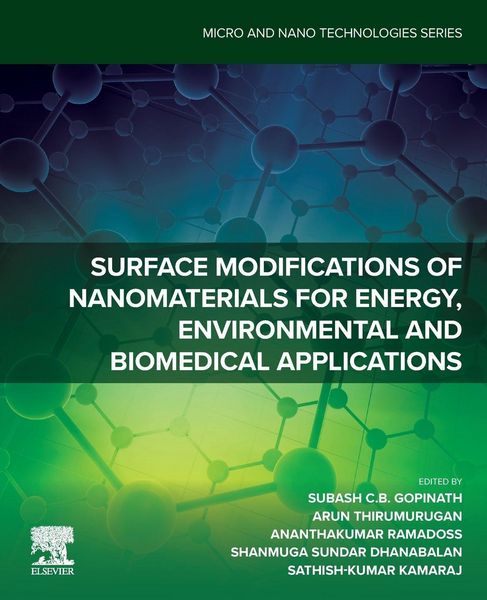
Produktbild: Surface Modifications of Nanomaterials for Energy, Environme
- 11%

Surface Modifications of Nanomaterials for Energy, Environme

11% sparen

209,99 € UVP 238,50 €

inkl. gesetzl. MwSt., Versandkostenfrei


Beschreibung

Produktdetails

Einband

Taschenbuch

Erscheinungsdatum

20.02.2026

Herausgeber

Subash C.B. Gopinath + weitere

Verlag

Elsevier Science & Technology

Seitenzahl

672

Maße (L/B/H)

23,6/19,2/3,4 cm

Gewicht

450 g

Sprache

Englisch

ISBN

978-0-443-28838-8

Beschreibung

Portrait

Subash C.B. Gopinath earned his doctorate from University of Madras, India (1999). He has gained experiences in the areas of nano- & aptamer-technologies, medical diagnosis of disease biomarkers and material processing. He obtained 9 patents, and his research works were published (total of 1046 with 21319 citations) in refereed scientific journals and he has 39 book chapters & 5 Edited books. Currently, Gopinath holds the position of Professor in the Faculty of Chemical Engineering & Technology at Universiti Malaysia Perlis. Additionally, he serves as Chief Scientific Consultant at Future Science, China, Distinguished Professor & Chief Scientist at the First Central Medical Hospital of Baoding City, China, Adjunct Professor at AIMST University (Malaysia), Western Caspian University (Azerbaijan), Indira Gandhi Institute of Engineering and Technology (India) and Saveetha Institute of Medical and Technical Sciences (India). He also holds the title of Visiting Professor at Prince Songkla University, Thailand; Daffodil International University, Bangladesh; and Universiti Sains Malaysia. He has received scholar visiting awards from Tianjin University (CHINA-ASEAN) and Karabuk University (Mevlana Exchange Programme, Turkey). He served as Joint Director at the Centre of Excellence for Nanobiotechnology and Nanomedicine at AIMST University, Malaysia. He was recently appointed as a Friendship Ambassador for the International Science and Technology Cooperation Base in China. Prof. Gopinath has been recognized among the TOP 2% Scientists in the World for several years. He has received numerous awards and research grants through both local and international academic and industrial collaborations.

Dr. Arun Thirumurugan is an Assistant Professor at the University of Atacama, Sede Vallenar, Chile. He earned his Ph.D. from the National Institute of Technology (NIT) Tiruchirappalli, India, and completed postdoctoral research at the Institute of Physics, India, and the University of Chile, Santiago. His research focuses on the synthesis and surface engineering of nanomaterials for energy and environmental applications.

Ananthakumar Ramadoss is a Scientist at the Advanced Research School for Technology & Product Simulation (ARSTPS), Central Institute of Petrochemicals Engineering and Technology (CIPET), Chennai, India. He has over 15 years of research expertise in developing various nanostructured materials for applications in supercapacitors, nanogenerators, self-powered systems, 3D printing, thin films, corrosion protection, and bio-implants. He has over 100 research publications in peer-reviewed journals, >25 book chapters and edited 1 book with renowned international publishers. Also, he has received various awards (>15), prestigious fellowships (Humboldt Post-Doctoral Fellowship), and a Top 2% Scientist. In addition, he has completed and ongoing various sponsored projects in the respective areas.

Shanmuga Sundar Dhanabalan is an accomplished researcher & ARC Industry Fellow, currently leads the Soft Electronics, Materials, and Sensors (SEMS) Research Group at La Trobe University, Melbourne. He also serves as the Associate Director (Research) for the Centre for Technology Infusion at La Trobe University. Dhanabalan completed his PhD in 2017 and was subsequently awarded a competitive Conicyt-Fondecyt postdoctoral fellowship from the Chilean government, as a Principal Investigator from 2018 to 2021. From May 2021 to October 2024, he worked as a Research Fellow in the Functional Materials and Microsystems (FMM) Research Group at RMIT University, Melbourne. His work has contributed to the development of wearables, wireless battery-free patches, biosensors, and Bluetooth-enabled devices for continuous health monitoring in rural and remote areas. He has secured over $ 4.1 million in funding in the last 5 years and primarily focuses on translational research, collaborating with Australian industry partners to drive innovations from design to commercialization.

Sathish-Kumar Kamaraj is a professor and the group leader of the Sustainable Nexus Laboratory at the Centro de Investigación en Ciencia Aplicada y Tecnología Avanzada Altamira (CICATA-Altamira) in the Instituto Politécnico Nacional (IPN). He has published over 50 JCR papers, garnered more than 1,528 citations, achieved an h-index of 21, authored over 10 book chapters, edited six books with esteemed publishers, and participates on multiple editorial boards. He has received national and international accolades and has secured four patents and four technological transfers. He obtained support from SEP, INCYTEA-Ags Mexico, SIP-IPN, and Conacyt Mexico, and acted as a mentor for ReachSci at the Cambridge University Society. He engages in strong collaboration with research and development in both the corporate and public sectors.

Produktdetails

Einband

Taschenbuch

Erscheinungsdatum

20.02.2026

Herausgeber

Verlag

Elsevier Science & Technology

Seitenzahl

672

Maße (L/B/H)

23,6/19,2/3,4 cm

Gewicht

450 g

Sprache

Englisch

ISBN

978-0-443-28838-8

EU-Ansprechpartner

Zeitfracht Medien GmbH
Ferdinand-Jühlke-Straße 7
99095 Erfurt
DE
produktsicherheit@zeitfracht.de

Herstelleradresse

Elsevier Science & Technology
London Wall 125
EC2Y 5AS London
GB
tradeorders@elsevier.com

Ein neues Kapitel für Ihre Bücher

Ein neues Kapitel für Ihre Bücher

Schenken Sie Ihren alten Schätzen ein zweites Leben: Einfach Barcode scannen, Versandetikett ausdrucken, Bücher verschicken und Thalia Geschenkkarte erhalten.

Jetzt verkaufen
Jetzt verkaufen

Noch keine Bewertungen vorhanden

Verfassen Sie die erste Bewertung zu diesem Artikel

Helfen Sie anderen Kundinnen und Kunden durch Ihre Meinung.

Kundinnen und Kunden meinen

Bewertungen (0)

  • Produktbild: Surface Modifications of Nanomaterials for Energy, Environme
  • Section I: Fundamental of Surface Modification Techniques
    1. Introduction to Surface modification techniques
    2. Surface modification methods and technologies
    3. Surface modification of two-dimensional materials
    4. Surface modified Carbon nanomaterials
    5. Surface modification of metal oxides and their applications
    6. Surface modification of hydroxides
    7. Surface modification of metals
    8. Surface modification of polymeric materials

    Section II Surface Modified Nanomaterials for Energy Applications
    9. Surface modified nanomaterials for supercapacitor applications
    10. Surface modified nanomaterials for Li Ion battery
    11. Surface modified nanomaterials for Li-S battery
    12. Surface modified nanomaterials for Solar cells
    13. Surface modified nanomaterial electrodes for bioelectrochemical energy generation systems

    Section III Surface Modified Nanomaterials for Environmental Applications
    14. Surface modified nanomaterials for Photocatalytic applications
    15. Wastewater treatment process with surface modified nanomaterials
    16. Surface modified nanomaterials for electro chemical sensors
    17. Surface modified nanomaterials for adsorption process
    18. Surface modified nanomaterials for CO2 capture

    Section IV Surface Modified Nanomaterials for Biomedical Applications
    19. Surface modified nanomaterials for drug delivery applications
    20. Surface modified nanomaterials for antimicrobial/ antibacterialapplications

    Section V Future and risk assessment
    21. Sustainable approach for the surface modification of nanomaterials
    22. Surface modified reusable nanomaterials
    23. Life cycle assessment of surface modified nanomaterials
    24. Economic analysis of surface modified nanomaterials
    25. Risk management on surface modification