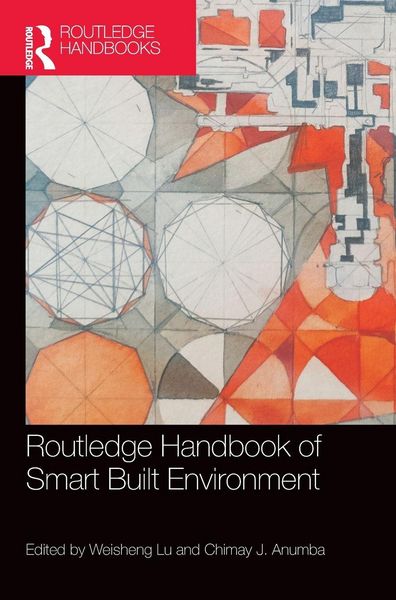
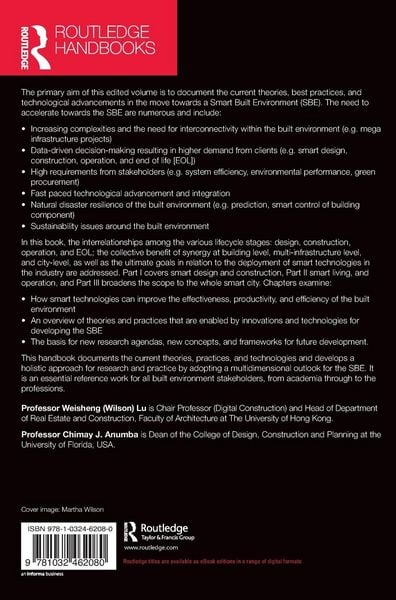
• Produktbild: Routledge Handbook of Smart Built Environment
  • Produktbild: Routledge Handbook of Smart Built Environment
- 27%

Routledge Handbook of Smart Built Environment

27% sparen

191,99 € UVP 265,70 €

inkl. gesetzl. MwSt., Versandkostenfrei


Beschreibung

Produktdetails

Einband

Gebundene Ausgabe

Erscheinungsdatum

20.03.2025

Abbildungen

10 SW-Abb., 65 Farbabb., 65 Farbfotos, 10 SW-Zeichn.

Herausgeber

Weisheng Lu + weitere

Verlag

Taylor & Francis

Seitenzahl

362

Maße (L/B/H)

25/17,5/2,4 cm

Gewicht

804 g

Sprache

Englisch

ISBN

978-1-03-246208-0

Beschreibung

Produktdetails

Einband

Gebundene Ausgabe

Erscheinungsdatum

20.03.2025

Abbildungen

10 SW-Abb., 65 Farbabb., 65 Farbfotos, 10 SW-Zeichn.

Herausgeber

Verlag

Taylor & Francis

Seitenzahl

362

Maße (L/B/H)

25/17,5/2,4 cm

Gewicht

804 g

Sprache

Englisch

ISBN

978-1-03-246208-0

EU-Ansprechpartner

Taylor & Francis Verlag GmbH
Kaufingerstraße 24
80331 München
DE
GPSR@taylorandfrancis.com

Herstelleradresse

Taylor & Francis Group
5 Howick Place
SW1P 1WG London
UK
GPSR@taylorandfrancis.com

Ein neues Kapitel für Ihre Bücher

Ein neues Kapitel für Ihre Bücher

Schenken Sie Ihren alten Schätzen ein zweites Leben und erhalten dafür eine Thalia Geschenkkarte.

Jetzt verkaufen
Jetzt verkaufen

Noch keine Bewertungen vorhanden

Verfassen Sie die erste Bewertung zu diesem Artikel

Helfen Sie anderen Kundinnen und Kunden durch Ihre Meinung.

Kundinnen und Kunden meinen

Bewertungen (0)

  • Produktbild: Routledge Handbook of Smart Built Environment
  • Produktbild: Routledge Handbook of Smart Built Environment
  • Foreword by Faye Bowser

    Introduction

    Chapter 1: Digital twins for smart decision making

    Chapter 2: From particles to spaces: The intelligent planning unit (IPU) theory to simplify the built environment

    Chapter 3: Generative design for excellence (DfX) for a smart built environment: From rule-based imitation to data-driven exploration

    Chapter 4: Project Delivery Methods to Digital Fabrication in Architecture: A Comparative Case Study from a Modularity Perspective

    Chapter 5: Unlocking the power of language models for smart configuration in the AEC domain using spoken language understanding

    Chapter 6: Physical fatigue assessment (PFA) for construction workers with AI and sensory techniques

    Chapter 7: Smart or not? Perspectives on digital fabrication and digital construction

    Chapter 8: Methodical review of exoskeleton use in the construction industry

    Chapter 9: Ontological Models for Construction Scheduling and Resource Planning

    Chapter 11: A Theoretical Framework for Integrating Digital Twins in Building Lifecycle Management

    Chapter 12: Digital Twin-Based Prototype System for Healthcare Facilities Management

    Chapter 13: Activity-Based Models for Smart and Sustainable Urban Environment

    Chapter 14: Sustainable Urban Built Environment: Principles, Tools, and Applications

    Chapter 15: Exploring the Potentials and Obstacles of City Information Modelling

    Chapter 16: Mobility-as-a-Service (MaaS) and the Built Environment

    Chapter 17: Integrated Smart Curb Management in Urban Built Environments Addressing Human Dynamics and Disruptive Technologies

    Chapter 18¿Digital technologies for climate-adaptive smart urban transportation systems

    Chapter 19: Blockchain for Smart Built Environment: Current Status, Challenges, and Prospects

    Chapter 20: Effects of Signage Color on Human Psychophysiological States and Wayfinding Performance in Urban Underground Spaces with Different Noise Levels: A Combined EEG and VR Experiment

    Conclusion