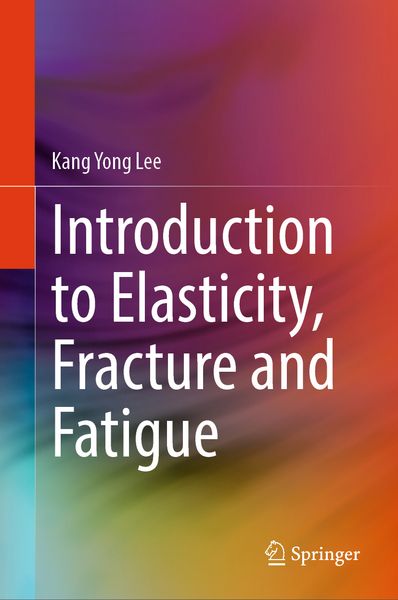
Introduction to Elasticity, Fracture and Fatigue
-
- Hardcover ausgewählt
- Taschenbuch
- eBook
-
Sprache:Englisch
78,99 €
UVP
90,94 €
inkl. gesetzl. MwSt.,
Beschreibung
Produktdetails
Einband
Gebundene Ausgabe
Erscheinungsdatum
18.03.2025
Verlag
Springer SingaporeSeitenzahl
110
Maße (L/B/H)
24,1/16/1,3 cm
Gewicht
380 g
Auflage
1. Auflage
Sprache
Englisch
ISBN
978-981-9635-99-3
This book includes three big subjects such as elasticity, fracture, and fatigue. The contents came from his lecture notes are delivered to the third- and fourth-grade undergraduate students. To understand what this book talks about, the knowledge of mechanics of materials is required. This book consists of three parts. Part I deals with elasticity and consists of four chapters. Chapter 1 introduces tensor notation. In Chapter 2, three-dimensional governing equations in elasticity are introduced in tensor notation. It includes equilibrium equation, Hooke’s law, relationship between strain and displacement, traction vector, compatibility equations, and Navier’s equilibrium equations. Chapter 3 deals with two-dimensional elasticity. The difference of plane strain state and plane stress state is stated, and the governing equations of each state are obtained from three-dimensional governing equations. In Chapter 4, airy stress functions in Cartesian and polar coordinates are introduced. The transformation method between the governing equations in Cartesian coordinate and polar coordinator is also explained.
Part II treats fracture and consists of three chapters. In Chapter 5, the difference between notch and crack, the concept, physical meaning, and importance of stress intensity factor, and theoretical and experimental plastic zone shapes and sizes at the crack tip are explained. In Chapter 6, the standard test method of plane strain fracture toughness is introduced. Chapter 7 deals with fatigue fracture. The standard test method of fatigue crack growth rate is briefly introduced.
Part III deals with fatigue subject and has only one chapter, Chapter 8. It explains why fatigue data have scattering band, how to get constant hysteresis loop from random fatigue load, how to get fatigue life, and how to get approximation of S-N curves in metallic and non-metallic materials.
Ein neues Kapitel für Ihre Bücher
Ein neues Kapitel für Ihre Bücher
Schenken Sie Ihren alten Schätzen ein zweites Leben: Einfach Barcode scannen, Versandetikett ausdrucken, Bücher verschicken und Thalia Geschenkkarte erhalten.
Jetzt verkaufenNoch keine Bewertungen vorhanden
Verfassen Sie die erste Bewertung zu diesem Artikel
Helfen Sie anderen Kundinnen und Kunden durch Ihre Meinung.
Kurze Frage zu unserer Seite
Vielen Dank für Ihr Feedback
Wir nutzen Ihr Feedback, um unsere Produktseiten zu verbessern. Bitte haben Sie Verständnis, dass wir Ihnen keine Rückmeldung geben können. Falls Sie Kontakt mit uns aufnehmen möchten, können Sie sich aber gerne an unseren Kund*innenservice wenden.
zum Kundenservice