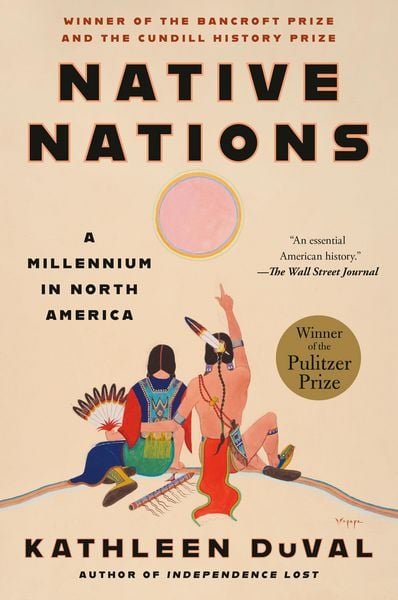
Native Nations A Millennium in North America
-
- Taschenbuch ausgewählt
- eBook
-
Sprache:Englisch
-
Verlag:Random House N.Y.
- Profile Books 15,69 €
- Random House N.Y. 28,99 € ausgewählt
28,99 €
inkl. gesetzl. MwSt.,
Beschreibung
Produktdetails
Einband
Taschenbuch
Erscheinungsdatum
27.05.2025
Abbildungen
76 BLACK&WHITE PHOTOS; 13 MAPS
Verlag
Random House N.Y.Seitenzahl
754
Maße (L/B/H)
15,5/24/4,6 cm
Gewicht
1174 g
Farbe
Beige / Mokka
Sprache
Englisch
ISBN
978-0-525-51105-2
PULITZER PRIZE WINNER • “A magisterial overview of a thousand years of Native American history” (The New York Review of Books), from the rise of ancient cities more than a thousand years ago to fights for sovereignty that continue today
WINNER OF THE BANCROFT PRIZE, THE CUNDILL HISTORY PRIZE, AND THE MARK LYNTON HISTORY PRIZE
Long before the colonization of North America, Indigenous Americans built diverse civilizations and adapted to a changing world in ways that reverberated globally. And, as award-winning historian Kathleen DuVal vividly recounts, when Europeans did arrive, no civilization came to a halt because of a few wandering explorers, even when the strangers came well armed.
A millennium ago, North American cities rivaled urban centers around the world in size. Then, following a period of climate change and instability, numerous smaller nations emerged, moving away from rather than toward urbanization. From this urban past, egalitarian government structures, diplomacy, and complex economies spread across North America. So, when Europeans showed up in the sixteenth century, they encountered societies they did not understand—those having developed differently from their own—and whose power they often underestimated.
For centuries afterward, Indigenous people maintained an upper hand and used Europeans in pursuit of their own interests. In Native Nations, we see how Mohawks closely controlled trade with the Dutch—and influenced global markets—and how Quapaws manipulated French colonists. Power dynamics shifted after the American Revolution, but Indigenous people continued to command much of the continent’s land and resources. Shawnee brothers Tecumseh and Tenskwatawa forged new alliances and encouraged a controversial new definition of Native identity to attempt to wall off U.S. ambitions. The Cherokees created institutions to assert their sovereignty on the global stage, and the Kiowas used their power in the west to regulate the passage of white settlers across their territory.
In this important addition to the growing tradition of North American history centered on Indigenous nations, Kathleen DuVal shows how the definitions of power and means of exerting it shifted over time, but the sovereignty and influence of Native peoples remained a constant—and will continue far into the future.
“An essential American history”—The Wall Street Journal
Ein neues Kapitel für Ihre Bücher
Ein neues Kapitel für Ihre Bücher
Schenken Sie Ihren alten Schätzen ein zweites Leben und erhalten dafür eine Thalia Geschenkkarte.
Noch keine Bewertungen vorhanden
Verfassen Sie die erste Bewertung zu diesem Artikel
Helfen Sie anderen Kundinnen und Kunden durch Ihre Meinung.
Kurze Frage zu unserer Seite
Vielen Dank für Ihr Feedback
Wir nutzen Ihr Feedback, um unsere Produktseiten zu verbessern. Bitte haben Sie Verständnis, dass wir Ihnen keine Rückmeldung geben können. Falls Sie Kontakt mit uns aufnehmen möchten, können Sie sich aber gerne an unseren Kund*innenservice wenden.
zum Kundenservice