Beschreibung
Produktdetails
Format
ePUB
Kopierschutz
Ja
Family Sharing
Ja
Text-to-Speech
Ja
Erscheinungsdatum
13.06.2025
Verlag
GoldCoast BooksSeitenzahl
(Printausgabe)
Dateigröße
784 KB
Sprache
Englisch
EAN
9789988949785
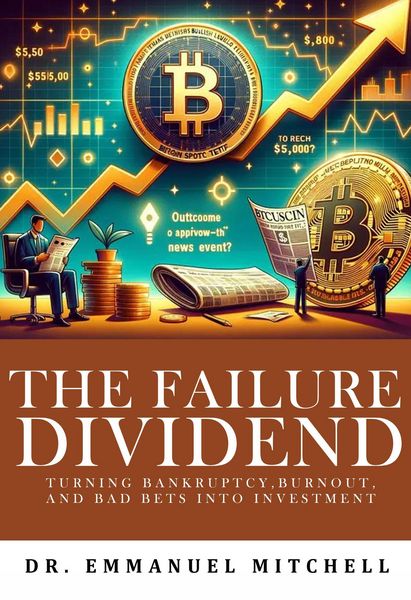
In a world obsessed with success stories and overnight victories, Dr. Emmanuel Mitchell presents a revolutionary perspective that challenges our fundamental understanding of failure. "The Failure Dividend" reveals how society's most devastating setbacks-bankruptcy, burnout, and catastrophic business decisions-can be transformed into the most valuable investments of our lives.
Drawing from two decades of research in behavioral economics and organizational psychology, Dr. Mitchell introduces the groundbreaking concept of the "failure dividend"-the compound returns that emerge when we systematically extract wisdom, resilience, and strategic advantage from our lowest moments. Unlike traditional self-help approaches that treat failure as something to overcome or forget, this book demonstrates how failure, when properly harvested, becomes a renewable resource for exponential growth.
Through compelling case studies spanning Silicon Valley startups, Fortune 500 companies, and individual entrepreneurs, Mitchell illustrates how today's most successful leaders didn't succeed
despite their failures, but because of them. He reveals the hidden patterns behind how bankruptcy taught Richard Branson to diversify risk, how burnout led Arianna Huffington to create a wellness empire, and how spectacular product failures enabled companies like Dyson and 3M to revolutionize entire industries.
The book's framework centers on three core principles: Failure Forensics (systematically analyzing what went wrong), Wisdom Extraction (converting painful lessons into actionable intelligence), and Strategic Reinvestment (deploying failure-derived insights for competitive advantage). Mitchell provides practical tools including the Failure Portfolio Assessment, the Burnout-to-Breakthrough Protocol, and the Bad Bet Recovery Framework-methodologies tested across diverse industries and proven to accelerate both personal and organizational transformation.
What sets "The Failure Dividend" apart is its rigorous, data-driven approach to failure analysis. Mitchell combines cutting-edge neuroscience research with real-world business intelligence to explain why our brains are wired to avoid failure-and how this evolutionary programming now limits our potential in the modern economy. He presents counterintuitive strategies for failure- forward thinking, including controlled failure experimentation, pre-mortem planning, and psychological failure insurance.
The book addresses the unique challenges facing today's professionals, from startup founders navigating volatile markets to corporate executives managing unprecedented change. Mitchell explores how the fear of failure paralyzes innovation, how perfectionism becomes a competitive disadvantage, and why organizations that embrace intelligent failure consistently outperform their risk-averse competitors.
Beyond individual application, "The Failure Dividend" offers a blueprint for creating failure- positive cultures within teams and organizations. Mitchell demonstrates how companies can build systematic failure-learning capabilities, turning inevitable setbacks into institutional knowledge and competitive moats.
This isn't a book about accepting failure or finding silver linings-it's about actively engineering failure into a strategic asset. For readers ready to transform their relationship with setbacks, "The Failure Dividend" provides both the theoretical foundation and practical roadmap for converting life's inevitable failures into the most profitable investments they'll ever make.
Kundinnen und Kunden meinen
Verfassen Sie die erste Bewertung zu diesem Artikel
Helfen Sie anderen Kund*innen durch Ihre Meinung
Kurze Frage zu unserer Seite
Vielen Dank für Ihr Feedback
Wir nutzen Ihr Feedback, um unsere Produktseiten zu verbessern. Bitte haben Sie Verständnis, dass wir Ihnen keine Rückmeldung geben können. Falls Sie Kontakt mit uns aufnehmen möchten, können Sie sich aber gerne an unseren Kund*innenservice wenden.
zum Kundenservice