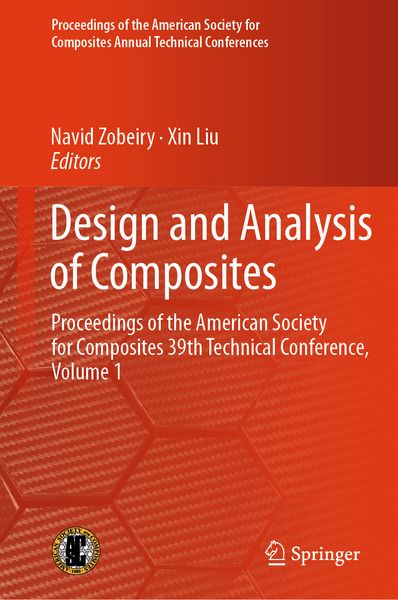
Produktbild: Design and Analysis of Composites
- 12%

Design and Analysis of Composites Proceedings of the American Society for Composites 39th Technical Conference, Volume 1

12% sparen

206,99 € UVP 235,39 €

inkl. gesetzl. MwSt., Versandkostenfrei


Beschreibung

Produktdetails

Einband

Gebundene Ausgabe

Erscheinungsdatum

03.01.2026

Abbildungen

XI, 359 p. 230 illus., 207 illus. in color.

Herausgeber

Navid Zobeiry + weitere

Verlag

Springer

Seitenzahl

359

Maße (L/B/H)

24,1/16/2,5 cm

Gewicht

788 g

Sprache

Englisch

ISBN

978-3-032-01729-1

Beschreibung

Portrait

Navid Zobeiry is an associate professor in the Materials Science and Engineering department at the University of Washington, with an adjunct position in the Aeronautics and Astronautics department. His research focuses on the intersection of materials science, data science, and advanced manufacturing.

Xin Liu is an Assistant Professor in the Mechanical and Aerospace Department at the University of Texas at Arlington (UTA). He is also a member of the Institute for Predictive Performance Methodologies at the UTA Research Institute. His research focuses on machine learning-assisted multiscale modeling, composite materials and structures, and lattice metamaterials.

Produktdetails

Einband

Gebundene Ausgabe

Erscheinungsdatum

03.01.2026

Abbildungen

XI, 359 p. 230 illus., 207 illus. in color.

Herausgeber

Verlag

Springer

Seitenzahl

359

Maße (L/B/H)

24,1/16/2,5 cm

Gewicht

788 g

Sprache

Englisch

ISBN

978-3-032-01729-1

Herstelleradresse

Springer-Verlag KG
Sachsenplatz 4-6
1201 Wien
AT

Email: GPSR Kontakt

Ein neues Kapitel für Ihre Bücher

Ein neues Kapitel für Ihre Bücher

Schenken Sie Ihren alten Schätzen ein zweites Leben und erhalten dafür eine Thalia Geschenkkarte.

Jetzt verkaufen
Jetzt verkaufen

Noch keine Bewertungen vorhanden

Verfassen Sie die erste Bewertung zu diesem Artikel

Helfen Sie anderen Kundinnen und Kunden durch Ihre Meinung.

Kundinnen und Kunden meinen

Bewertungen (0)

  • Produktbild: Design and Analysis of Composites
  • Part 1: AI and ML in Composites.- Chapter 1: A Machine Learning Approach for Predicting Bending After Impact Strength and Failure Modes in Hybrid (CFRP/GFRP) Sandwich Composites.- Chapter 2: Deep Learning Models for Automatic Image Segmentation of Low Velocity Impact Damage in CFRP Composites.- Chapter 3: Developing Continuum Damage Model Tensors for Ceramic Matrix Composites Using Genetic Programming Based Symbolic Regression.- Chapter 4: Development of Data-Driven Surrogate Models for Rapid Simulation of Fibre Reinforced Composites in Progressive Fracture Tests.- Chapter 5: Discerning Microstructure of CMC Minicomposites from Micro-CT Imaging Data Using Machine Learning.- Chapter 6: Failure Prediction of Fiber-Reinforced Polymer Composite Materials Using Data-Driven Modeling.- Chapter 7: Image-Based RKPM for Accessing Failure Mechanisms in Composite Materials.- Chapter 8: Implementing Machine Learning Methodologies to Characterize Hidden Damages in Composite Plates Through Lamb Waves.- Chapter 9: Integrated Process and Failure Analysis in Composites Using Multi-Fidelity Simulations and Machine Learning.- Chapter 10: Using Neural Network to Improve Failure Predictions.- Part 2: Architected Composites.- Chapter 11: Additive Manufacturing of Wood Nanocomposites Using Natural Fibers.- Chapter 12: Composite Core Designs for Freeform Structures.- Chapter 13: Development of Auxetic Composite Materials for Improved Impact Properties.- Chapter 14: Failure Mechanism and Energy Absorption Characteristics of Auxetic Pyrolytic Carbon Reinforcements Embedded in Different Matrix Materials.- Chapter 15: Improving Composite Tailorability Through Architected Nacre Tablets.- Chapter 16: Interlaminar Shear Strength of Carbon/Epoxy Laminates Containing Magnetically Aligned Nickel-Coated, Diazotized Carbon Nanotubes.- Part 3: Design and Manufacturing.- Chapter 17: 3D Printing of Woven Carbon Fiber Composites via a Stereolithography-Inspired Technique with Consolidation.- Chapter 18: Abrasive Friction Drilling in Fiber Reinforced Thermosetting Polymer Composites.- Chapter 19: Effect of Fiber Angle on the Radial Stress in Hybrid Aluminum/Composite Tubes.- Chapter 20: Efficient Manufacturing of Carbon Fiber Reinforced EPON-Based Epoxy Resin Composites via Hot Press-Triggered Frontal Polymerization.- Chapter 21: Evaluation of Alumina Particle Reinforced Aluminum Matrix Composites Fabricated by Accumulative Roll Bonding Method.- Chapter 22: Optimal Design of Viscoelastic Laminated Sandwich Composite Structures Considering Thermally-Induced Deformation of Composite Skins Using Lamination Parameters.- Chapter 23: Optimized Design Workflow for Patient-Customized Composite Orthotics.- Chapter 24: Stack Drilling of Carbon Fiber Reinforced Polymer Laminate and Metals Stacks Using Friction Flow Drilling.- Part 4: ICME.- Chapter 25: Molecular Dynamics Investigation of Bonding Structure and Property Relationships at the Interface Between Cellulose Nanocrystals and Glass Fibers.- Part 5: Uncertainty Quantification.- Chapter 26: Bayesian Calibration and Uncertainty Quantification of Cohesive Zone Parameters at an Adhesively Bonded Textile and Fabric Interface.- Chapter 27: Efficient Design of Laminate Composites Using Ensemble Kalman Inversion Method.- Chapter 28: Reliability-Based Design and Certification of Hybrid Composites.- Chapter 29: Uncertainty Quantification in Advanced Aerospace Composite Manufacturing Through Stochastic Finite Element Analysis and Probabilistic Machine Learning.