KI-Beratung Beta

Produktbild: Occurrence, Detection, and Fate of Microplastics in Freshwater Ecosystems
- 12%

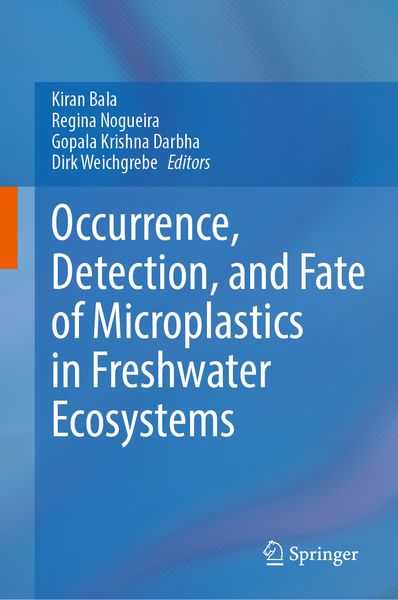
Occurrence, Detection, and Fate of Microplastics in Freshwater Ecosystems

12% sparen

187,99 € UVP 213,99 €

inkl. gesetzl. MwSt., Versandkostenfrei


Beschreibung

Produktdetails

Einband

Gebundene Ausgabe

Erscheinungsdatum

31.08.2025

Abbildungen

XXII, 356 p. 50 illus., 49 illus. in color.

Herausgeber

Kiran Bala + weitere

Verlag

Springer Singapore

Seitenzahl

356

Maße (L/B/H)

24,1/16/2,6 cm

Gewicht

733 g

Auflage

1. Auflage

Sprache

Englisch

ISBN

978-981-9502-24-0

Beschreibung

Portrait

Prof. Kiran Bala has been serving as Professor in the Department of Biosciences & Biomedical Engineering at the Indian Institute of Technology Indore since October 2023. Prior to this, she held the position of Associate Professor and Assistant Professor from February 2017. With a robust academic journey, she began as INSPIRE Faculty at the Indian Institute of Technology Indore in November 2012, following a stint as a DBT scientist at DAVV, Indore from July 2012 to October 2012. Prof. Bala’s research focuses on microplastics, which includes monitoring and assessment, and developing enzyme-based biodegradation for emerging contaminants. She has more than 65 papers in international journals, along with 11 book chapters. She has also edited 2 books with reputed publishers.

Prof. Regina Nogueira is a distinguished academician with extensive experience and expertise in water and wastewater biology. Since January 2012, she held the esteemed position of Professor for Water and Wastewater Biology at the Leibniz Universität Hannover, Germany. Prior to this, she served as an Assistant Professor at the University of Minho in Braga, Portugal, from February 2003 to January 2012. In the field of microplastics, Prof. Nogueira has developed a method for extraction and analysis of microplastics from complex biological matrices. She has experience in characterizing the composition and function of biofilms growing on the surface of microplastics/biopolymers using molecular tools and microscopy. Her commitment to sustainability is evident through research grants and third- party funding, including projects like LegioGrowth and Intelligente Systeme Wasser, which focus on critical issues such as the impact of climate change on Legionella pneumophila and the spread of antibiotic-resistant germs in aquatic systems. To date, 80 research papers have been published in international peer-reviewed journals.

Dr. Gopala Krishna Darbha is an accomplished academic with a diverse educational background and a wealth of experience in the field of environmental sciences. He completed his Ph.D. in Chemistry at Jackson State University, USA, in 2008. Currently serving as Associate Professor in the Department of Earth Sciences at IISERK. He has garnered significant recognition for his contributions, such as the prestigious Ramanujan Fellowship award from SERB and being highlighted by Nature (India) for research on nano and microplastics in 2021. In the field of micro- and nanoplastics, Dr. Darbha has made significant contributions to 1) Understanding their presence in various environmental compartments (air, water, soil and sea food) and finding the human exposure pathways, 2)Mechanisms of eco-accumulation and mobility, ecological toxicity, and 3) Sustainable methods for their remediation from wastewaters. With a prolific publication record comprising 80 scientific publications and a patent.

Dr. Dirk Weichgrebe currently serves as Associated Professor, Senior Scientist, and Head of the Research Field Waste Management, Circular Economy, and Bioenergy at the Institute for Sanitary Engineering and Waste Management (ISAH) at Leibniz University Hannover since 2015. PD Dr.Ing.habil. Dirk Weichgrebe is a distinguished academician with a rich educational background and significant achievements in the field of engineering and environmental science. He obtained his Habilitation at Leibniz University Hannover in 2015, focusing on Compendium Biogas and earned the degree of Privat Dozent (Dr.-Ing. habil.), akin to an Associate Professor. His expertise and dedication to the field were further recognized with the EU Madame-Curie Fellowship from 2011 to 2015. Dr. Dirk brings research experience in the fields of analysis and characterization of MPs, material and energy flow analysis, life cycle assessment as well as wastewater and waste management and processing. 

Produktdetails

Einband

Gebundene Ausgabe

Erscheinungsdatum

31.08.2025

Abbildungen

XXII, 356 p. 50 illus., 49 illus. in color.

Herausgeber

Verlag

Springer Singapore

Seitenzahl

356

Maße (L/B/H)

24,1/16/2,6 cm

Gewicht

733 g

Auflage

1. Auflage

Sprache

Englisch

ISBN

978-981-9502-24-0

Herstelleradresse

Springer-Verlag KG
Sachsenplatz 4-6
1201 Wien
AT

Email: ProductSafety@springernature.com

Ein neues Kapitel für Ihre Bücher

Ein neues Kapitel für Ihre Bücher

Schenken Sie Ihren alten Schätzen ein zweites Leben und erhalten dafür eine Thalia Geschenkkarte.

Jetzt verkaufen
Jetzt verkaufen

Noch keine Bewertungen vorhanden

Verfassen Sie die erste Bewertung zu diesem Artikel

Helfen Sie anderen Kundinnen und Kunden durch Ihre Meinung.

Kundinnen und Kunden meinen

Bewertungen (0)

  • Produktbild: Occurrence, Detection, and Fate of Microplastics in Freshwater Ecosystems
  • Chapter 1. Microbes and Microplastics Interactions in Fresh Water Ecosystems: Fate and Implications for Environmental Health.- Chapter 2: Release of Microplastics by Terrestrial Sources into Freshwater Environments.- Chapter 3. Understanding various pathways of microplastic pollution in freshwater systems.-  Chapter 4: Distribution pattern of microplastics in aquatic sources.- Chapter 5. Tracing the Path: Fate and Transport of Microplastics from Aquatic Systems to Soils.- Chapter 6. Techniques for sampling, detection, and characterization of microplastics in water, sediment, and tissue samples.- Chapter 7. Advances in microplastics research in freshwater ecosystems: An overview of newly developed separation and identification methods.- Chapter 8. Impact of Microplastics on Human Health.- Chapter 9. Microplastics and Aquatic Limnology: Conception of Biogeochemical Processes.- Chapter 10. Microplastics Occurrence in Sediments and Associated Ecological Risk: A Study of Saurashtra Coastline, Gujarat, India.- Chapter 11. From Cradle to Contamination: The Lifecycle of Plastics with an Emphasis on Household Waste and Remediation via Biochar.- Chapter 12. Microplastic Pollution: Review of Degradation, Detection, and Treatment Technologies.- Chapter 13. Microplastic Remediation in Aquatic Environment.