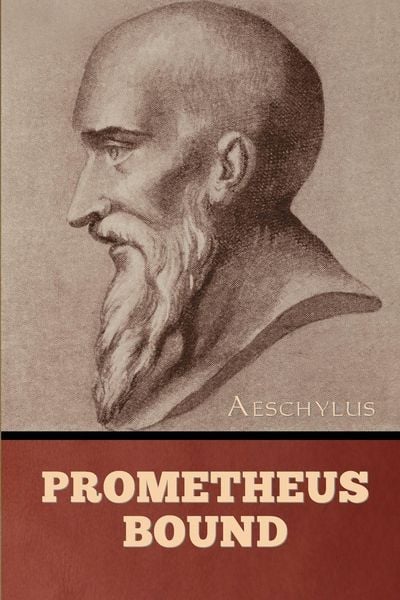
Prometheus Bound
-
- Hardcover
- Taschenbuch ausgewählt
- eBook
-
Sprache:Englisch
- Englisch 16,99 € ausgewählt
- Griechisch 19,99 €
16,99 €
inkl. gesetzl. MwSt.,
Beschreibung
Produktdetails
Einband
Taschenbuch
Erscheinungsdatum
05.08.2025
Verlag
Bibliotech PrSeitenzahl
112
Maße (L/B/H)
22,9/15,2/0,8 cm
Gewicht
195 g
Sprache
Englisch
EAN
9798897732012
Prometheus Bound is an ancient Greek tragedy traditionally attributed to Aeschylus and thought to have been composed sometime between 479 BC and the terminus ante quem of 424 BC. The tragedy is based on the myth of Prometheus, a Titan who defies Zeus, and protects and gives fire to mankind, for which he is subjected to the wrath of Zeus and punished. British-born author, C.J. Herington, a scholar of classical Greek and Latin, wrote that Aeschylus certainly did not mean Prometheus Bound to be a "self-contained dramatic unity", and suggests that "most modern students of the subject would probably agree" that Prometheus Bound was followed by a work with the title Prometheus Lyomenos (Prometheus Unbound). Herington adds that "some very slight evidence" indicates that Prometheus Unbound "may have been followed by a third play", Prometheus Pyrphoros (Prometheus the Fire-Bearer); the latter two survive only in fragments. Some scholars have proposed that these fragments all originated from Prometheus Unbound, and that there were only two Promethean plays rather than three. Since the final two dramas of the trilogy have been lost, the author's intention for the work as a whole is not known. The ascription to Aeschylus had never been challenged since antiquity down to relatively recent times. By the 1970s, both R. P. Winnington-Ingram and Denys Page had become sceptical of its authenticity, but the majority of scholars still affirmed the traditional attribution of authorship. Independently in 1977 both Oliver Taplin and Mark Griffith made forceful cases, on linguistic, technical and stagecraft grounds, for questioning its authenticity, a view supported by M. L. West. Academic knowledge of the genre begins with his work, and understanding of earlier Greek tragedy is largely based on inferences made from reading his surviving plays. According to Aristotle, he expanded the number of characters in the theatre and allowed conflict among them. Formerly, characters interacted only with the chorus. Only seven of Aeschylus's estimated 70 to 90 plays have survived in complete form. There is a long-standing debate regarding the authorship of one of them, Prometheus Bound, with some scholars arguing that it may be the work of his son Euphorion. Fragments from other plays have survived in quotations, and more continue to be discovered on Egyptian papyri. These fragments often give further insights into Aeschylus' work. He was likely the first dramatist to present plays as a trilogy. His Oresteia is the only extant ancient example. At least one of his plays was influenced by the Persians' second invasion of Greece (480-479 BC). This work, The Persians, is one of very few classical Greek tragedies concerned with contemporary events, and the only one extant.
Ein neues Kapitel für Ihre Bücher
Ein neues Kapitel für Ihre Bücher
Schenken Sie Ihren alten Schätzen ein zweites Leben und erhalten dafür eine Thalia Geschenkkarte.
Noch keine Bewertungen vorhanden
Verfassen Sie die erste Bewertung zu diesem Artikel
Helfen Sie anderen Kundinnen und Kunden durch Ihre Meinung.
Kurze Frage zu unserer Seite
Vielen Dank für Ihr Feedback
Wir nutzen Ihr Feedback, um unsere Produktseiten zu verbessern. Bitte haben Sie Verständnis, dass wir Ihnen keine Rückmeldung geben können. Falls Sie Kontakt mit uns aufnehmen möchten, können Sie sich aber gerne an unseren Kund*innenservice wenden.
zum Kundenservice