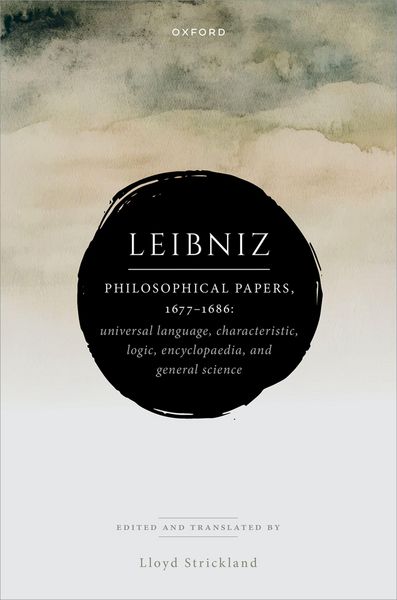
Produktbild: Leibniz: Philosophical Papers, 1677-1686
Vorbesteller Neu

Leibniz: Philosophical Papers, 1677-1686 Universal Language, Characteristic, Logic, Encyclopaedia, and General Science

199,99 €

inkl. gesetzl. MwSt., Versandkostenfrei


Beschreibung

Produktdetails

Einband

Gebundene Ausgabe

Erscheinungsdatum

30.07.2026

Verlag

Oxford Academic

Seitenzahl

704

Maße (L/B/H)

24/16/4,2 cm

Gewicht

1177 g

Sprache

Englisch

ISBN

978-0-19-895978-6

Beschreibung

Produktdetails

Einband

Gebundene Ausgabe

Erscheinungsdatum

30.07.2026

Verlag

Oxford Academic

Seitenzahl

704

Maße (L/B/H)

24/16/4,2 cm

Gewicht

1177 g

Sprache

Englisch

ISBN

978-0-19-895978-6

Herstelleradresse

Libri GmbH
Europaallee 1
36244 Bad Hersfeld
DE

Email: gpsr@libri.de

Ein neues Kapitel für Ihre Bücher

Ein neues Kapitel für Ihre Bücher

Schenken Sie Ihren alten Schätzen ein zweites Leben: Einfach Barcode scannen, Versandetikett ausdrucken, Bücher verschicken und Thalia Geschenkkarte erhalten.

Jetzt verkaufen
Jetzt verkaufen

Kundinnen und Kunden meinen

0 Bewertungen

Informationen zu Bewertungen

Zur Abgabe einer Bewertung ist eine Anmeldung im Konto notwendig. Die Authentizität der Bewertungen wird von uns nicht überprüft. Wir behalten uns vor, Bewertungstexte, die unseren Richtlinien widersprechen, entsprechend zu kürzen oder zu löschen.

Die Bewertungen sind nach Format, Anzahl Sterne und Datum sortiert.

Verfassen Sie die erste Bewertung zu diesem Artikel

Helfen Sie anderen Kund*innen durch Ihre Meinung

Kundinnen und Kunden meinen

0 Bewertungen filtern

  • Produktbild: Leibniz: Philosophical Papers, 1677-1686
    • Abbreviations

    • Introduction

    • 1. Leibniz's Life

    • 2. Leibniz's Writings

    • 3. Overview: Logic, Universal Language, Characteristic, General Science and Encyclopaedia

    • 4. About the Volumes, Selections of Texts, Apparatus and Typographical Conventions

    • Logic, Universal Language, Characteristic

    • 1. After So Many Logics, The Logic I Want Has Not Yet Been Written

    • 2. Definition

    • 3. Empirical Notions

    • 4. On the Natural Origin of Languages

    • 5. A Dialogue

    • 6. Words

    • 7. Didactic Method

    • 8. On Teaching Languages

    • 9. General Language

    • 10. Universal Language

    • 11. Chrysippus' Heap

    • 12. On a Rational Grammar and the Art of Memory

    • 13. Paradoxes

    • 14. Rational Language

    • 15. On Estimating the Uncertain

    • 16. Analysis of Languages

    • 17. Logical-Grammatical Notes

    • 18. Grammatical Thoughts

    • 19. Tables. Divisions. Method. Genera and Subaltern Species

    • 20. On the Logical Characteristic

    • 21. Primitive Propositions

    • 22. On a General Analytical Calculus

    • 23. On Principles

    • 24. Elements for Building a Calculus

    • 25. Through the Characteristic, We Can Set Up Experiments in Metaphysics

    • 26. Logical Conversion

    • 27. What is Prior by Nature

    • 28. On Negation

    • 29. My Characteristic Requires a New Encyclopaedia

    • 30. Elements of a Universal Characteristic

    • 31. Elements of a Calculus

    • 32. Elements of a Universal Calculus

    • 33. Investigations for a Universal Calculus

    • 34. A Calculus of Inferences

    • 35. A Method of Examining Inferences by Numbers

    • 36. Rules for the Validity of Inferences

    • 37. Rules from which the Validity of Inferences and the Forms and Moods of Categorical Syllogisms Can Be Judged by Means of Numbers

    • 38. Characteristic Numbers Expressed in Latin, Greek, and Hebrew

    • 39. On the Universal Characteristic Language and the Art of Discovery

    • 40. Reasoning Calculus, or, the Art of Reasoning Easily and Infallibly

    • 41. Specimen of the Universal Calculus

    • 42. Addenda to Specimen of the Universal Calculus

    • 43. Verbal Characteristic

    • 44. Whether Ideas Have Parts

    • 45. Characteristic

    • 46. Giving a Specimen of the Philosophical Language in Geometry

    • 47. On Primary and Secondary Syllogistic Moods

    • 48. On Mathematically Determining the Forms of Syllogisms

    • 49. On the Demonstration of Non-identical Axioms

    • 50. Method of Disputing Until the Subject is Exhausted

    • 51. On Overcoming an Opponent Quickly

    • 52. A Thread for Thinking, or, on Founding a New Logic

    • 53. The Synthetic Method, that is, the Art of Ordering Theorems and Problems

    • 54. On the Rational Language

    • 55. On True and False, Affirmation and Negation, and Contradictories

    • 56. General Investigations concerning the Analysis of Notions and Truths

    • 57. Specimens of the Rational Calculus

    • 58. Demonstration of the Axioms of Identity and Diversity

    • 59. Definitions: Alike, Similar, Species, Affection

    • 60. A Calculus of Coincidents

    • 61. The Composition of One Thing by Another

    • 62. Specimen of a Calculus of Coincidents and Inexistents

    • 63. Grammatical Analysis for Creating a General Characteristic or Language

    • 64. Principles of Human Knowledge

    • 65. On the Principles of Contradiction and That There Is Nothing Without a Reason

    • General Science and Encyclopaedia

    • 66. The True Method

    • 67. Deleted Remarks on Methods

    • 68. On the Art of Discovery in General

    • 69. On the Most Excellent Use of the Combinatorial Art, Which Is to Write an Encyclopaedia

    • 70. Two Methods of Geometry

    • 71. Universal Atlas

    • 72. A Society or Order of Charity

    • 73. Society of the Friends of God for Celebrating God's Praises and in Opposition to the Atheism Spreading Throughout the World

    • 74. On the Organon or Great Art of Thinking

    • 75. On the Alphabet of Human Thoughts

    • 76. Definitions: Something, Nothing, Substance

    • 77. A Plan for a New Encyclopaedia to Be Written Using the Method of Discovery

    • 78. On the Combinatorial Art of Discovery

    • 79. The Art of Mathematics

    • 80. Preface for The Key to Secret Mathematics

    • 81. On the Synthetic and Analytic Methods

    • 82. On the Usefulness of the Analytic and Synthetic Methods

    • 83. Combinatorics

    • 84. Elements of Mathesis for the Use of Beginners

    • 85. On the Characteristic Art and Analytical or Combinatorial Discoveries in Universal Mathesis

    • 86. Definitions: Good, Perfect, Privative

    • 87. Formulas for Commands in All the Mechanical Arts Following the Example of Military Commands concerning the Handling of Arms and Evolutions

    • 88. Reduction of the Sciences to Figures and Formulas

    • 89. Precognita to the Encyclopaedia, that is, to Universal Science

    • 90. Directing Studies to Happiness

    • 91. Foundations and Specimens of the General Science concerning a New System for the Renewal and Enhancement of the Sciences

    • 92. Foundations and Specimens of the General Science concerning the Renewal and Enhancement of the Sciences

    • 93. Foundations of the General Science

    • 94. Preface for Foundations of the General Science

    • 95. Introduction to the General Science

    • 96. On the Notions that Form the Basis of Everything We Think About

    • 97. On the Literary Republic

    • 98. On Joining the Advances of the Ancients with Ours

    • 99. Preface for a Work on the Renewal of the Sciences

    • 100. On the Elements of Truth

    • 101. Mathematical Reflection on the Transformation of Bodies

    • 102. Synopsis of Foundations and Specimens of the New General Science

    • 103. Foundations and Specimens of the General Science

    • 104. A Rule of Discovery

    • 105. On the Use of the Combinatorial Art in the General Science

    • 106. Idea for a Book Whose Title Will Be New Elements of Universal Mathesis

    • 107. On the Division of the Whole World of the Sciences

    • 108. Introduction to a Secret Encyclopaedia

    • 109. Short Definition of General Science

    • 110. On Universal Synthesis and Analysis, or the Art of Discovery and Judgement

    • 111. General Observations

    • 112. Division of Terms and Enumeration of Attributes

    • 113. Genera of Terms

    • 114. Divisions

    • 115. A Popular Method of Teaching, and a More Perfect Scientific One

    • 116. On the True Perfection of Humankind

    • 117. Plus Ultra

    • 118. Definitions of Metaphysical and Logical Notions

    • 119. New Proposals

    • 120. Recommendations for Founding the General Science

    • 121. On the Obscuring of Primary Propositions

    • 122. The Elements of Universal Truth

    • 123. For the Preface to The Elements of Eternal Truth

    • 124. The Elements of Reason

    • Bibliography

    • Index